Featured High-Performance Photopolymer Grades
Specialty wholesale oligomers tailored for fast cure kinetics, low shrinkage stress, and balanced crosslink density across demanding rigid and flexible substrates.
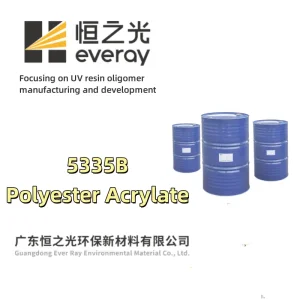
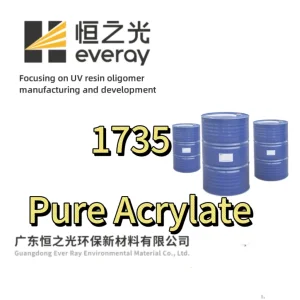
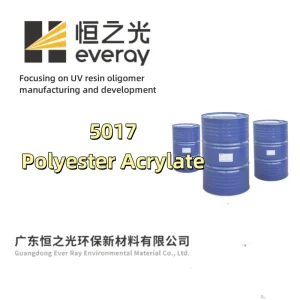
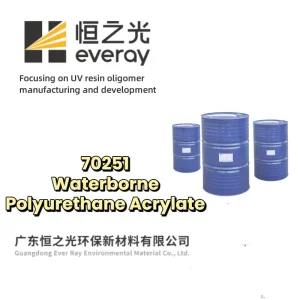
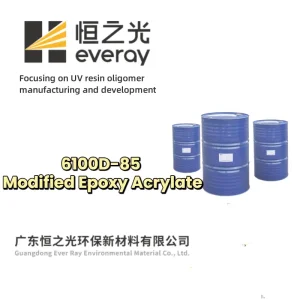
Next-Generation Modified Epoxy Dynamics
Overcoming the historical limitations of bisphenol A epoxy acrylates through deliberate molecular architecture modification and high-purity synthesis.
Specialty hyperbranched and polyether segments dissipate internal curing stresses, eliminating substrate warping and micro-cracking.
Maintains high crosslink density on cured films, delivering industrial abrasion resistance without compromising ductile flexibility.
Aliphatic chain modifications shield the aromatic core from photodegradation under intensive UV-A and UV-B exposure spectrums.
Active polar hydroxyls combined with silane/phosphate hybrids enable direct covalent bonding to metals, glass, PC, and treated PET.
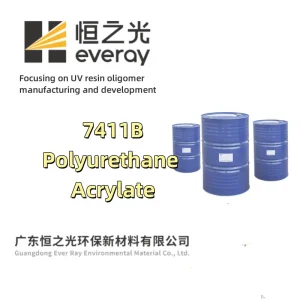
Polyurethane-Modified Hybrids (PUA-EA)
By grafting urethane prepolymers into the terminal oxirane/acrylate architecture, our synthesis eliminates standard epoxy brittleness while retaining rapid photopolymerization line speeds.
- High Elastic Modulus
- Thermal Shock Proof
- Tensile Toughness
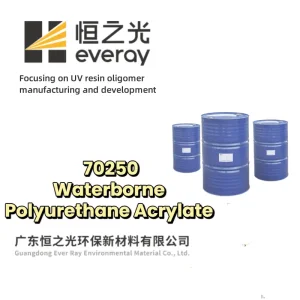
Waterborne Modified Epoxies (Zero-VOC)
Self-emulsifying dispersions functionalized with non-ionic hydrophilic polyether chains allow water dilution without sacrificing chemical resistance, boiling water tolerance, or deep curability.
- Clean Air Compliant
- Ultra-Low Odor
- Open-Grain Wood Feel
Hyperbranched Dendritic Architectures
Multi-arm core-shell topologies that provide unmatched functional density with low shear viscosity. Enables high-solid UV formulations that flow cleanly through roller coats and inkjet printheads.
- Shear-Thinning Control
- Oxygen-Inhibition Resistant
- Zero Monomer Migration
Enterprise Procurement Framework & Technical Compatibility
Engineered to mitigate risk across international supply routes while adhering to strict environmental, safety, and line processing constraints.
Rheological Tuning
Custom diluent package formulation using reactive monomers (TPGDA, DPGDA, TMPTA, or low-irritant IBOA/ACMO) to balance flashpoint, viscosity, and atomization stability.
Regulatory Cleared
Comprehensive registration covering EU REACH, RoHS, EPA TSCA, and GB standards. Safe formulations engineered without free bisphenol, halogens, or toxic heavy metals.
Batch Uniformity
Continuous closed-loop reactor management tracking GPC molecular weight distribution, acid value (< 2 mg KOH/g), and chromatic index (Gardner ≤ 1).
Bulk Logistics Assured
Export packaging across 20kg pails, 200kg steel drums, and 1000kg IBC totes equipped with nitrogen inerting to preserve photo-inhibitor stability during transit.
R&D Roadmap: Sustainable High-Efficiency Chemistry
Continuous evolution toward non-toxic bio-based building blocks, LED long-wavelength curing adaptability, and circular formulation economics.
LED 395nm/365nm Fine-Tuning
Eliminating mercury-arc lamp thermal signatures. Oligomer backbones modified to maximize free radical initiation efficiency under monochromatic LED-UV curing systems.
Renewable Bio-Carbon Epoxies
Transitioning aliphatic epoxy synthesis towards cardanol, lignin, and vegetable-oil derived precursors, achieving >45% renewable bio-carbon content per ASTM D6866.
Dual-Cure (UV/Thermal-Moisture)
Secondary latent curing mechanisms integrated into the terminal polymer chain, securing absolute shadow cure across complex 3D electronic assemblies and structural components.
Recyclable Polymer Networks
Incorporating covalent adaptable networks (CANs) enabling post-cure disassembly, de-inking, and circular substrate reclaim for high-volume packaging converters.
Formulation & Technical Procurement Q&A
Comprehensive engineering insights derived from application testing, laboratory analytics, and field performance.
How does modified epoxy solve the brittleness associated with standard bisphenol A epoxy acrylate?
Standard bisphenol A epoxy acrylates form tightly crosslinked, rigid networks that suffer from extreme post-cure shrinkage stress and brittle failure under mechanical deflection. By inserting flexible polyether, aliphatic polyester, or polyurethane segments between the rigid aromatic core and the terminal acrylate groups, modified epoxies dramatically lower the crosslink density gradient. This preserves surface hardness while increasing elongation at break from < 2% to over 15%, stopping edge-chipping during cutting and slitting operations.
What is the optimal strategy to counter oxygen inhibition on high-speed thin-film printing inks?
Oxygen inhibition primarily quenches free radicals at the outermost film boundary, resulting in a persistent tacky layer. To counter this without excessive photoinitiator dosage, formulators pair modified epoxy acrylates with reactive amino acrylates or active amine synergists. The secondary/tertiary amines donate active hydrogens to peroxy radicals (ROO•), regenerating initiating alkyl radicals and converting inhibitory oxygen into harmless hydroperoxides, ensuring instant surface cure at line speeds above 100 m/min.
Can modified epoxy resins achieve boiling-water resistance on untreated architectural glass?
Direct adhesion to glass is typically degraded by moisture migrating to the hydrophilic silicon dioxide interface, displacing standard organic bonds. Modified epoxies customized with silane coupling backbones and high-polarity organophosphate moieties build covalent Si-O-Si bridging bonds with the glass matrix. When combined with hydrophobic polyurethane acrylate modifiers, the resulting interpenetrating network blocks water ingress, successfully enduring 2-hour boiling water testing without delamination.
What testing data and quality control metrics are provided for full-container export shipments?
Every commercial production batch undergoes strict quality control documented on formal Certificates of Analysis (COA). Standard tested parameters include Brookfield rotational viscosity (mPa.s at 25°C), acid value (mg KOH/g), color scale (APHA or Gardner), volatile matter content (solid % at 105°C for 3 hours), specific gravity, and standardized cure response speed under a calibrated 120 W/cm medium-pressure mercury arc. SDS and technical formulation dossiers accompany all export consignments.
Specialty Resin Formulations & Adhesion Promoters
Advanced oligomers engineered for specialty optical varnishes, tough functional coatings, deep-cure 3D resins, and multi-substrate industrial adhesives.