High-Performance Precision Curing Resins
Engineered for extreme substrate adhesion, rapid photochemical kinetics, and defect-free film formation across complex plastic resins, rigid boards, and high-speed industrial coating lines.
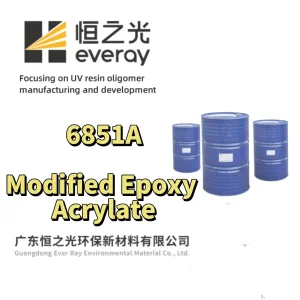
Wholesale 6851A High-Performance Modified Epoxy Acrylate Resin | For UV Coatings, Inks & Gel Polishes
Product Details & TDS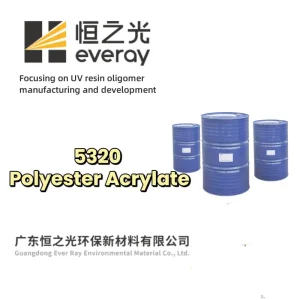
High-Quality 5320 Polyester Acrylate: Optimal Ink Wettability and High Gloss Factory Grade
Product Details & TDS
Buy 61163 High Solid Low Viscosity Anti-Yellowing Modified Epoxy Acrylate Resin For UV Coating
Product Details & TDS
Buy High Adhesion 6100D-85 Epoxy Acrylate for UV Wood Coating and Rigid Substrate Applications
Product Details & TDS
Buy Polyester Acrylate 5319A-1 – A Reliable Solution for High-Performance UV Coatings
Product Details & TDS
High-Quality 1200A UV Resin in Adhesion of Density-Board Primer and Metal-Substrate Systems
Product Details & TDS
High-Quality 7901B UV-Resin for Industrial Protective Coatings and Structural Polymer Finishes
Product Details & TDS
High-Quality 6803A Modified Epoxy Acrylate Resin High Gloss Fast Curing Oligomer for Plastic Coating
Product Details & TDSGlobal Commercial Status & Industrial Transformation
The worldwide transition toward 100% solids photocurable systems is accelerating rapidly as global environmental legislation penalizes Volatile Organic Compounds (VOCs) and production lines mandate higher throughput.
The global UV plastic coating market has moved decisively past simple decorative topcoats into functional, barrier-grade surface physics. Modern industrial plastics—ranging from low-surface-energy polyolefins (polypropylene, polyethylene) to engineered thermoplastics such as polycarbonate (PC), acrylonitrile butadiene styrene (ABS), polymethyl methacrylate (PMMA), and polyamide (PA)—present notoriously demanding interface challenges. As international supply chains enforce strict environmental standards (EU REACH Annex XVII, RoHS 3.0, and US EPA Rule 1113), the legacy reliance on solvent-borne thermal coatings has collapsed. Formulators now seek solventless, 100% reactive solids UV-curable oligomers that deliver complete curing in fractions of a second without compromising crosslink density or mechanical toughness.
In the Asia-Pacific basin, particularly within high-density electronics manufacturing ecosystems, cycle times are measured in single-digit seconds. Robotic spray lines, vacuum roll coaters, and automated multi-axis curing tunnels demand that coating chemistries achieve immediate dust-free, non-blocking properties directly downstream from UV-LED exposure stations. Meanwhile, North American and European automotive interiors mandate rigorous hydrolytic stability, skin-oil resistance, anti-fog performance, and long-term non-yellowing under direct solar irradiation. To satisfy these converging demands, polymer manufacturers must synthesize highly specific acrylate functional groups capable of compensating for volumetric shrinkage while optimizing free radical crosslink density.
During free-radical photopolymerization, carbon-to-carbon double bonds (C=C) convert into single covalent bonds (C-C), shifting van der Waals intermolecular distances (~0.34 nm) to covalent bond lengths (~0.154 nm). This spatial collapse induces 3% to 12% macro-volumetric shrinkage. On rigid plastics, shrinkage manifests as tremendous internal shear stress at the interface, causing delamination, micro-cracking, or substrate warpage. Ever Ray counteracts this thermodynamic reality via precision-synthesized hyperbranched acrylate architectures and modified polyurethane backbones that effectively relieve internal stress without sacrificing scratch resistance.
Substrate-Specific Formulations & Technical Solutions
Different thermoplastic and composite substrates possess unique critical surface tensions and thermal distortion ceilings. Explore our tailored chemical architectures designed for specific industrial substrates.
3C Electronics & Mobile Housings
Substrates: PC, ABS, PMMA, and Glass-Fiber Reinforced Composites. Requires pencil hardness exceeding 3H-4H, anti-fingerprint properties, resistance to cosmetic oils and synthetic sweat, and thermal shock endurance (-40°C to 85°C).
Automotive Cockpit & Exterior Trim
Substrates: PC/ABS blends, polyolefin instrument panels, and headlamp polycarbonate lenses. Mandates extreme hydrolytic aging stability, non-yellowing under Xenon weathering (SAE J2527), and high scratch resilience without optical haze.
Barrier Films & Flexible Packaging
Substrates: Corona-treated BOPP, PET, and biodegradable PLA films. Requires low migration compliance (FDA / Swiss Ordinance), high flex-crack fatigue resistance, ultra-low residual odor, and rapid ink wet-out at web speeds >300 m/min.
| Resin Chemistry Family | Hardness Range | Elongation at Break | Shrinkage Rate | Yellowing Resistance | Optimal Industrial Substrates |
|---|---|---|---|---|---|
| Aliphatic Polyurethane Acrylate | H to 4H | 15% – 65% | Low (2.5% – 4.0%) | Superior (ΔE < 1.0) | Polycarbonate, ABS, PMMA, PET, Optical Lenses |
| Aromatic Polyurethane Acrylate | 2H to 5H | 5% – 25% | Moderate (4.0% – 6.5%) | Moderate (Indoor Use) | Rigid PVC, Density Board, Automotive Structural Floor |
| Modified Epoxy Acrylate | 3H to 6H | 2% – 8% | Moderate-High (5.0% – 8.0%) | Standard | Paper Overprint, Rigid Plastics, Primed Metal, Wood |
| Polyester Acrylate Oligomer | F to 2H | 20% – 80% | Low-Moderate (3.0% – 5.5%) | High | Offset Inks, Flexographic Films, Corona Plastics |
| Hyperbranched Dendritic Acrylate | 4H to 7H | < 3% | Ultra-Low Stress Built | Excellent | Anti-Scratch Hard Coats, 3C Electronic Housings |
Technical Roadmap: Overcoming Modern Curing Bottlenecks
In-depth chemical engineering principles addressing oxygen inhibition, high-speed LED monochromatic curing, and low-surface-energy interfacial bonding.
Industrial UV coating formulators face a trilemma: achieving high line speeds under energy-efficient UV-LED emitters, ensuring complete surface cure free of oxygen inhibition, and maintaining tenacious intercoat and substrate adhesion without toxic adhesion promoters. Addressing this requires careful optimization of oligomer backbone architectures, photoinitiator absorption spectra, and reactive diluent choices.
1. Overcoming Atmospheric Oxygen Inhibition in Thin-Film Plastic Coatings: When UV-cured plastic coatings are applied at thicknesses below 15 microns (common in packaging varnishes and 3C spray coats), atmospheric triplet oxygen ($^3\text{O}_2$) diffuses rapidly into the wet resin. Oxygen molecules scavenge propagating free carbon radicals ($R\cdot$), forming relatively unreactive peroxy radicals ($ROO\cdot$). This quenches the kinetic chain reaction, resulting in incomplete crosslinking, undercured tacky surfaces, and high residual monomer content. Ever Ray addresses this by incorporating copolymerizable amino acrylate synergists (such as reactive amine-modified polyether and polyester acrylates). The amine α-hydrogen facilitates rapid hydrogen transfer to peroxy radicals, regenerating active alkyl radicals while consuming oxygen in an autocatalytic scavenging cascade, guaranteeing tack-free surfaces under atmospheric air.
2. Transitioning from Mercury Arc Lamps to 385nm/395nm UV-LED Systems: Traditional medium-pressure mercury lamps emit broad-spectrum UV (200nm–450nm) alongside substantial infrared heat. This heat frequently distorts low-$T_g$ plastics like thin-gauge polystyrene or oriented polypropylene films. In contrast, UV-LED curing units operate at narrow spectral outputs (typically 365nm, 385nm, or 395nm) with almost zero thermal radiation. However, conventional photoinitiators like α-hydroxyketones (Irgacure 184) absorb weakly above 360nm. Formulating for UV-LED requires pairing long-wavelength photoinitiators—such as mono- or bis-acylphosphine oxides (TPO, BAPO)—with specialized polyester and epoxy acrylates that exhibit low optical attenuation at 395nm, ensuring deep, uniform through-cure across pigmented systems.
Substrate Characterization
Measurement of dynamic contact angles, surface free energy (dyne/cm), and plasticizer migration profiles to determine polar functionalization needs.
Backbone Synthesis
Precision copolymerization adjusting isocyanate/polyol chemistry, tuning the glass transition temperature ($T_g$) from -20°C to +85°C.
Diluent & Kinetic Tuning
Incorporation of multi-functional and monofunctional modified acrylate monomers to match line viscosity (100–3,000 cps) and kinetic cure response.
Environmental Stress Testing
Validation via ASTM B117 salt fog, Taber abrasion (CS-10F wheels), Xenon Arc weatherometers, and cross-hatch tape testing after thermal cycling.
Industrial Reliability, ISO Quality & Batch Reproducibility
How Guangdong Ever Ray Environmental Material Co., Ltd. ensures continuous polymer batch-to-batch consistency across global automated coating plants.
Chromatographic Purity Control
Every reactor batch is analyzed via Gel Permeation Chromatography (GPC) and Gas Chromatography-Mass Spectrometry (GC-MS). We enforce a polydispersity index (PDI) window of ±0.08, preventing viscosity drift in automated robotic delivery systems.
Scalable Chemical Synthesis
Operating dedicated synthesis trains at our Dawan Industrial Park manufacturing base in Yunfu, Guangdong. Multi-ton automated stainless steel reactors equipped with high-precision heat-exchange mantles allow seamless scale-up from lab synthesis to bulk tankers.
Global Regulatory Compliance
Our entire product library complies strictly with international chemical safety and environmental laws: REACH registration, pre-clearance under TSCA, RoHS compliance, low heavy-metal verification, and complete Technical and Safety Data Sheets (TDS/SDS).
Frequently Asked Engineering Questions (FAQ)
Direct answers to the most demanding formulation, rheological, and substrate-bonding challenges encountered by industrial coatings engineers.
How do you achieve 5B adhesion on non-polar plastics without aggressive plasma or corona pretreatment?
Adhesion on low-energy substrates (like untreated PP, PE, or modified TPOs) requires oligomers functionalized with polar carboxyl, hydroxyl, or chlorinated moieties, alongside specific monomers that gently swell the polymer interface (such as IBOA or cyclic trimethylolpropane formal acrylate). This creates an interpenetrating polymer network (IPN) at the interfacial boundary, mechanically anchoring the cured film during the crosslinking reaction.
What is the structural difference between aliphatic and aromatic polyurethane acrylates in outdoor applications?
Aliphatic polyurethane acrylates are synthesized using aliphatic diisocyanates (such as IPDI or HDI), which contain saturated hydrocarbon chains completely free of conjugated aromatic pi (π) bonds. Consequently, they cannot form quinoid chromophores upon exposure to solar UV-A and UV-B radiation, preventing yellowing and matrix degradation. Aromatic PUAs (derived from TDI or MDI) offer superior cost-performance and initial hardness, but decompose and yellow rapidly outdoors, making them suitable only for indoor or heavily pigmented systems.
How can formulators balance high pencil hardness (3H+) with flexible mandrel impact resistance?
High crosslink density typically breeds brittleness. To achieve both extreme hardness and flexibility, formulators employ a bimodal oligomer distribution: pairing a high-functionality hyperbranched acrylate (which provides rigid surface hardness through densely packed acrylates) with a high-molecular-weight, flexible difunctional aliphatic polyurethane acrylate backbone. The soft polyether or polyester segments in the PUA absorb mechanical impact energy, while the dendritic hardcoat core prevents abrasive micro-scratching.
What mechanisms prevent warping or optical distortion when curing thin plastic foils?
Substrate warpage results from the combination of high curing shrinkage and thermal load from curing lamps. To prevent distortion, three formulation strategies are critical: (1) Replace standard tri- and tetra-acrylate monomers with low-shrinkage alkoxy-modified monomers or mono-functional acrylates; (2) Transition from broad-spectrum mercury lamps to narrow-wavelength cold UV-LED (385nm/395nm) sources; and (3) Use modified epoxy acrylate oligomers (such as Ever Ray 6203F) specifically synthesized with flexible molecular hinges that dissipate shrinkage stress before matrix vitrification.
Advanced Chemical Grades & Functional Prepolymers
Explore our full spectrum of specialized oligomers: from boil-water resistant glass and metal primers to low-odor varnishes, weather-resistant PSAs, and dual-cure resins.
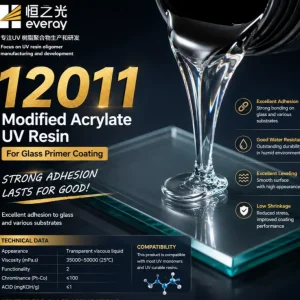
Wholesale 12011 Modified Acrylate UV Resin for Glass Primer Coatings | Boiling Water Resistance
Product Details & TDS
High-Quality 9105A-80: Bisphenol A Epoxy Acrylate Resin - Superior Hardness and Chemical Resistance
Product Details & TDS
Wholesale 6203F Low-Shrinkage Modified Epoxy Acrylate Resin - High Adhesion UV Prepolymer
Product Details & TDS
Wholesale Bisphenol A Epoxy Acrylate Resin 9105M-80: Core Resin for Durable and Glossy UV Coatings
Product Details & TDS
Wholesale Polycarbonate Acrylate 72203A – Fast Curing UV Resin for Soft Touch Coatings
Product Details & TDS
Buy 2406 UV Resin: Low Odor Solution for Rapid Paper and Plastic Varnishes Manufacturer Grade
Product Details & TDS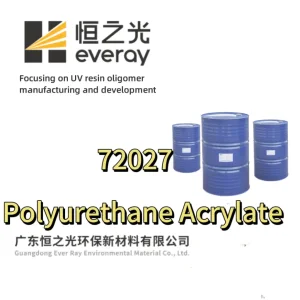
Wholesale Model 72027 Weather-Resistant Polyurethane Acrylate Resin | Low Yellowing & High Tack PSA
Product Details & TDS