Wholesale 72017A-8 Dual-Curing UV Resin for 3D Printed Footwear | High Elasticity & Low Shrinkage Resin Manufacturer, Factories
Product Description
Product Overview
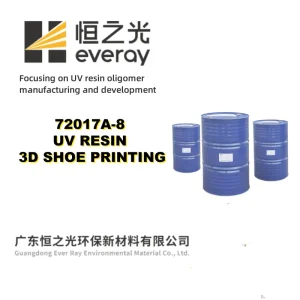
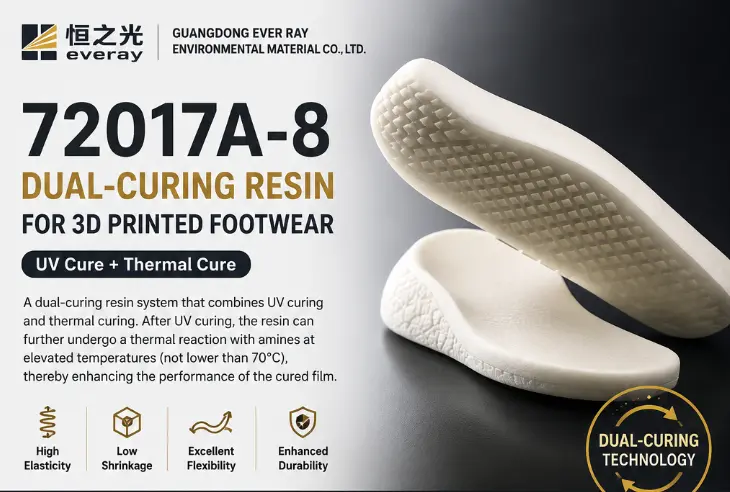
72017A-8 is an innovative dual-curing resin system developed for demanding UV-curable applications requiring both flexibility and mechanical durability.
Unlike conventional UV resins, 72017A-8 combines rapid UV curing with a secondary thermal curing mechanism. After UV exposure, the resin can further react with amine components at elevated temperatures (≥70°C), forming an enhanced crosslinked network that significantly improves the final mechanical properties.
This dual-curing approach provides an excellent balance between printing precision, elasticity, dimensional stability, and long-term durability.
Key Features
Dual-Curing Technology
- Fast UV curing for high-speed manufacturing
- Secondary thermal curing for enhanced performance
- Improved crosslink density after post-curing
Excellent Elasticity
- High flexibility
- Excellent rebound performance
- Suitable for wearable applications
Low Curing Shrinkage
- Reduced internal stress
- Improved dimensional accuracy
- Better print stability
Enhanced Mechanical Properties
After thermal post-curing:
- Increased toughness
- Improved fatigue resistance
- Higher durability
- Better long-term performance
Excellent Printability
- High printing precision
- Good layer adhesion
- Suitable for complex lattice structures
- Consistent processing performance
Typical Applications
Footwear Industry
- 3D Printed Shoe Midsoles
- Customized Insoles
- Sports Footwear Components
- Performance Footwear Structures
Functional 3D Printing
- Flexible Lattice Structures
- Energy Absorption Components
- Wearable Products
- Functional Prototypes
UV-Curable Systems
- UV Adhesives
- Flexible UV Coatings
- Specialty UV Formulations
Advantages of Dual-Curing Technology
Compared with traditional UV-curable resins, 72017A-8 provides:
Recommended Processing
UV cure to achieve rapid shape formation.
Thermal post-cure at temperatures above 70°C.
Amine crosslinking reaction further enhances the mechanical performance of the cured material.
Target Markets
Frequently Asked Questions (FAQ)
The system combines rapid UV curing for initial shape formation with a secondary thermal cure (≥70°C). During thermal post-curing, the material undergoes an amine crosslinking reaction that significantly elevates crosslink density and mechanical strength.
Thermal post-curing increases toughness, improves fatigue resistance, boosts overall durability, and ensures reliable long-term performance under cyclic mechanical stress.
Footwear components like shoe midsoles and insoles require high elasticity, superior rebound, and fatigue resistance. 72017A-8 provides high flexibility alongside low curing shrinkage, ensuring dimensional accuracy for lattice structures.
Low curing shrinkage minimizes internal stress during photopolymerization, which reduces deformation, enhances dimensional accuracy, and delivers higher printing stability for complex geometries.
It is ideal for 3D printed midsoles, customized insoles, sports shoe parts, flexible lattice cushioning components, energy absorption products, wearable goods, and specialty UV adhesives.
After UV curing, parts should be thermally post-cured at temperatures above 70°C to activate the amine crosslinking reaction and achieve full mechanical properties.