High-Purity UV Acrylate Solutions & Resins
Featured oligomers and prepolymers precision-engineered for maximum optical clarity, ultra-low curing shrinkage, and superior substrate bonding.
Global Market Landscape & Molecular Engineering
Understanding the transition toward radiation-curable, VOC-free chemical solutions across modern optical, electronic, and industrial manufacturing sectors.
Aliphatic Backbone Clarity
Traditional aromatic epoxy resins suffer from light-induced free radical decomposition, resulting in severe chromatic degradation (Gardner color shifts). By synthesizing aliphatic urethane acrylate structures (IPDI/H12MDI backbones), our factory prevents chromophore formation, ensuring lasting water-clear transparency under high-intensity UV exposure and thermal stress.
Mitigating Oxygen Inhibition
Thin film clear coatings often develop surface tackiness caused by atmospheric oxygen scavenging free radicals. Through precise incorporation of copolymerizable amino acrylate synergists and active amine co-initiators, we enhance rapid hydrogen transfer. This enables instantaneous surface polymer network closure even at micro-film thicknesses under standard mercury or 395nm LED lamps.
Volumetric Shrinkage Control
Free radical polymerization of conventional polyfunctional acrylates frequently leads to volumetric shrinkage exceeding 8-12%, causing substrate warping and adhesive shear failure. Our advanced low-shrinkage oligomers integrate branched polyols and flexible ether bridges that lower shrinkage below 2.5%, guaranteeing dimensional fidelity for precision optical casting.
China Manufacturing Scalability & Direct Factory Efficiency
How Guangdong Ever Ray Environmental Material Co., Ltd. drives global procurement cost reductions, consistent batch-to-batch polymer metrics, and short lead times.
Fully Integrated Upstream Sourcing
Located in the Dawan Industrial Park chemical hub of Guangdong, our facility directly integrates raw materials including pure acrylic acid, isocyanates (IPDI, TDI, HDI), and special glycols. This direct vertical integration insulates procurement partners from wild commodity market swings and ensures dependable batch production schedules.
Distributed Automated Reactors
Our production floor operates over 10 independent computerized batch reactor systems. This modular layout prevents cross-contamination between yellowing-prone aromatic formulations and pure water-white aliphatic crystal-clear oligomers, yielding strict chromatic stability (APHA < 30) for every drum shipped.
Quality Control & Global Compliance
Every industrial production run is monitored with real-time FTIR spectrometry, Gel Permeation Chromatography (GPC) for narrow molecular weight dispersion, and Brookfield viscosity tracking. All formulations ship with comprehensive GHS-compliant SDS, RoHS, and REACH dossiers tailored for rapid customs clearance worldwide.
Comprehensive Resin Chemistry Comparison Matrix
Select the precise molecular architecture for your formulation constraints across curing kinetics, optical performance, and mechanical targets.
| Resin Chemistry Family | Optical Transmission (400-700nm) | Yellowing Resistance (ΔE UV Test) | Tensile / Hardness | Shrinkage Rate | Primary Industrial Applications |
|---|---|---|---|---|---|
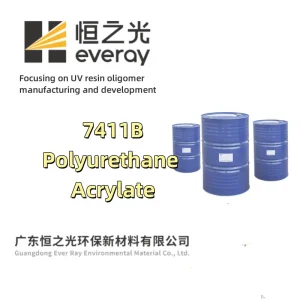
| Aliphatic PUA Oligomers | >98.5% | Exceptional (ΔE < 1.0) | Medium / Flexible (Shore 60A - 75D) | 1.8% - 2.8% | Optical adhesives (LOCA), 3C clear coats, 3D lattice footwear |
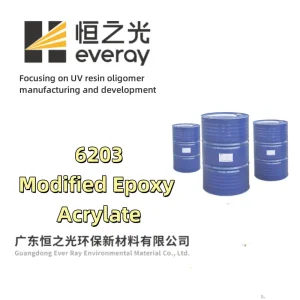
| Modified Epoxy Acrylates | 90.0% - 94.0% | Moderate (Indoor use) | High (Pencil Hardness 2H - 4H) | 5.5% - 8.0% | Glass primers, wood sanding sealers, overprint varnishes (OPV) |
| Hyperbranched Acrylates | >96.0% | High (ΔE < 2.0) | Ultra-High (4H - 6H scratch guard) | 4.0% - 6.0% | Consumer electronics hard-coats, anti-scratch vehicle films |
| Polyester Acrylates | 92.0% - 95.0% | Good (ΔE < 2.5) | Balanced Toughness | 3.5% - 5.0% | Flexographic, offset, and screen inks; pigment-loaded systems |
| Dual-Cure (Photo-Thermal) PUA | >97.0% | Superior (ΔE < 1.2) | High Elasticity (Elongation > 350%) | 1.2% - 2.0% | Additive manufacturing lattices, thick shadowed bonding |
Industrial Application Profiles: Engineering the Critical Interface
Deploying specialized acrylate backbones to solve extreme environmental, chemical, and optical adhesion challenges across global production lines.
3C Electronics & Mobile Optics
Handheld glass lenses, PC/PMMA touch displays, and wearable shells require crystal clear topcoats resistant to cosmetic oils, skin sweat, and mechanical scratching without yellowing over time. Ever Ray aliphatic polyurethane acrylates provide lasting chemical barrier properties with pencil hardness exceeding 3H.
Photopolymer 3D Printing (SLA/DLP/LCD)
From transparent dental aligners to functional aerospace prototypes, photopolymer print engines depend on fast layer reactivity combined with deep optical transmission. Formulations containing our reactive acrylate monomers yield low viscosity, crisp exposure resolution, and parts that remain clear instead of turning amber after post-curing.
Boil-Proof Glass & Ceramic Primers
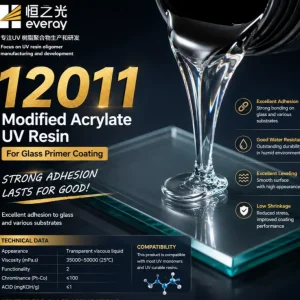
Bonding UV polymer matrices onto inorganic glass surfaces fails when exposed to moisture. By integrating silane-grafted modified acrylates (such as our 12011 grade), formulators establish covalent Si-O-Si bonds at the interface, surviving continuous boiling-water immersion tests without cross-hatch delamination.
UV Metallizing & Vacuum Plating
Vacuum aluminum metallizing on ABS/PC automotive trim demands an ultra-clear leveling basecoat that provides high mirror reflection and an elastic, clear topcoat that shields delicate metallic layers from oxidation, weather exposure, and gravel impact chips.
Emerging Formulation Trends & International Procurement Criteria
Anticipating next-generation chemical compliance, photoinitiator migration limits, and low-energy LED light curing platforms.
Transition to Long-Wavelength LED-UV (365nm - 405nm)
Global manufacturing facilities are replacing high-voltage mercury lamps with energy-efficient UV LED arrays. This shift requires raw oligomers with tailored absorption dynamics that react cleanly with surface photoinitiators (such as TPO or BAPO) without residual unreacted double bonds that cause yellowing or release strong odors.
Low-Migration & Food-Packaging Safety
Global brand owners in Europe and North America enforce strict regulations (Swiss Ordinance, Nestlé guidance) against volatile organic migration. Polymerizable amino acrylates and hyperbranched oligomers chemically integrate the amine synergist directly into the cured polymer backbone, cutting extractables to near-undetectable parts-per-billion levels.
Zero-VOC Waterborne UV Dispersions
Stringent regional carbon and solvent emission policies are accelerating demand for waterborne polyurethane acrylates (WPUA). These water-dilutable hybrid systems combine the safety of water-based coatings with the instantaneous cure speed and scratch resistance of radiation-curable networks, ideal for eco-conscious luxury wood, leather, and paper packaging.
Frequently Asked Questions (FAQ) for Chemical Engineers & Buyers
In-depth technical answers addressing resin selection, yellowing prevention, substrate wetting, and customized sample logistics.
What is the structural cause of yellowing in cured UV clear resins?
Yellowing typically stems from two chemical sources: aromatic isocyanate backbones (such as TDI or MDI) forming photo-oxidizable quinoid structures under UV light, and residual photoinitiator decomposition byproducts (such as alpha-cleavage fragments from Irgacure 651/907). For water-white optical clear topcoats, we specify pure aliphatic isocyanate chemistry (IPDI/H12MDI) combined with phosphine-oxide type photoinitiators (TPO/819) that bleach to a transparent finish upon complete irradiation.
How can formulators overcome adhesive failure on low-energy plastics (PP, PE, PC)?
Plastics like untreated polyolefins present low surface free energy, inhibiting spontaneous resin spreading. We recommend blending pure acrylate oligomers and special functional adhesion-promoting prepolymers containing chlorinated or acid-modified groups (such as carboxyl or phosphate functional acrylates). These functional groups generate chemical anchoring across interfacial plastic micro-clefts while lowering cure-shrinkage stress.
What role do copolymerizable amino acrylates play in high-speed printing inks?
Amino acrylates function as non-extractable amine synergists for Type II photoinitiators (such as benzophenone derivatives). Their alkylamino groups act as efficient hydrogen donors to generate reactive ketyl radicals. Crucially, they readily consume atmospheric oxygen that would otherwise terminate propagating free-radical chain ends, securing rapid tack-free surface curing in thin 2-5 micron print films on web presses.
Can Ever Ray engineer custom viscosities and molecular weight profiles?
Yes. Our in-house synthesis R&D team adjusts monomer chain stoichiometry, average prepolymer functionality (from difunctional to hexafunctional), and reactive diluent blending ratios (such as TPGDA, TMPTA, DPGDA, IBOA, or HDDA). We formulate tailored viscosity curves matching roll coating, flexographic anilox transfer, air-assisted spray lines, and high-speed robotic jet dispensing.
What are the minimum trial sample sizes and standard international packaging options?
We supply standardized 500g and 1kg sample bottles packed in light-shielded, hermetically sealed fluorinated HDPE containers for laboratory evaluations. For industrial container loads, bulk resin grades are shipped internationally in 20kg plastic pails, standard 200kg steel drums, or 1000kg reinforced IBC totes, backed by complete COA (Certificate of Analysis) verifications for every lot.
How do photo-thermal dual-curing resins behave in shadowed industrial assemblies?
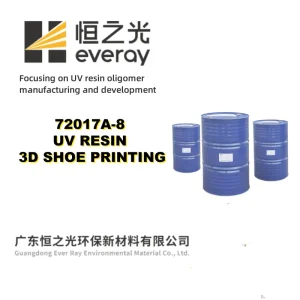
In complex assemblies such as 3D lattice footwear or opaque electronic components, UV light cannot reach interior crevices. Dual-curing resins (such as 72017) resolve this by coupling rapid UV-initiated radical front-curing with secondary thermal crosslinking (via blocked isocyanate or epoxy-latent amine additions), completing cure in unexposed areas.
Advanced Chemical Specialties & Functional Resins
Explore the remainder of our engineered acrylate prepolymer portfolio for vacuum metallizing, flexographic varnishes, and high-performance adhesives.