
2006+
Polymer R&D Heritage
40,000m²
Scale Smart Production Plant
10+
Automated Continuous Lines
<1.8%
Engineered Low Shrinkage
Direct Sourcing Matrix
Primary High-Performance UV Formulations & Resins
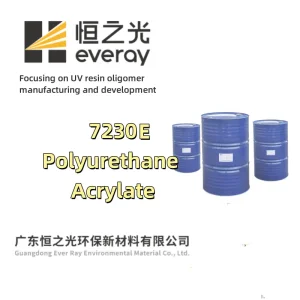
Directly source high-reactivity bisphenol-A epoxies, non-yellowing polyurethane acrylates, and precision-engineered oligomers for rapid integration into global assembly lines.
Industry White Paper Analysis
Global UV Adhesive Trends: The Green Crosslinking Paradigm
The transition from solvent-borne and thermal curatives toward light-induced free radical and cationic polymer networks has become the focal point of advanced industrial manufacturing.
UV-LED 365nm-405nm Monomer Tuning
Global assembly is standardizing on narrow-spectrum UV-LED cold light sources. Because traditional medium-pressure mercury systems generate surplus heat and toxic ozone, formulators must buy advanced oligomers specifically tuned for prompt surface curing and depth activation at long wavelengths without yellowing.
Zero-VOC & Ultra-Low Extractables
Strict ESG guidelines, EU REACH restrictions, and TSCA thresholds require modern industrial coatings to eliminate fugitive VOCs completely. Acrylate oligomers and functional monomers now act both as building blocks and as non-evaporating diluents, forming fully crosslinked networks with zero hazardous atmospheric discharge.
Hybrid Photo/Thermal & Moisture Systems
As electronic packages, optical sensors, and automotive cameras grow progressively denser, light cannot reach deep shaded cavities. Dual-cure formulations that blend immediate UV spot-tack with secondary heat or moisture cures represent the highest-growth segment in Tier-1 technical sourcing.
Engineering Evaluation
Global Enterprise Procurement Strategy
Purchasing agents, technical chemists, and industrial manufacturing directors evaluate distinct parameter trade-offs when selecting core UV oligomer grades.
| Resin Classification | Hardness vs. Elasticity | Substrate Affinity | Volumetric Shrinkage | Thermal / Weathering Matrix |
|---|---|---|---|---|
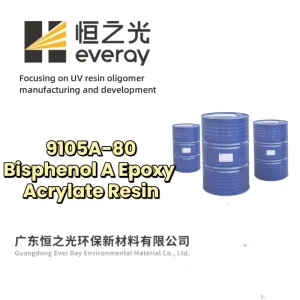
| Standard Bisphenol A Epoxy Acrylates | High Hardness (3H-5H pencil), rigid chain | Paperboard, flat wood, prime rigid plastics | 5.5% – 8.5% (High cure contraction) | Indoor only; moderate thermal yellowing |
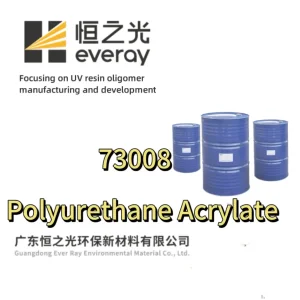
| Aliphatic Polyurethane Acrylates (PUA) | Exceptional Elongation (40% - 220%), impact resistant | PET, polycarbonate, untreated metals, glass | 1.2% – 2.8% (Ultra-low shrinkage) | QUV > 1,000h non-yellowing, -40°C to +130°C |
| Aromatic Polyurethane Acrylates | Balanced Hardness & Toughness (H-2H) | Industrial metals, industrial floorings, wood | 3.0% – 4.5% (Controlled strain) | Cost-effective toughness; tends to yellow under UV |
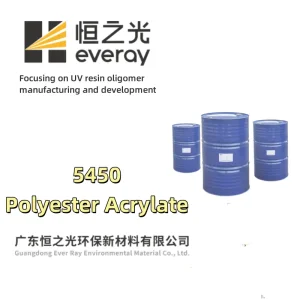
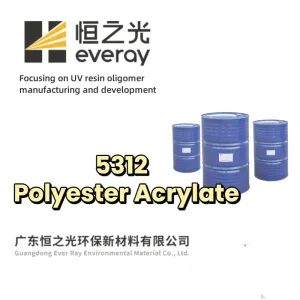
| Polyester Acrylate Oligomers | Medium Hardness, exceptional flex-crack resistance | Offset inks, treated polyolefins, packaging films | 3.5% – 5.0% (Fast surface cure) | Balanced ink-water rheology; moderate heat stability |
| Hyperbranched Multi-Functional Acrylates | Extreme Scratch Hardness (>4H), low viscosity | Optical lens coatings, high-speed 3C electronics | 4.0% – 6.5% (Dense crosslink core) | High thermal deflection, tight chemical resistance |
Smart Manufacturing Ecosystem
China Factory 4.0: Supply Chain Resilience & Yield Advantage
Operating from our modern facility in Yunfu, Guangdong, Guangdong Ever Ray Environmental Material Co., Ltd. demonstrates how centralized chemical supply chains deliver quality and commercial value.
DCS Automated Synthesis
Closed-loop Distributed Control Systems oversee isocyanate addition, esterification, and transesterification reactions, eliminating human batch error and keeping product viscosity inside tight ±5% tolerances.
Upstream Raw Sourcing
Direct supply-line integrations for acrylic acid, polyols, aliphatic IPDI/HDI, and specialty epoxy pre-polymers guarantee stable raw cost access, shielding global buyers from spot-market price spikes.
Rigid Analytical QC
Every lot passes thorough testing: Gel Permeation Chromatography (GPC) for molecular distribution, FTIR for NCO/double-bond conversion, and Karl Fischer titration for strict trace-moisture thresholds.
Export Logistics Packaging
High-barrier UV-shielded steel drums (200kg) and 1000kg IBC totes feature nitrogen purging and internal inhibitors to preserve reactivity across international ocean routes.
Applied Formulation Engineering
High-Precision Applications: From Cleanrooms to Rollers
Optimizing monomer polarity and functional chain architecture solves common bonding issues across industrial processes.
3C Electronics & Micro-Optics
Bonding touch panels, camera prism modules, and acoustic components demands high optical clarity (refractive index matched >1.50) alongside zero peel under thermal shocks (-40°C to +85°C). Our low-modulus PUA oligomers resolve interfacial delamination without stressing fragile display layers.
Industrial Additive Manufacturing (SLA/DLP)
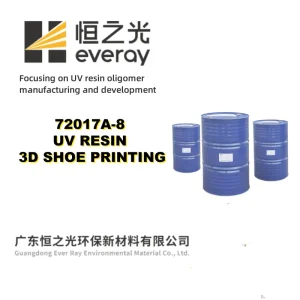
Photopolymer formulation requires fast line speed and controlled critical exposure (Ec) alongside minimal volume reduction. Our dual-cure resins match elastomer-grade performance (tensile strength >45MPa, elongation >120%), enabling accurate direct printing of footwear lattices and industrial prototypes.
High-Line-Speed Packaging & Overprint Varnishes
Press lines operating above 200 m/min face immediate oxygen inhibition at thin cross-sections (<5µm). Incorporating copolymerizable amino acrylates and active amine synergists overcomes atmospheric oxygen quenching, ensuring clean scratch-resistant surfaces at lower photoinitiator levels.
Advanced Chemical Grades
Specialized Reactive Acrylates & Performance Pre-Polymers
High-elongation dual cures, wrinkle polymers, and functional specialty resins designed to meet exacting bonding and coating requirements.
Technical FAQs
Frequently Asked Questions: Industrial Procurement & Formulation
Clear, direct answers to common questions about buying, scaling, and processing UV curable polymers.
What parameters govern the balance between cure speed and volumetric shrinkage in UV adhesives?
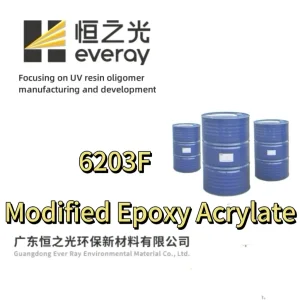
Free radical acrylate crosslinking converts Van der Waals intermolecular spaces (approx. 3.4 Å) into covalent carbon-carbon bonds (1.54 Å), producing shrinkage from 2% to over 8%. Monomers with higher double-bond density speed up cure times, but increase internal stress and cause shrinkage. We lower shrinkage stress below 2.0% by combining higher molecular-weight polyurethane acrylate backbones (like 73008 and 6203F) with bulky monofunctional acrylates (such as IBOA) without compromising surface cure speed.
How do aliphatic polyurethane acrylates avoid yellowing compared to aromatic grades?
Aromatic polyurethane acrylates (built with TDI or MDI) form quinoid chromophore structures when exposed to sunlight and UV rays, resulting in visible yellowing. Aliphatic acrylates use stable cycloaliphatic or linear diisocyanates (such as IPDI or H12MDI) that do not form light-absorbing chromophore radicals. This maintains >99% optical clarity and ΔE < 1.0 over long outdoor exposure cycles.
Can customized oligomers resolve poor adhesion on untreated polyolefins (PP/PE) or inert metals?
Untreated PP, PE, and plated metals have low surface free energy, making wetting difficult. We develop functional oligomers with modified carboxylic acid, phosphate ester, or silane groups. The functional polar heads bond directly with metallic oxides and inorganic bonds, while the acrylate groups crosslink into the bulk matrix to deliver strong 5B cross-hatch adhesion without requiring aggressive chemical primers.
What are the typical minimum order quantities (MOQ), export packaging, and transport precautions?
Standard trial samples ship in 1kg to 20kg sealed UV-blocking canisters. Bulk production orders ship in 200kg steel drums or 1,000kg IBC totes. Shipments maintain a controlled temperature range between 10°C and 30°C away from heat and light sources. All formulas include balanced internal radical scavengers (MEHQ/BHT) to ensure clear chemical stability for 12 months in transport and storage.
How do Ever Ray chemical synthesis reactors satisfy international compliance standards?
Our manufacturing base in Dawan Industrial Park runs under full ISO9001 and ISO14001 certifications. All finished oligomers comply directly with EU REACH (SVHC-free), RoHS 3.0, and TSCA inventory requirements. We provide complete third-party SDS (GHS 16-section standard) and Technical Data Sheets (TDS) alongside every production batch for smooth customs and factory audits.
