Featured Fast-Cure Resin Formulations & Reactive Acrylates
Engineered for immediate tack-free surface curing, anti-oxygen inhibition, superior boiling-water resistance, and nano-indentation scratch resistance across composite, glass, wood, and plastic substrates.
The Global Paradigm Shift Toward Rapid Photopolymerization
Evaluating molecular dynamics, energy reduction mandatories, and VOC decarbonization across international high-speed coating lines.
Sub-Second Photopolymer Dynamics
Traditional thermal-cure polyurethanes and solvent-borne epoxies necessitate extensive drying tunnels with cure schedules ranging from 15 to 45 minutes. Quick curing resin systems utilize UV-radical (free-radical acrylate crosslinking) or UV-cationic mechanisms that convert monomeric liquid to solid glass within 0.1 to 1.5 seconds under 365nm to 405nm LED radiation, increasing production throughput by over 800%.
Overcoming Atmospheric Oxygen Inhibition
In high-speed roll-to-roll conversion and thin-film overprint varnishing (OPV), atmospheric O2 quenches free radicals, causing uncured tacky surfaces. Advanced quick-curing resin manufacturers overcome this without nitrogen blanketing by integrating amine-modified polyether acrylates and hyperbranched dendritic oligomers, dramatically raising radical density at the atmospheric boundary layer.
Zero-VOC & Decarbonization Mandates
With stringent regulatory standards such as EU REACH, RoHS, and EPA Clean Air requirements, 100% solid-content UV-curable oligomers and waterborne polyurethane acrylates (WPUA) eliminate greenhouse gas emissions, minimize flash-point hazards during ocean freight transit, and drastically lower energy consumption during downstream industrial application.
Technical Distinction for Formulators: Aliphatic urethane acrylates (such as PUA 7291B) utilize isophorone diisocyanate (IPDI) or hexamethylene diisocyanate (HDI) backbones to achieve complete non-yellowing and weatherability for 3C electronics and outdoor optical films, whereas aromatic polyurethane acrylates synthesize toluene diisocyanate (TDI) backbones to maximize hardness, chemical resistance, and cost efficiency in interior wood and industrial flooring applications.
Why Global Tier-1 Brands Source Quick Curing Resins from Guangdong, China
Combining end-to-end upstream monomer synthesis, rapid custom molecular engineering, and automated batch reactor precision.
Chemical Integration
Direct upstream integration with acrylic acid, polyols, epoxy resins, and isocyanate precursors within the Pearl River Delta industrial corridor guarantees raw material price buffering and uninterrupted volume production schedules.
Custom Formulation
In-house laboratories synthesize experimental batches matching client-specific viscometric windows (100 mPa.s to 120,000 mPa.s), refractive index thresholds, and specific adhesion criteria on untreated polyolefins or anodized metals in 7 business days.
Stringent Batch Consistency
Equipped with automated multi-ton glass-lined and stainless reactors, our Yunfu manufacturing base enforces automated temperature PID loops, precise double-bond conversion monitoring via FTIR, and GPC molecular weight tracking.
Export Logistics Excellence
Strategically positioned near major container terminals (Nansha, Shenzhen, Hong Kong), Ever Ray delivers temperature-stabilized ISO-tanks, IBC totes, and 200kg steel drums compliant with GHS, IMDG, and IATA safety guidelines worldwide.
Engineered Chemistry for Demanding Industrial Substrates
Overcoming adhesion barriers, dimensional shrinkage, and thermal cycling across diverse manufacturing verticals.
3C Electronics & Vacuum Metallization
Smartphone frames, laptop casings, and wearable bezels require high optical clarity and steel-wool scratch resistance. Our aromatic and aliphatic PUA polymers ensure inter-coat adhesion on ABS and PC substrates without requiring aggressive solvent etching or corona pretreatment, surviving 500+ cycles of MEK solvent rub tests.
Additive Digital Manufacturing (3D Printing)
Photopolymer resins for SLA, DLP, and LCD/mSLA additive footwear midsoles and functional prototyping must strike a delicate balance between tensile strength and elongation. Ever Ray dual-curing UV elastomeric systems (such as 72017A-8) eliminate green-state distortion, delivering energy return and impact resilience comparable to injection-molded TPU.
Automotive Glass & Structural Primers
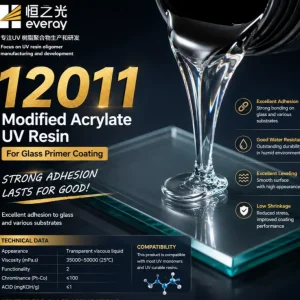
Glass and ceramic frits present an exceptionally smooth, hydrophilic surface where traditional adhesives fail under hydrothermal stress. Ever Ray 12011 and 5830A modified acrylate polymers utilize organosilane-coupling backbones that withstand immersion in boiling water for over 2 hours without delamination, pinholing, or tensile loss.
Quick Curing Oligomer Family Selection Matrix
Direct comparative benchmarks based on molecular architecture, curing kinetics, hardness, and substrate affinity.
| Oligomer Family | Curing Mechanism | Surface Hardness | Elongation % | Yellowing Index | Primary Target Applications |
|---|---|---|---|---|---|
| Standard Epoxy Acrylate (EA) | Free-Radical UV / EB | 2H – 4H Pencil | 1% – 5% | Moderate (ΔE > 3.0) | Wood primers, high-speed overprint varnishes, flexo packaging inks |
| Aliphatic Polyurethane Acrylate (PUA) | Free-Radical UV / LED | H – 2H Pencil | 40% – 180% | Superior (ΔE < 0.5) | 3C electronics, clear coat top finishes, nail enhancement cosmetic gels |
| Aromatic Polyurethane Acrylate | Free-Radical UV | 2H – 3H Pencil | 15% – 50% | Standard | Industrial parquet flooring, PVC floor tiles, vacuum metallization basecoats |
| Polyester Acrylate Oligomer | Free-Radical UV / LED | HB – H Pencil | 10% – 30% | Low | Offset lithographic inks, screen printing, plastics coating modifiers |
| Hyperbranched Multi-Functional Acrylate | Ultra-Fast UV LED | 4H – 6H Pencil | < 2% | Low | Extreme scratch-resistant hard-coats, high-speed roll manufacturing |
| Dual-Cure (UV + Thermal / Moisture) | Hybrid Polyaddition | Shore 60A – 85D | 80% – 350% | Very Low | 3D printed footwear midsoles, optical bonding, shadow-cure electronics assembly |
Trends Defining Enterprise Resin Sourcing Through 2030
Understanding buyer risk mitigation, sustainable substitution, and custom synthetic responsiveness.
Total Cost of Formulation (TCO) Optimization
Industrial procurement executives increasingly shift away from localized distributors charging 35–60% markups, preferring direct factory partnerships that grant transparency on monomer pricing indices and offer custom adjustments to reactive diluent packages (e.g., TPGDA, TMPTA, DPGDA, HDDA).
Technical Documentation & Compliance
International buyers require extensive batch-specific documentation: Certificate of Analysis (COA) specifying viscosity at 25°C, solid content percentages, Gardner color standards, acid value titration, along with full 16-section SDS in multiple languages conforming to UN GHS standards.
Transition to UV-LED (395nm/405nm)
The global phase-out of traditional mercury vapor lamps due to the Minamata Convention on Mercury has driven procurement teams toward oligomers tailored for long-wave UV-LED absorption spectra. Ever Ray incorporates tailored sensitizer-friendly structures that cure reliably at 385–405nm with lower energy flux.
Frequently Asked Questions for Global Procurement & Formulation Teams
Direct technical guidance from chemical synthesis and formulation application engineers.
Specialty High-Gloss, Fast-Setting Resins & Primers
Expand your industrial formulation capabilities with specialized oligomers designed for shadowless adhesives, lithographic printing inks, and glass-bonding primers.