
High-Performance Acrylates for Chicagoland Converters
Direct from factory synthesis: batch-controlled UV oligomers customized to support Midwest high-speed offset lines, flexographic packaging, and industrial surface finishes.
Powering Greater Chicago's Packaging & Industrial Coating Infrastructure
From the packaging converting epicenters in Elk Grove Village and Cook County to industrial coating operations across Illinois, Indiana, and Wisconsin, the Midwest market requires strict chemical reliability.
Corrugated & Folding Carton Flexo
The Chicago hub serves as North America's freight junction and food packaging capital. Our polyester acrylates provide superior pigment wetting, rapid electron-beam / UV cure response, and low migration profiles essential for high-throughput flexographic converting lines.
Heavy Industrial Metal & Coil Systems
Midwest manufacturing requires extreme mechanical endurance. Modified polyester acrylates balance high crosslink density with micro-elongation, preventing micro-cracking during metal stamping, deep drawing, and severe thermal fluctuations across freezing Chicago winters.
VOC Elimination & Regulatory Decarbonization
With stringent air quality mandates enforced by Illinois EPA and Region 5 EPA frameworks, industrial converters are actively transitioning from solvent systems. Our 100% solids UV polyester oligomers eliminate VOC tracking while optimizing energy utilization per square foot.
Next-Generation Radiation Curing: Chemistry, Rheology, and Resilience
An engineering breakdown of polyester acrylate macromolecular architecture, oxygen inhibition abatement, and smart supply chain integration for Midwest chemical buyers.
1. Molecular Engineering of Multifunctional Polyester Acrylates
Polyester acrylate oligomers are synthesized via the polycondensation of polyhydric alcohols and polybasic acids, followed by end-capping with acrylic acid. In UV-curable formulations, performance is dictated by the degree of branching and ester backbone composition. Our Guangdong synthesis plant leverages computerized stoichiometric controls to optimize oligomer functionality ranging from difunctional (for high flexibility and elongation) to hexafunctional (for supreme scratch hardness and ultra-fast line speeds exceeding 400 m/min).
Formulation Insight: By precisely managing the ratio of aliphatic dibasic acids (e.g., adipic acid) to aromatic counterparts (isophthalic or terephthalic anhydride), our chemists tailor glass transition temperatures (Tg) between -15°C and +65°C. This allows Chicago converters to achieve zero-curling on thin film substrates (BOPP, PET) while maintaining pencil hardness up to 3H on rigid plastic moldings.
2. Solving Oxygen Inhibition in High-Speed Offset & Overprint Varnishes
In thin-film applications such as overprint varnishes (OPV) and flexographic printing common in Chicago packaging facilities, atmospheric oxygen diffuses into the curing film, scavenging free radicals and forming stable peroxy radicals. This results in incomplete surface cure, residual tack, and odor issues. Ever Ray's polyester acrylates incorporate optimized hyperbranched architectures and secondary amine-modified polyol matrices that substantially accelerate surface cure speeds under mercury arc, LED-UV (385–395 nm), and excimer laser systems.
3. Supply Chain Resilience: Factory 4.0 Synergy with Chicago Distribution
Modern formulators cannot tolerate batch-to-batch viscosity variance or unannounced supply bottlenecks. Our Yunfu production center operates under automated DCS closed-loop control systems, validating each reaction step via online FT-IR spectroscopy and gel permeation chromatography (GPC). Consignments destined for Chicago, Milwaukee, and Rockford undergo stringent moisture titration, acid value monitoring (< 2 mg KOH/g), and Gardner color index validation (≤ 1.0) before departure.
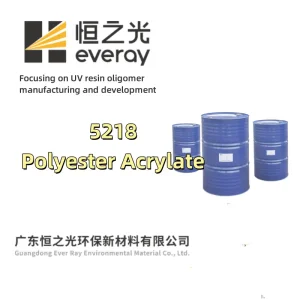
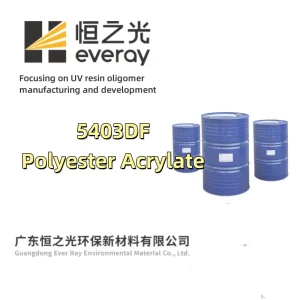
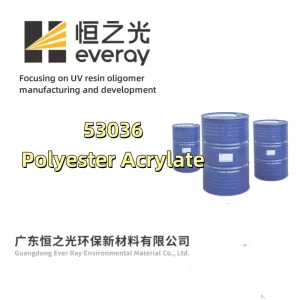
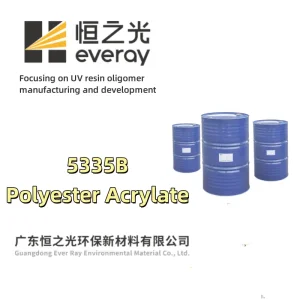
Full Industrial Series: Polyester Acrylate UV Resins
Engineered for high adhesion, excimer laser matte effects, flexographic clarity, and active dilution. Select a technical grade below to view full specifications.
Frequently Asked Questions for Chicago & Midwest Buyers
Comprehensive responses detailing TSCA inventory listing, FDA indirect food contact compliance, cold-weather stability, and intermodal freight routing.
Are Ever Ray's polyester acrylates fully TSCA compliant for importation into Illinois?
How do Ever Ray polyester acrylates resolve offset water-ink balance issues?
Can these polyester acrylates withstand Midwest sub-zero freight conditions?
What is your bulk lead time and logistics route serving the Chicago area?
Do you support FDA 21 CFR indirect food contact packaging formulations?
Accelerate Your Formulation Development in Chicago
Partner with an authoritative UV curable resin synthesis factory. Request custom backbone modification, bulk container quotes, and free 1 kg formulation testing samples delivered directly to your Midwest facility.
Send Inquiry Now