
High-Performance Resins for Wood & Industrial Coatings (Part I)
Engineered oligomer systems tailored for high-speed roller coating, vacuum spraying, and automated UV/LED curing wood production lines.
China Factory 4.0: Supply Chain Resilience & Batch-to-Batch Cpk Stability
Transitioning from standard chemical synthesizing to high-fidelity molecular engineering, Guangdong Ever Ray Environmental Material Co., Ltd. operates state-of-the-art distributed control synthesis reactors (DCS) to guarantee rigorous international quality parameters.
DCS Automated Synthesis
Reactor temperatures, polyol addition speeds, and isocyanate index (NCO/OH stoichiometry) are monitored by multi-loop closed automated controllers. This eliminates human variability and guarantees batch-to-batch molecular weight distribution (Mw/Mn < 1.35).
- Exothermic runaway suppression
- Real-time FTIR end-point titration
- Automated vacuum degassing systems
Cost & Supply Chain Dominance
Situated within the Greater Bay Area chemical corridor, Ever Ray directly sources upstream isocyanates (IPDI, HDI, TDI) and acrylic acid intermediates at high volume, insulating global B2B procurement partners from erratic raw material price volatility.
- Zero middleman material acquisition
- Dedicated bulk monomer bulk-storage park
- Continuous buffer stock for 60-day cycles
Statistical Quality Control (Cpk ≥ 1.67)
Every single polyurethane wood varnish lot undergoes stringent rheological profiling, Gardner color index testing, and crosslink density validation to ensure flawless compatibility on industrial roller and vacuum coater pipelines.
- Viscosity tolerance within ±5% at 25°C
- Residual isocyanate monomer < 0.05%
- Certified COA accompanied export delivery
Macro Industry Solutions: Engineering Finishes by Substrate & Stress
From high-traffic solid hardwood flooring requiring 10,000-cycle Taber abrasion resistance to acoustic musical instruments demanding zero acoustic dampening, our polyurethane wood varnish oligomers solve fundamental substrate friction.
Pre-Finished Hardwood Flooring
Combines aromatic/aliphatic hybrid PUA with micro-corundum (aluminum oxide) slurries. Delivers diamond-grade 6H-8H pencil hardness while retaining sufficient substrate elasticity to absorb extreme thermal expansion and contraction cycles.
- Taber CS-17 > 12,000 cycles without breakthrough
- No white stress cracking during high-impact drop tests
- Instant stackability post-UV cure line
Architectural Kitchen & Bath Cabinetry
Engineered for relentless resistance to household chemical spills (coffee, alcohol, mustard, bleach, boiling water). Aliphatic polyurethane backbones withstand kitchen greases and frequent disinfection without surface dulling or degradation.
- Passes European EN 12720 Chemical Resistance Class 1A
- Zero gloss flaking on edges or routed MDF profiles
- Available in dead-matte (<5 GU) to ultra-gloss (>95 GU)
Exterior Joinery & Marine Teak
Formulated with specialized aliphatic IPDI/HDI polyurethane acrylate frameworks, fortified with reactive UV absorbers (UVA) and hindered amine light stabilizers (HALS). Prevents timber graying and film micro-fissuring caused by intense UV exposure.
- 3,000+ hours QUV accelerated weathering resistance
- High water vapor permeability prevents blistering
- Hydrophobic film barrier repels salt fog spray
Luthiery & High-End Instruments
Traditional thick coatings deaden the acoustic resonance of solid spruce, maple, and mahogany. Our high-solids, low-film-build waterborne UV PUD delivers a crystal-clear micro-coating that preserves organic timber tone and enhances three-dimensional wood figure.
- Ultra-low film build (under 25 μm dry film thickness)
- Rapid polishability to mirror gloss within minutes
- Non-yellowing optical clarity over delicate natural grains
Next-Generation Technology Roadmap: Beyond Traditional Varnish Chemistries
A comprehensive technical comparison highlighting the performance matrix across conventional polyurethane varnishes, high-performance aliphatic oligomers, waterborne dispersions, and hyperbranched polymers.
| Polymer Chemistry Family | Resin Backbone Type | Cure Kinetic Mechanism | VOC Content (g/L) | Pencil Hardness | Elongation at Break (%) | Yellowing ΔE (500h QUV) | Primary Industrial Wood Application |
|---|---|---|---|---|---|---|---|
| Aliphatic PUA (e.g., 7296-1 / 7600) | Isophorone Diisocyanate (IPDI) / Polyester-polyether | Free-radical UV / LED (365-395nm) | < 50 (100% Solids) | 3H - 5H | 15% - 45% | < 1.2 (Ultra Non-Yellowing) | High-end residential furniture, white oaks, bleached veneers |
| Aromatic PUA (e.g., 7160 / 7200F) | Toluene Diisocyanate (TDI) / Polyether Polyol | Mercury UV lamp (254-365nm) | < 65 (High Solids) | 4H - 6H | 5% - 18% | > 4.5 (Moderate Yellowing) | Industrial commercial parquet, dark timber, sealers & basecoats |
| Waterborne UV PUD (e.g., 70251) | Anionic Polyurethane Dispersion Acrylate | Thermal dewatering + UV crosslinking | < 20 (Ultra-Low VOC) | 2H - 4H | 60% - 120% | < 0.8 (Superior Optical Clarity) | Open-pore natural tactile coatings, child-safe cribs, wall paneling |
| Hyperbranched Acrylate Oligomer | Dendritic multi-hydroxyl polyester-urethane core | Ultra-rapid dual-path photopolymerization | Zero VOC / Reactive Diluent | 6H - 8H | < 3% | < 1.8 (Good Stability) | Excimer laser matte anti-fingerprint topcoats, nano-scratch shields |
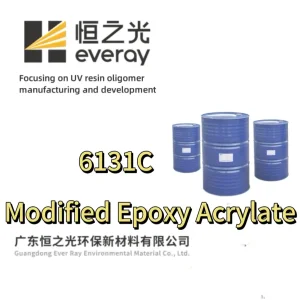
| Modified Epoxy Acrylate (e.g., 6100D) | Bisphenol A Diglycidyl Ether Acrylate | Standard UV free radical initiator | < 80 | 5H - 7H | < 5% | > 6.0 (Prone to Yellowing) | Ultra-fast sanding sealers, MDF edge filling, heavy build primer |
Localized Support & International Environmental Compliance
Regulatory frameworks across Europe, North America, and the Asia-Pacific demand steep cuts in volatile organic emissions, monomer migration, and hazardous air pollutants (HAPs). Ever Ray delivers chemical solutions fully verified for trans-continental distribution.
EU REACH & SVHC Compliance
All monomer components, reactive photoinitiators, and polyurethane oligomer backbones supplied by Ever Ray are registered under EU REACH regulations. Formulations are 100% free of Substances of Very High Concern (SVHC), complying with stringent Scandinavian and German eco-labels.
- No phthalate plasticizers or organotin catalysts
- Formaldehyde-free crosslinking chemistry
- Compliant with DIN EN 71-3 (Toy Safety Standard)
US EPA & CARB Phase 2 Standards
Engineered to enable multinational wood product manufacturers to seamlessly achieve CARB Phase 2, TSCA Title VI, and LEED v4 green building credits. Our near-zero VOC and waterborne oligomers mitigate VOC taxes and simplify plant air permit compliance.
- Negligible HAPs (Hazardous Air Pollutants) content
- Zero reportable ozone-depleting blowing agents
- BCA & SCAQMD Rule 1113 compliant finishes
Field Formulation Engineering
We do not just ship resin containers; our doctorate-level chemical application specialists provide turnkey on-site formulation guidance: line speed matching, photoinitiator synergist tuning, oxygen inhibition mitigation, and roll coater rheology optimization.
- Multi-language SDS and TDS documentation
- Customized photoinitiator matching packages
- Laboratory trial support within 48-72 hours
Global Enterprise Procurement: Turnkey OEM/ODM Resin Services
Sourcing bulk raw chemical intermediates across continents requires airtight logistics, strict temperature control, and customizable delivery options. Ever Ray services tier-1 coating brands, mega-scale flooring manufacturers, and regional paint formulators.
Tailored Packaging Specifications
Flexible industrial export packaging formats: from 20kg sample drums for pilot line testing, to standard 200kg tight-head steel drums, and 1,000kg UV-shielded composite IBC containers. All packaging features antistatic liners and nitrogen-blanketed headspace.
- UN-certified heavy gauge steel drums
- Dry nitrogen purging to prevent moisture gelation
- Custom container labeling and private labeling (ODM)
Flexible MOQs & Rapid Lead Time
We understand lean supply chains. Ever Ray supports container-consolidation, multi-grade sample pallets, and flexible batch volumes starting at 1 drum (200kg) for standard grades, with bulk FCL production ship-outs accomplished within 7 to 10 working days.
- Direct seaport trucking to Guangzhou & Shenzhen ports
- Pre-shipment retainer sample archiving for 12 months
- Transparent ocean logistics tracking integration
Custom Molecular Customization
Do you need to overcome poor wetting on resinous teak? Or eliminate micro-bubbling on high-speed curtain coating machines? Our synthesis chemists tailor oligomer ester backbones, adjust acrylate functionality (di- to hexa-functional), and modify solvent diluent packages.
- Joint NDA-protected proprietary formulation
- Targeted viscosity matching (±100 mPa.s)
- Custom refractive index for optical timber grain pop
High-Performance Resins for Wood & Industrial Coatings (Part II)
Engineered oligomer solutions covering tough epoxy acrylates, multi-functional urethanes, and high-adhesion polyester resins.
Polyurethane Wood Varnish Technical Q&A: Formulator Guidance
In-depth responses covering resin synthesis selection, film delamination prevention, yellowing mitigation, and LED curing optimization directly from our chief polymer engineering lab.
