
AI-Assisted Macromolecular Engineering & Continuous Polymerization
By coupling reactive chemical physics with real-time multi-angle laser light scattering (MALLS) and AI predictive viscosity analytics, Ever Ray eliminates batch variance, guaranteeing ultra-low polydispersity indices (PDI < 1.3) and predictable curing kinetics across extreme industrial parameters.
Engineered UV Resins: Top Recommended OEM Grades
Explore our laboratory-proven, mass-production oligomers formulated to overcome high curing stress, yellowing, poor interfacial adhesion, and surface oxygen inhibition.
Engineered specifically for low-surface-energy polymers and premium flexographic packaging varnishes.
Prevents micro-cracks and delamination in water transfer printing and dense vitreous substrate finishing.
Aliphatic polyurethane backbone offering absolute non-yellowing stability and elastic peel integrity.
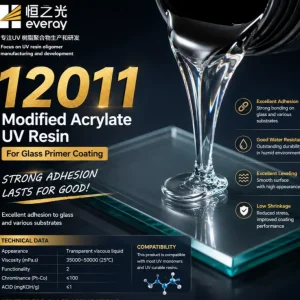
Withstands severe hydrothermal stress testing without adhesion loss or blistering on architectural glass.
Water-dispersible resin balancing zero emissions with rapid photopolymerization for 3D additive printing.
High-efficiency, cost-optimized vehicle delivering outstanding pigment wet-out in lithographic offset inks.
Ultra-low residual monomer content, designed specifically for rapid overprint paper varnishing.
High-toughness oligomer engineered for optoelectronic bonding where zero haze and low creep are vital.
Engineering Macro Solutions: The Global UV Curing Revolution
The transition from solvent-heavy thermal drying to 100% solids UV/EB photopolymer chemistry is now an industrial mandate driven by stringent decarbonization benchmarks and operational speed.
Decarbonization & Scope 1 Emissions
Traditional thermal bake lines consume colossal volumes of natural gas, emitting metric tons of fugitive volatile organic compounds (VOCs). Ever Ray’s solvent-free, 100% active oligomer chemistry eliminates thermal curing stacks, slashing processing energy consumption by up to 75% per square meter coated.
Supply Chain Resiliency & Raw Material Purity
International supply chains suffer from upstream acrylate monomer price fluctuations and inconsistent monomer purity. Operating an integrated synthesis park with 10 automated lines in Yunfu, Guangdong, Ever Ray controls its supply backbone from basic acrylic acid esterification to targeted oligomerization.
Overcoming LED 395nm Oxygen Inhibition
The industrial shift from broad-spectrum mercury lamps to narrow-wavelength UV-LED (365nm, 385nm, 395nm) often creates under-cured, tacky surfaces due to atmospheric oxygen scavenging free radicals. Ever Ray’s copolymerizable amino acrylates and hyperbranched architectures eliminate this defect natively.
Global Industrial Compliance & Localized Support Framework
Chemically rigorous formulations are irrelevant without borderless regulatory compliance. Ever Ray secures cross-continental chemical registration, backed by localized technical consultation.
EU REACH & UK REACH Compliance
Every commercialized acrylate monomer and proprietary oligomer is fully registered under EU REACH protocols with complete Dossiers, ensuring frictionless customs clearance and supply security across European manufacturing facilities.
EPA TSCA & Prop 65 Governance
Products engineered for the North American market adhere strictly to EPA TSCA Active Inventory guidelines. Furthermore, our pure aliphatic urethane resins are formulated to remain free of California Proposition 65 targeted substances.
FDA 21 CFR & Nestlé Guidance Compliant
For sensitive food contact materials (FCM), graphic arts converters can utilize our amino acrylate synergists and highly functional polyesters that fulfill strict Swiss Ordinance and Nestlé Guidance migration thresholds.
On-Demand Application Engineering
We provide global partners with multilingual application engineers (fluent in English and Mandarin) who conduct remote Fourier-transform infrared (FTIR) cure-extent testing, Brookfield viscometry analysis, and surface-energy tailoring.
UV Curable Resin Oligomer Selection Matrix
Analytical performance cross-referencing across core synthesis platforms. Formulators can leverage these comparative baselines to select base resins or engineer dual-curing hybrid matrices.
| Resin Chemistry Class | Pencil Hardness | Elasticity & Elongation | Non-Yellowing (ΔE) | LED Surface Cure Speed | Target Substrates |
|---|---|---|---|---|---|
| Bisphenol A Epoxy Acrylate | (5H) | (<5%) | (Fair) | (Instant) | Hardwood, MDF, Paper, Structural Composites |
| Aliphatic Polyurethane Acrylate | (2H-3H) | (>150%) | (Zero Drift) | (Moderate) | PC, PMMA, PET, TPU, Cosmetic Nail Gels |
| Aromatic Polyurethane Acrylate | (3H-4H) | (40-60%) | (Indoor Only) | (Fast) | LVT Flooring, Heavy-Duty Machinery, Primers |
| Polyester Acrylate Oligomer | (HB-2H) | (20-40%) | (Moderate) | (Fast) | Offset Litho, Flexo Packaging Inks, Screen Print |
| Hyperbranched Acrylate | (6H+) | (<2%) | (High) | (Ultra-Fast) | Anti-Scratch 3C Shells, Automotive Glass Primers |
Engineered for Extreme Applications: Field Performance Scenarios
Our oligomers undergo rigorous accelerated aging, adhesion, and rheological testing to fulfill demanding commercial manufacturing criteria.
Consumer Electronics (3C) Topcoats
Smartphone housings, laptop frames, and wearable devices encounter abrasion, chemical sanitizers, and human sebum daily. Formulations incorporating our aliphatic urethane acrylates paired with hyperbranched architectures survive 1,000+ cycles of steel-wool rub tests at 1kgf without optical gloss depreciation.
Functional Additive 3D Photopolymers
SLA, DLP, and LCD resin formulations require ultra-low initial viscosity for immediate vat recoating and precise layer consolidation. Our modified low-shrinkage monomers and flexible urethane grades prevent model distortion, yielding isotropic mechanical strength and high heat deflection temperatures (HDT > 85°C).
Automotive Glass & Vacuum Metallization
Deposition of aluminum or chromium films over UV basecoats requires zero outgassing and pinhole-free planarization. Ever Ray’s boiling-water-resistant modified acrylates anchor irreversibly to silica matrices via functional bonding sites, retaining 100% adhesion after continuous pressure-cooker testing.
Technology Roadmap: The Next Decade in Photochemistry
Continuous investment into green polymer synthesis, high-throughput testing, and renewable feedstocks cements Ever Ray's position at the leading edge of custom chemical synthesis.
Bio-Based Carbon Feedstocks
Replacing fossil-based petrochemical polyols with plant-derived succinic acid, cardanol, and itaconic derivatives to deliver >45% certified renewable carbon UV acrylates without compromising toughness.
Self-Initiating Photo-Oligomers
Engineering terminal backbone chromophores that undergo direct photocleavage upon irradiation, removing the requirement for volatile small-molecule photoinitiators that risk surface bloom.
Dual-Cure Thermal/UV Matrix
Developing secondary condensation and blocked isocyanate mechanisms into acrylic oligomer frameworks, resolving shadow cure failures in opaque geometries and intricate microelectronics.
Circular & Debondable Polymers
Synthesizing reversible dynamic covalent networks (DCN) that allow UV-cured optical adhesives and structural coatings to selectively dissociate under specific enzymatic or chemical triggers.
Specialized OEM Resins: Industrial Formulator Series
Explore high-performance monomers and oligomer solutions designed for high chemical resistance, anti-fouling coatings, and demanding offset lithography.
Offers outstanding solvent resistance, mirror-like depth of image (DOI), and rapid line processing.
Overcomes standard epoxy brittleness, providing flexibility and non-yellowing durability for exterior wood.
Exceptional surface leveling and zero volatile condensation inside high-vacuum metallization chambers.
Specifically tuned hydrophilic/lipophilic balance (HLB) for high-speed sheetfed and web offset printing.
Minimal volumetric shrinkage upon conversion, keeping flexible film substrates curl-free.
Silicon-fluorine modified oligomer giving extreme hydrophobic water contact angles (>108°) and marker wipeability.
Reaches fully polymerized hardness under high-speed line speeds exceeding 80 meters per minute.
Engineered specifically for non-absorbent plastic film substrates, BOPP, and metallized foil cardboards.
Frequently Asked Questions: Global Industrial Purchasing & Formulation
Expert answers addressing the primary commercial and formulation questions posed by technical directors, raw material buyers, and senior chemical formulators.
