Precision Engineering Portfolio
Primary Wholesale Epoxy & Acrylate Formulations (Batch Series A)
Chemically stabilized, high-purity oligomers, reactive diluents, and modified epoxy acrylates optimized for industrial ink manufacture, adhesion reliability, and thermal curing durability.
6102 UV Resin: Enhanced Low Shrinkage Epoxy Acrylate
Order Wholesale Batch
Polycarbonate Acrylate 72203A Fast Curing UV Resin
Order Wholesale Batch
72017A-8 Dual-Curing Highly Elastic UV Prepolymer
Order Wholesale Batch
4600 Hyperbranched Scratch-Resistant Acrylic Resin
Order Wholesale Batch
6271 Low-Yellowing Industrial Grade UV Resin
Order Wholesale Batch
5336B High-Performance Ultra-Fast Cure Polyester Acrylate
Order Wholesale Batch
61163 High Solid Low Viscosity Epoxy Acrylate
Order Wholesale Batch
Enterprise Procurement Strategy
Global Industrial Demand Dynamics: Epoxy Inks & Prepolymer Chemistry
Navigating chemical supply resilience, substrate-specific adhesion criteria, and structural viscosity stabilization across Tier-1 and Tier-2 worldwide manufacturing hubs.
In modern industrial manufacturing, epoxy inks constitute the backbone of high-adhesion graphic and functional coatings. Their utilization spans printed circuit board (PCB) legend inks, aerospace identification, glass container decoration, automotive sensor markings, and complex multilayer flexible packaging. Industrial procurement officers and chief chemical formulation engineers face an increasingly volatile supply landscape governed by regulatory scrutiny (REACH, RoHS, TSCA), geopolitical supply-chain reorganizations, and intense demands for reduced volatile organic compounds (VOCs).
Substrate Versatility & Surface Energy
Bulk buyers prioritize epoxy ink resins capable of wetting low-surface-energy polyolefins, chemically reinforced aluminosilicate glass, untreated copper, and anodized aluminum without micro-cracking during subsequent thermal curing or high-speed shearing cycles.
Chemical Integrity & Harsh Environments
Epoxy chemistry provides unmatched crosslinking density. Our wholesale formulations resist continuous immersion in aviation hydraulic fuels, boiling solvents, alkaline autoclaving environments, and harsh post-print soldering fluxes without optical loss or delamination.
Batch-to-Batch Rheological Stability
Rotational viscosity deviations exceeding ±5% can ruin automated gravure or roll-to-roll screen production. We utilize closed-loop, automated polymerization reactors in our Yunfu facility to guarantee uniform non-Newtonian flow and shear-thinning indices.
Executive Sourcing Perspective: Modern formulators cannot afford disconnected supply chains. Direct access to primary manufacturers that control upstream oligomer synthesis enables customized acid values, targeted molecular weights (Mw), and exact diluent ratios without broker margins or inventory degradation.
Technical Architecture & R&D
Systemic Performance Comparison: Crosslinking Matrices
Engineering the molecular balance between epoxide ring-opening, acrylate radical cure, and polycondensate matrix integrity.
Formulating high-efficiency epoxy inks requires a profound understanding of binder-pigment interactions, functionality distributions, and kinetic propagation rates. Standard Bisphenol-A (BPA) diglycidyl ethers offer high hardness but suffer from photolytic embrittlement and high volumetric cure shrinkage (typically 6-9%). By contrast, modern engineered modified epoxy acrylates leverage hyperbranched architecture or polyurethane flexible linkages to achieve optimal strain dissipation.
| Resin Classification | Tensile Strength (MPa) | Elongation at Break (%) | Volumetric Shrinkage | Glass Transition (Tg °C) | Primary Industrial Use-Case |
|---|---|---|---|---|---|
| Standard Bisphenol-A Epoxy Acrylate | 55 – 72 | 1.5 – 3.0 | 6.8% – 8.5% | 65 – 85 | Rigid PCB solder masks, glass overprints, hard paper packaging varnishes |
| Modified Low-Shrinkage Epoxy Acrylate | 42 – 58 | 6.0 – 12.0 | < 2.2% | 45 – 60 | Thin film flexible packaging, high-speed offset inks, heat-resistant metal foils |
| Hyperbranched Multi-Functional Acrylate | 60 – 85 | 2.0 – 4.5 | 3.0% – 4.1% | 85 – 115 | Diamond-hard topcoats, chemical-resistant barrier inks, fast-drying varnishes |
| Aliphatic Urethane-Epoxy Hybrids | 35 – 48 | 25.0 – 65.0 | < 1.8% | 25 – 45 | Automotive membrane switches, outdoor PVC banners, IMD/IML inks |
| Waterborne Epoxy Dispersion Oligomers | 30 – 42 | 15.0 – 35.0 | Negligible (Evap) | 30 – 50 | Zero-VOC food-contact board printing, green architectural screen inks |
By tailoring the resin synthesis, our R&D facility introduces specific functional moieties (such as carboxyl groups for alkali-developability or phosphate esters for direct metallic adhesion) directly into the oligomer chain. This completely eliminates the need for unstable post-added adhesion promoters that shorten shelf-life.
Future Horizons & Sustainability
Technology Roadmap: Next-Gen Radiation Curing & Bio-Epoxy Platforms
Anticipating structural shifts toward low-energy UV-LED pin-curing, bio-based aromatics, and PFAS-free slip additives.
UV-LED Narrow-Band Reactivity (385-395nm)
Traditional mercury vapor systems are rapidly being phased out worldwide. Our next-generation oligomers incorporate tertiary amine backbones and customized Norrish Type I/II synergistic networks that counter oxygen inhibition at low millijoule radiation doses.
Bio-Based Epichlorohydrin & Epoxidized Oils
Addressing industrial decarbonization, our engineering team synthesizes prepolymers utilizing 30% to 55% renewably sourced carbon fractions, yielding high structural hardness without the supply-chain vulnerabilities of virgin petrochemistry.
Direct-to-Semiconductor Conductive Inks
Epoxy matrices engineered with zero ionic chloride contamination (< 10 ppm Cl-) to prevent galvanic micro-corrosion when compounded with nano-silver and copper flakes for flexible printed electronics (FPE).
2006
Founded In Guangdong
40,000+
M² Modern Facility
10+
Dedicated Production Lines
10+
Patented Syntheses
Regulatory & Supply Chain Assurance
Full Regulatory Compliance & Worldwide Industrial Export Infrastructure
Seamless international customs clearance, dangerous goods shipping integrity, and rigorous third-party batch traceability.
Global Dossier Documentation
Every industrial shipment is backed by GHS-compliant multilingual Safety Data Sheets (SDS), full technical dossiers (TDS), certificates of analysis (COA) specifying exact acid values, viscosity at 25°C, and residual monomer fractions via gas chromatography.
Stabilized Dangerous Goods (DG) Logistics
We deploy nitrogen-blanketed ISO tanks, epoxy-phenolic coated steel drums (200kg), and reinforced IBC containers (1000kg) fitted with thermostatic monitoring sensors to prevent premature free-radical auto-polymerization during trans-equatorial maritime shipping.
Application Lab Troubleshooting
We do not simply ship raw chemicals. Our technical team works side-by-side with ink chemists via remote formulation reviews or on-site pilot trials, diagnosing issues like pigment flocculation, low gloss, or inadequate solvent rub resistance (MEK 200+ rubs).
Technical & Commercial Clarifications
Frequently Asked Questions: Epoxy Ink Raw Materials & Wholesale Supply
In-depth responses covering resin synthesis parameters, crosslinking efficiency, minimum ordering quantities, and specialized substrate compatibility.
What defines the chemical difference between epoxy acrylates and pure epoxy resins in ink formulations?
Standard epoxy resins cure primarily via polyaddition with amine or anhydride hardeners, requiring elevated baking temperatures (120–180°C) or extended cycle times (24 to 48 hours). In contrast, epoxy acrylates are synthesized through the functional esterification of acrylic acid with glycidyl epoxy backbones. This introduces terminal acrylic unsaturation while preserving the rigid aromatic core and pending hydroxyl groups of the epoxy. As a result, ink chemists achieve instantaneous UV radical photopolymerization (under 0.1 seconds under typical UV/UV-LED systems) combined with the extreme chemical, solvent, and adhesive resistance traditionally exclusive to thermally cured epoxy networks.
How does Ever Ray control batch-to-batch viscosity tolerances for high-speed printing presses?
Viscosity variations present significant hazards in offset and gravure printing, causing ink spitting, dot gain fluctuations, and color shifting. We utilize DCS-controlled stainless steel reactors at our Yunfu chemical industrial site. Polymerization temperatures are governed within ±0.5°C, while real-time torque and refractive index sensors monitor monomer conversion rates. All finished products undergo Brookfield or Cone-and-Plate rheological verification at 25°C, maintaining viscosity within an industry-leading standard of ±5%, fully documented on each analytical COA.
Can modified epoxy acrylate resins achieve direct adhesion onto untreated glass and raw metals?
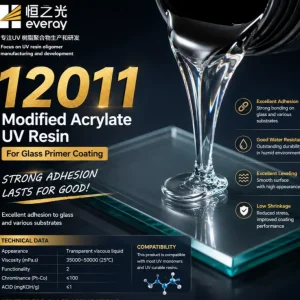
Yes. Untreated glass and polished metals exhibit extraordinarily polar and non-porous surfaces that easily suffer interfacial failure when subjected to moisture or boiling water tests. Standard unmodified epoxy acrylates tend to pull away due to shrinkage stress. Ever Ray's modified series (such as 12011 and 6203F) feature specialized carboxyl, silane, or phosphate groups copolymerized along the backbone. These functional moieties form strong covalent and coordination bonds with inorganic silanol (Si-OH) and metallic oxide matrices, successfully passing standard cross-hatch tape adhesion (ASTM D3359 5B) even after 60-minute boiling water tests.
What are the typical minimum order quantities (MOQ) and packaging choices for export clients?
To accommodate industrial development through to full-scale production, our commercial framework offers three tiers: laboratory pilot evaluation (1kg to 20kg sample pails), pilot scale runs (200kg steel drums), and mass industrial production (minimum 1 FCL, equivalent to 80 drums or 16-18 metric tons in IBC totes / ISO tank containers). Packaging choices include internal epoxy-phenolic coated drums to eliminate metallic iron leaching that could induce pre-gelation.
How do amine synergists and active amines resolve surface tackiness in thin epoxy ink films?
Atmospheric oxygen acts as a powerful free-radical scavenger, reacting rapidly with curing carbon radicals to form unreactive peroxy radicals (ROO•), which causes severe surface tackiness in thin ink layers (1–5 μm). Amino acrylate oligomers and active amine co-initiators contain alpha-amino methylene hydrogens (-CH2-N-). These hydrogens transfer readily to peroxy radicals, regenerating active alkyl radicals that consume oxygen while maintaining rapid radical chain propagation. This ensures a clean, mar-resistant, tack-free surface at high press line speeds.
Performance Oligomer Roster
Advanced Wholesale Resins, Specialty Oligomers & Functional Prepolymers (Batch Series B)
Specialty modified structures engineered for delicate textural effects, flexographic water-ink equilibrium, and boiling-water resistant priming coats.
7600 Multifunctional Polyurethane Acrylate Oligomer
Order Wholesale Batch
6203F Low-Shrinkage High-Adhesion Epoxy Acrylate
Order Wholesale Batch
7317 UV Resin: Wrinkle & Snowflake Special Effects
Order Wholesale Batch
6805A-1 Fast-Cure High-Gloss Modified Epoxy Acrylate
Order Wholesale Batch
High Gloss Fast Curing Modified Epoxy Acrylate Oligomer
Order Wholesale Batch
7913 Anti-Fouling Abrasion-Resistant Urethane Acrylate
Order Wholesale Batch
5403DF Polyester Acrylic Resin for Flexographic Printing
Order Wholesale Batch