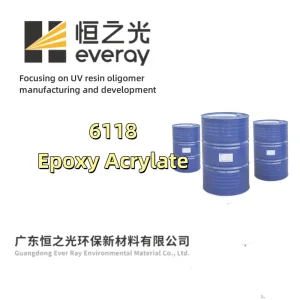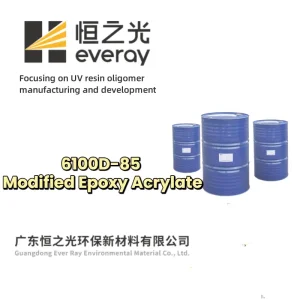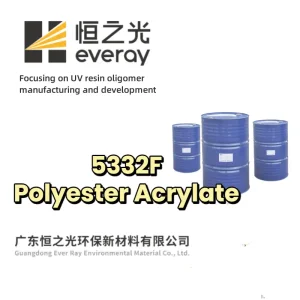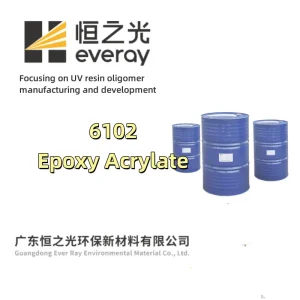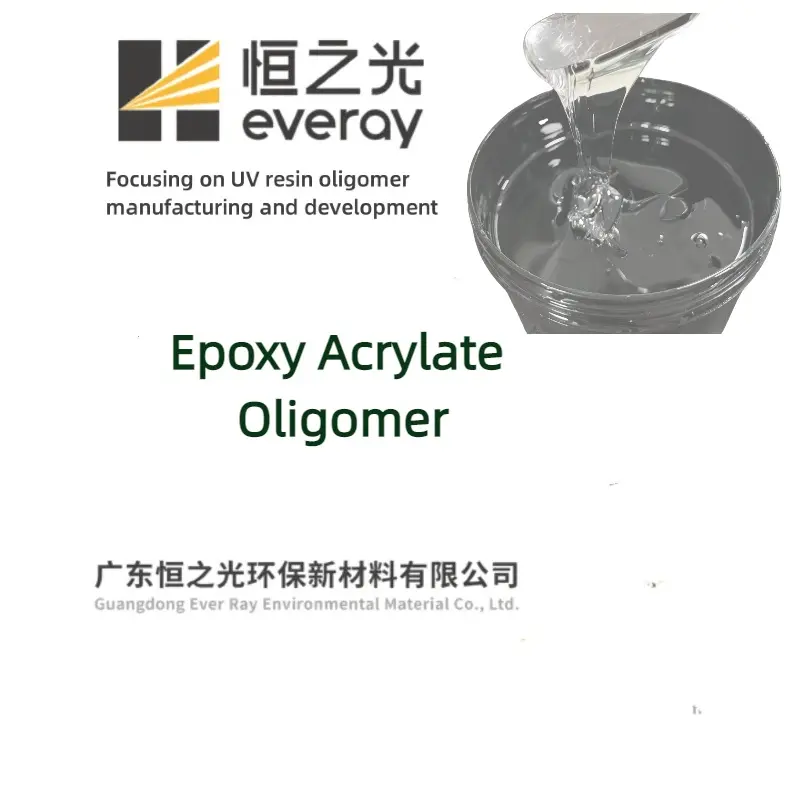
High-Performance Oligomers & 3D Photopolymer Resins
Formulated for extreme dimensional tolerance, thermal stability, ultra-low volumetric shrinkage, and rapid radical-photopolymerization response under standard 385nm - 405nm optical engines.
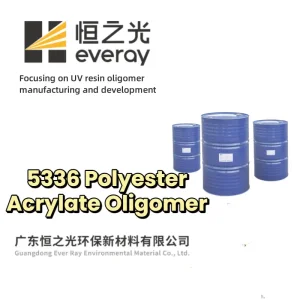
Global Enterprise Procurement Dynamics for 3D Epoxy Systems
The transition from rapid prototyping to end-use volume manufacturing requires radiation-cured epoxies that merge mechanical rigidity, thermal endurance, and exceptional chemical inertness. Guangdong Ever Ray Environmental Material Co., Ltd. addresses the worldwide industrial bottleneck in high-precision additive manufacturing chemistry.
Additive Manufacturing Rigidity
Unlike pure radical acrylate systems prone to severe curing shrinkage and warpage, 3D epoxy formulations utilize modified bisphenol-A or novolac backbones, enabling dimensional tolerances within ±25 microns across wide-format SLA and DLP vat photopolymerization printers.
Thermal & Mechanical Endurance
Demanding enterprise buyers in automotive prototyping, electronics packaging, and aerospace require Heat Deflection Temperatures (HDT) exceeding 90°C–140°C post thermal-cure. Our oligomer architectures guarantee high glass transition temperatures (Tg) and structural integrity.
Scalable Batch Consistency
Operating a dedicated 40,000 m² chemical production base in Yunan County, Yunfu City, Guangdong, Ever Ray enforces automated reactor synthesis protocols ensuring strict control of acid value, viscosity deviations under ±5%, and zero lot-to-lot color drift.
The Chemical Mechanism: Epoxy Acrylate Hybridization in Photopolymerization
In standard UV stereolithography, free-radical polymerization of standard acrylates occurs instantaneously, causing rapid shrinkage stress and micro-cracking. By contrast, wholesale 3D epoxy formulations incorporate ring-opening oxirane rings or epoxy-acrylate hybrids. This mechanism counters chain-length contraction, lowers volumetric shrinkage down to 1.2%–1.8%, and provides superior adhesion to metals, ceramics, and inter-layer polymer boundaries.
Cross-Sector Macro Industrial Solutions
From micro-fluidic semiconductor test fixtures to heavy-duty dental master models and high-clarity overprint barriers, our engineered 3D epoxy resins solve specific industrial challenges.
Microelectronics & Encapsulation
Electronics OEMs require high dielectric breakdown strength, non-conductive reliability, and moisture barriers. Our 3D epoxy resins serve as direct-print isolation jigs, potting barriers, and micro-component test sockets requiring tight dielectric dissipation factors.
Dielectric > 18 kV/mmAutomotive Prototyping & Wind-Tunnel Tooling
Under-the-hood components, aerodynamic air intake manifolds, and lightweight functional assembly jigs demand high flexural modulus (>3,200 MPa) and resistance to fuels, transmission fluids, and thermal cycling between -40°C and 120°C.
Flex Modulus > 3.2 GPaDental Diagnostic & Surgical Guides
High-precision dental labs depend on stable, non-slumping matrices during long-duration vat exposures. Our specialized low-viscosity modified prepolymers ensure sharp margin-line reproduction, crisp margins, and zero embrittlement during post-wash IPA immersion.
Shore D 85-88Industrial Tooling & Rapid Injection Molds
Short-run injection molding requires high compressive strength and low creep. Ever Ray epoxy acrylate grades tolerate repeated clamping pressure and cyclic thermal shock up to 500 low-temperature plastic injection shots without mold face erosion.
Compressive > 110 MPaHigh-Adhesion Wood & Architectural Sealers
By blending low-shrinkage epoxy acrylate oligomers (such as 6100D-85 and 6203F) into roller-coating formulations, architectural coaters achieve immediate sandability within 2 seconds of UV-LED exposure while sealing deep substrate pores against moisture penetration.
Sandability: SuperiorHigh-Definition Screen & Offset Inks
Combining high pigment wetting values with rapid radical responsiveness, our polyester acrylate prepolymers (5335F, 5336) maintain stable rheological rheology, pristine lithographic water-ink balances, and high chemical resistance against alcohol washes.
Viscosity Stability: >12 MoMaterial Performance Comparison: 3D Epoxy vs. Competing Chemistries
A rigorous empirical benchmark demonstrating how Ever Ray modified 3D epoxy formulations balance critical mechanical, rheological, and optical parameters against pure acrylates and standard urethanes.
| Property Parameter | Modified 3D Epoxy Acrylate | Standard Radical Acrylate | Aliphatic Urethane Acrylate | Cationic Hybrid Epoxy |
|---|---|---|---|---|
| Volumetric Shrinkage (%) | 1.2% - 1.8% (Ultra-Low) | 4.5% - 7.5% (High Warpage) | 2.0% - 3.2% (Moderate) | 0.8% - 1.3% (Minimal) |
| Tensile Strength (MPa) | 65 - 85 MPa | 35 - 50 MPa | 45 - 65 MPa | 70 - 90 MPa |
| Flexural Modulus (GPa) | 2.8 - 3.6 GPa | 1.4 - 2.1 GPa | 1.6 - 2.4 GPa | 3.0 - 3.8 GPa |
| Heat Deflection Temp (HDT @ 0.45 MPa) | 95°C - 130°C | 50°C - 65°C | 60°C - 80°C | 110°C - 145°C |
| Viscosity @ 25°C (mPa·s / cps) | 450 - 1,200 (Formulated) | 200 - 600 | 800 - 3,500 | 350 - 850 |
| Oxygen Inhibition Susceptibility | Low to Negligible | Very High (Surface Tacky) | Moderate | Zero (Unaffected) |
| Primary Industrial Utilization | Rigid Engineering Molds, Jigs, High-Build Coatings | Entry Prototyping, Low-Cost Castings | Impact Components, Flexible Shells | Precision Optical & Micro-SLA Assemblies |
Technological Roadmap & Next-Gen Outlook (2025–2030)
As industrial additive manufacturing migrates toward automated production lines and continuous liquid interface printing, Ever Ray's R&D laboratory is pioneering breakthrough molecular platforms to overcome current material thresholds.
Cationic / Radical Dual-Cure Systems
Pioneering hybrid dual-curing networks combining rapid 405nm light-initiated acrylate vitrification with latent thermal-triggered epoxy oxirane ring opening for deep-section polymerization and zero dark-zone cure deficiencies.
Bio-Derived Epoxy Acrylate Prepolymers
Synthesizing sustainable raw materials using itaconic acid derivatives, cardanol, and epoxidized vegetable backbones to deliver high bio-carbon content (>45%) without sacrificing mechanical hardness, glass transition, or chemical resistance.
Nano-Composite Engineered Matrices
Integrating pre-dispersed surface-functionalized silica nanoparticles and carbon nano-tubes directly into the 3D epoxy oligomer matrix to achieve isotropic thermal dissipation and flexural modulus surpassing 5,000 MPa.
Continuous High-Speed Printing Photopolymers
Developing ultra-low viscosity prepolymers (<200 mPa·s at 25°C) optimized for continuous layerless printing speeds reaching 100 mm/hour with minimal mechanical peel-force resistance.
Worldwide Compliance & Localized Technical Support
Enterprise chemical procurement requires verifiable international compliance, transparent raw material supply-chain tracing, and on-site integration assistance.
Global Regulatory Clearance
All wholesale resin grades undergo comprehensive toxicological and environmental analysis to guarantee strict compliance with EU REACH (SVHC declaration), RoHS 3 directives, US TSCA inventories, and regional VOC emission limits.
Export Packaging & Dangerous Goods Logistics
Standardized export packaging formats including 20 kg fluorinated HDPE containers, 200 kg anti-static sealed steel drums, and 1,000 kg IBC totes equipped with climate-buffered pallet wrapping and full GHS-compliant SDS labeling in 12 languages.
Dedicated Formulation Engineering
Our senior chemical formulation specialists assist global formulators and OEM printer manufacturers with spectrum-matching photoinitiator packages, reactive diluent balances, and print setting calibrations (exposure times, cure depth Ec, and Dp calculations).
Frequently Asked Questions on Wholesale 3D Epoxy Systems
Expert chemical answers to technical and supply chain questions encountered by formulators, plant managers, and procurement officers.
Standard commercial 3D resins are predominantly composed of multi-functional acrylic or methacrylic monomers and urethane acrylates. While they cure rapidly, they undergo significant volume contraction (often 4% to 8%), resulting in residual stress, curl deformation, and low thermal tolerance. 3D epoxy resins integrate modified epoxy backbones (such as bisphenol-A diglycidyl ether diacrylates or cycloaliphatic epoxies). This delivers rigid aromatic rings into the crosslinked network, dramatically lowering volumetric shrinkage to 1.2%–1.8%, elevating heat deflection temperatures to >100°C, and improving mechanical dimensional precision.
Yes. While our bulk oligomers are shipped uninhibited or pre-stabilized, our application engineering team formulates complete turn-key photopolymer solutions calibrated for both UV laser (355nm SLA), LED projector (385nm DLP), and LCD screen (405nm mSLA) architectures. We optimize the working curve parameters—critical exposure energy (Ec) and penetration depth (Dp)—using tailored photoinitiator packages (such as BAPO / TPO-L and amine synergists) to prevent light bleeding and optimize Z-axis layer resolution down to 25 microns.
Viscosity stability is critical for commercial formulators. We incorporate proprietary, highly efficient hindered phenol and nitroso-based radical scavengers that prevent thermal pre-polymerization during trans-equatorial ocean freight while maintaining high photo-reactivity once exposed to actinic radiation. Sealed batches exhibit less than a 3% viscosity variation over 12 months under 25°C storage conditions.
We maintain an agile sampling and supply protocol. For research institutes, private labelers, and material testing labs, we provide 1 kg to 5 kg sample evaluation containers accompanied by full Certificates of Analysis (COA) and Technical Data Sheets (TDS). For industrial bulk manufacturing contracts, commercial MOQ starts at 200 kg (1 drum) up to 20-foot full container loads (FCL), with standard dispatch windows within 7 to 14 business days from our Yunfu manufacturing plant.
Specialty Oligomers, UV Acrylates & Functional Monomers
Explore our complete industrial series formulated for scratch resistance, surface tension optimization, substrate adhesion, and specialized manufacturing demands.