
Optically Clear & High-Adhesion Transparent Resin Solutions
Curated industrial-grade photopolymer resins engineered for high optical transparency, low volumetric shrinkage, and rapid curing across glass, plastics, and precision vacuum metalizing substrates.
Modified acrylate resin offering minimal volumetric shrinkage and molecular anchoring for water transfer printing and glass UV coating lines.
Buy Special Modified Acrylate Resin
Engineered 6200D resin system tailored for transparent shadowless bonding adhesives, glass furniture, and crystal assembly with refractive match.
Wholesale 6200D UV-Resin
High-transparency 5403DF polyester acrylic matrix with pigment wetting stability, optimized for high-speed flexo and screen varnishes.
Wholesale 5403DF Polyester Acrylic
Versatile 70250 UV resin grade supporting stereolithography 3D formulations, micro-flow inkjet, and ultra-smooth wood transparent top finishes.
High-Quality 70250 UV-Resin
High-adhesion 6100D-85 epoxy acrylate backbone providing scratch-resistant, crystal-clear film build on high-density substrates and dense timber.
Buy 6100D-85 Epoxy Acrylate
Modified 61163 high-solid low-viscosity resin formulated for solar-resistant, water-clear clearcoats with persistent color stability.
Buy 61163 Anti-Yellowing Resin
Optical varnish grade 5650F delivering specular gloss, deep transparency, and rapid surface cure response under standard mercury or UV-LED lines.
High-Quality 5650F UV Resin
Dual-affinity 1200A UV oligomer designed to anchor cleanly onto non-porous metals, polished alloys, and dense fiberboards without hazing.
High-Quality 1200A UV ResinEngineering Optically Transparent Resins: Polymer Architecture & Chromophore Elimination
A rigorous examination of molecular design, photochemical kinetics, and crosslink density stabilization that define market-leading transparent UV resins.
In modern optical coatings, micro-optics encapsulation, and precision stereolithography, specifying a resin transparent supplier requires far more than evaluating basic liquid clarity. True optical purity in radiation-curable systems is governed by the absence of residual conjugated chromophores, strictly regulated photoinitiator cleavage residues, and the intentional selection of non-crystallizing aliphatic polyol and isocyanate backbones. When radical polymerization occurs under high-intensity ultraviolet (UV) or near-UV light-emitting diode (LED) radiation, traditional aromatic matrices undergo progressive photo-Fries rearrangement and quinoid-type chromophore generation, leading directly to the phenomenon commonly known as thermal and photochemical yellowing (delta E shift).
Ever Ray (Guangdong Ever Ray Environmental Material Co., Ltd., founded in 2006) approaches resin transparency from the atomic scale. By utilizing hydrogenated bisphenol-A epoxy derivatives, cycloaliphatic diisocyanates (such as isophorone diisocyanate - IPDI, and hydrogenated MDI - H12MDI), and hyperbranched polyester polyols, our resin synthesis eliminates inherent UV absorption bands within the 380 nm to 450 nm spectrum. This allows our clear coats, adhesives, and 3D printing resins to sustain total luminous transmission exceeding 92% (ASTM D1003) and a haze value below 0.3%, even when tested under prolonged QUV accelerated weathering (ASTM G154) conditions.
Furthermore, volumetric shrinkage during free-radical acrylic curing represents the primary root cause of internal stress, micro-voiding, and subsequent refractive index inhomogeneities. When an acrylate double bond reacts into a single carbon-carbon covalent link, van der Waals distances transition to shorter covalent distances, yielding volumetric shrinkage of 8% to 15% in standard monomers. Ever Ray mitigates this through custom synthesis of high-molecular-weight aliphatic polyurethane acrylate (PUA) prepolymers and ring-opening functional monomers. These molecular cushions absorb crosslinking contraction, securing substrate interfacial adhesion without inducing birefringence or micro-crack propagation.
Photochemical Equilibrium: Curing Speed vs. Optical Homogeneity
Formulators often face a direct trade-off: accelerating line cure speed typically demands multi-functional acrylates that intensify shrinkage stress and induce optical hazing. Our proprietary oligomer architecture leverages spatial steric hindrance to control reaction exotherm while ensuring over 95% double-bond conversion.
The Strategic Edge of Sourcing Transparent Resins from China Direct Factories
How deep petrochemical clustering, automated DCS reactor synthesis, and rigorous cost-to-performance economics empower international downstream formulators.
Vertical Chemical Supply Integration
Situated in Guangdong’s premier industrial chemistry corridor, our Yunfu production base draws feedstocks—acrylic acid, IPDI, TDI, TMP, and polyether polyols—directly from upstream pipelines. This structural integration eliminates international middleman markups, insulates buyers from monomer spot volatility, and guarantees competitive per-ton pricing.
Automated DCS Process Control
Batch variations represent catastrophic risks for UV clear coats and 3D resin printers. Ever Ray operates 10+ synchronized DCS-monitored reactor systems maintaining reaction exotherms within ±0.5°C. Every synthesis batch undergoes real-time GPC molecular weight tracking, viscometric standardization, and Gardner color calibration (always ≤ 1.0).
Stringent Regulatory & Export Compliance
Global procurement requires frictionless international customs clearance and compliance. Our transparent resin products strictly conform to EU REACH registration, RoHS heavy metal restrictions, and VOC environmental directives. We provide standardized SDS, comprehensive COA per lot, and customized dark-drum packaging tailored for global sea freight.
Industry Development Trends: The Evolution of Radiation Curable Systems (2025–2030)
Anticipating structural shifts toward ultra-energy-efficient LED pinning, bio-based monomer integration, and dual-cure microelectronics bonding.
The global photopolymer and transparent resin marketplace is undergoing radical restructuring driven by energy efficiency standards, halogen-free mandates, and the widespread adoption of narrow-wavelength LED illumination. Historically, traditional UV mercury curing relied on short-wavelength (254 nm, 313 nm) radiation to drive rapid surface cure and overcome atmospheric oxygen inhibition. However, the international phaseout of mercury vapor lamps under the Minamata Convention has compelled chemical manufacturers to design oligomers engineered for long-wavelength (365 nm, 385 nm, 395 nm, and 405 nm) initiation without sacrificing tack-free surface conversion.
Ever Ray leads this paradigm shift through three transformative material strategies:
Amine-Synergized LED-UV Oligomers
Our amino acrylate oligomers incorporate copolymerizable tertiary amine structures that act as perpetual hydrogen donors. When oxygen molecules react with initiating radicals to form unreactive peroxy radicals, our amino backbones abstract hydrogen, regenerating propagating radicals and achieving glass-like surface hardness even in low-dose LED air curing.
Bio-Renewable Carbon Transparent Oligomers
Addressing ESG supply mandates from international electronics and automotive conglomerates, Ever Ray is synthesizing bio-based transparent polyurethane acrylates derived from dimer fatty acids, modified epoxidized vegetable matrices, and cardanol derivatives, achieving up to 45% bio-based carbon content with uncompromised optical clarity.
Dual-Curing Shadowless Systems
In opaque or complex assembly structures such as camera modules, display border sealing, and multilayer 3D microfluidics, light cannot penetrate shadowed cavities. Our hybrid transparent resins merge rapid free-radical UV pinning with secondary moisture or thermal cures, ensuring 100% deep-matrix curing.
Macro Industry Solutions & Localized Application Scenarios
A systematic technical overview matching specific transparent resin families to high-demanding substrate conditions, manufacturing speeds, and mechanical stresses.
| Resin Chemistry Class | Refractive Index (nD) | Volumetric Shrinkage | Shore Hardness / Pencil | Anti-Yellowing (QUV) | Primary Industrial Use Case |
|---|---|---|---|---|---|
| Aliphatic Urethane Acrylate (e.g. 7200F / 7911) | 1.492 – 1.505 | 2.8% – 4.2% | Shore D 70 – 85 (2H – 4H) | Grade 5 (Superior) | 3C electronics covers, automotive instrument lenses, optical disc lacquers, nail gel topcoats. |
| Bisphenol A Epoxy Acrylate (e.g. 6100D / 6805A-1) | 1.530 – 1.555 | 6.5% – 9.0% | Shore D 85 – 92 (4H – 6H) | Grade 2 (Indoor Only) | High-speed roller wood primers, OPV overprint varnishes, high-gloss paper coatings, PCB solder masks. |
| Modified Epoxy Acrylate (e.g. 61163 / 6231) | 1.515 – 1.535 | 4.5% – 6.2% | Shore D 78 – 86 (3H – 5H) | Grade 4 (High) | Screen printing clear coats, vacuum metallization basecoats, scratch-resistant plastic finishes. |
| Polyester Acrylate (e.g. 5403DF / 5311A) | 1.480 – 1.510 | 5.0% – 7.5% | Shore D 65 – 80 (HB – 2H) | Grade 3.5 (Moderate) | UV offset lithographic printing inks, flexographic overprint varnishes, paper foil laminates. |
| Hyperbranched Acrylate Hardcoat | 1.500 – 1.520 | 3.5% – 5.0% | Shore D 90+ (6H – 8H) | Grade 4.5 (High) | Touchscreen anti-scratch covers, optical film hardcoats (TAC/PET), optical molding components. |
Localized Industrial Application Profiles:
1. Consumer Electronics (3C) & Display Enclosures: Mobile devices, wearable displays, and automotive center consoles demand razor-thin optical topcoats capable of resisting 500g steel-wool abrasion, harsh synthetic sebum/sweat exposure, and micro-impacts. Ever Ray's aliphatic urethane acrylate formulations deliver a crosslinked network with elastomeric urethane soft segments that absorb physical deformation, paired with rigid acrylic functional heads that provide superior pencil hardness without delaminating from polycarbonate (PC) or PMMA substrates.
2. High-Precision Additive Manufacturing (SLA / DLP / LCD): In additive manufacturing, transparent photopolymer resins must display exceptionally low formulation viscosity (150–450 mPa·s at 25°C) for rapid layer recoating, alongside razor-sharp critical exposure (Ec) and depth of penetration (Dp) parameters. Our custom 3D resins eliminate unreacted monomer leachables, delivering optical prototypes, clear aligners, and fluidic manifolds with glass-like transparency post-solvent wash and thermal UV post-cure.
3. Vacuum Metallization & PVD Basecoats/Topcoats: In decorative cosmetics packaging and automotive exterior trim, transparent UV resins function as leveling basecoats that seal injection-molded plastics to mirror finishes before aluminum sputtering, and as topcoats protecting the reflective metallic foil. Ever Ray's vacuum plating resins deliver unmatched inter-coat adhesion, thermal cycle stability (-40°C to +85°C), and zero off-gassing under high-vacuum chambers.
Enterprise Procurement Protocol: Criteria for Tier-1 Chemical Buyers
How procurement heads, formulation directors, and technical sourcing managers evaluate and validate bulk transparent resin supply partnerships.
Viscosity Window & Rheological Shelf-Stability
Tier-1 procurement requires narrow batch viscosity tolerance (within ±5% of TDS benchmark) to maintain automated coating and inkjet line calibration. Ever Ray incorporates stabilization packages ensuring zero thermal gelation and less than 3% viscosity fluctuation over a verified 12-month ambient storage profile.
Residual Monomer Stripping & Low-Odor Specifications
For nail cosmetics, food packaging varnishes, and indoor furniture, residual free acrylic acid or harsh monomer vapors are unacceptable. Our synthesis reactors employ multi-stage thin-film vacuum deodorization, driving residual volatile monomer fractions below 500 ppm for safe, low-odor operator environments.
Scalable ODM Custom Polymerization Capability
Global formulators require suppliers capable of scaling custom formulations from 500ml bench trials to 5-ton pilot synthesis and 20-ton continuous commercial production. Ever Ray's dedicated polymer R&D laboratory provides rapid backbone tweaking (molecular weight, branching index, active amine titration) within 10 business days.
Specialty Acrylate Oligomers & High-Performance Resins
Explore our specialized portfolio of fast-curing, wear-resistant, and high-tenacity transparent grades engineered for severe operating environments.
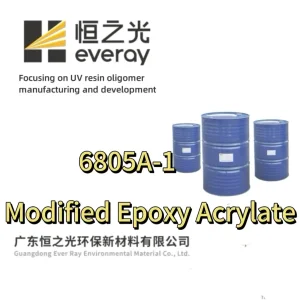
Rapid-cure high-gloss modified epoxy acrylate 6805A-1 tailored for high-speed printing inks, overprint varnishes, and industrial coaters.
Buy 6805A-1 Modified Epoxy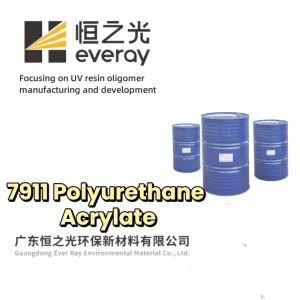
Polyurethane acrylate 7911 delivering structural flexibility, abrasion resistance, and crack resistance for high-end clearcoat formulations.
Wholesale Polyurethane 7911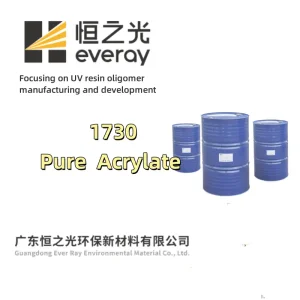
Ultra-tenacious 1730 UV resin providing crystal-clear leveling and adhesion for metal evaporation, plastic metallization, and PVD layers.
High-Quality 1730 UV Resin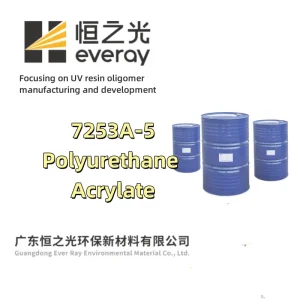
Multifunctional 7253A-5 transparent adhesive oligomer engineered for extreme temperature resistance (-40°C to 120°C) without hazing.
Wholesale 7253A-5 UV Resin
Cost-effective polyester acrylate 5311A offering rapid cure response, film toughness, and brilliant clarity in packaging surface varnishes.
Buy 5311A Polyester Acrylate
Specialty low-exotherm 72583 polyurethane resin designed for heat-sensitive electronic encapsulation, cosmetic gel extensions, and clear finishes.
High-Quality 72583 Resin
Heavy-duty 7200F polyurethane acrylate maintaining non-yellowing clarity and crack resistance across severe environmental weather testing.
Buy 7200F Polyurethane Acrylate
Versatile A150 transparent resin platform engineered for solvent-free UV ink systems, clear graphic lacquers, and substrate adhesion promotion.
High-Quality A150 UV-ResinTechnical Q&A: Troubleshooting Optical Clarity & Resin Performance
Direct answers from Ever Ray’s senior synthesis chemists regarding formulation stability, photoinitiator optimization, substrate adhesion, and yellowing prevention.
How do aliphatic and aromatic polyurethane acrylates compare in optical transparency and outdoor aging?
What is the root cause of hazing and loss of clarity when thick-section transparent UV resins are cured?
How can a formulator resolve poor adhesion and peeling of transparent UV coatings on smooth glass substrates?
What is the function of amino acrylate oligomers in high-speed optical varnish and ink lines?
What documentation and testing standards does Ever Ray provide for global export shipments?
Collaborate with a Leading Transparent Resin Engineering Team
Whether you are developing next-generation optical adhesive bonding systems, anti-scratch electronic finishes, or high-definition 3D photopolymers, our technical team is ready to analyze your substrate and line parameters.
Request Technical TDS & Formulation Samples