
Specialty Photopolymer Resin & Oligomer Formulations (Part I)
Direct factory-synthesized acrylate resins engineered for extreme adhesion, ultrafast cure response, weatherability, and demanding industrial substrate performance.
High Adhesion 6100D-85 Epoxy Acrylate for UV Wood Coating Applications
View Product Specs
Polyester Acrylate 5319A-1 Reliable Solution for High-Performance UV Coatings
View Product Specs
High-Quality Polyester Acrylate 5335F Solution for Offset Inks
View Product Specs
High Abrasion & Yellowing Resistance Modified Epoxy Acrylate Resin 6271
View Product Specs
Waterborne 70601 UV-Resin for 3D Printing, UV-Ink, and Wood-Coatings
View Product Specs
61003A Fast Curing Tough Yellowing Resistant Modified Epoxy Acrylate Resin
View Product Specs
Aromatic PA UV-Resin 7113A for Vacuum-Metallization & Plastic Coating
View Product Specs
Low Viscosity 1262B Polymeric Resin for Commercial PVC Floor Coating
View Product SpecsThe Structural Evolution of Photopolymer Resin Chemistry
Navigating the transition from simple free-radical acrylates to dual-cure, hyperbranched, and cationic hybrid molecular matrices in the global advanced materials industry.
Next-Gen Molecular Architecture
Modern photopolymer systems are moving rapidly beyond standard Bisphenol A derivatives. Formulators demand hyperbranched dendrimers and functionalized aliphatic polyurethane backbones that maximize crosslinking density while suppressing resin viscosity, eliminating the historical trade-off between hardness and brittleness.
LED-UV 365–405nm Reactivity Tuning
With global industrial lines switching from energy-intensive medium-pressure mercury lamps to monochromatic LED curing arrays, chemical factories must tailor absorption spectra via precision photoinitiator synergists, amino acrylates, and tertiary active amines to counter oxygen inhibition and eliminate surface tack.
Zero-VOC & Waterborne Conversions
Stringent regulatory mandates like REACH, TSCA, and regional VOC ceiling restrictions are catalyzing waterborne polyurethane acrylate (WPUA) adoption. High-stability dispersions allow film-forming without toxic reactive diluents, satisfying green building protocols and cosmetic skin-contact benchmarks.
Photopolymer resin formulations represent one of the most chemically intricate segments of the synthetic polymers landscape. At its core, the photo-induced crosslinking mechanism transforms low-viscosity multifunctional oligomers and reactive monomers into highly crosslinked three-dimensional polymer networks within milliseconds. As modern industrial manufacturing scales toward sub-micron stereolithography (SLA), digital light processing (DLP), high-frequency optical lithography, and high-speed roller coatings, the material tolerances expected of photopolymer chemical manufacturers have narrowed significantly.
In conventional radiation curing systems, excessive volumetric shrinkage stress has continuously threatened interlayer adhesion and dimensional accuracy. During ultra-rapid photopolymerization, covalent carbon-carbon double bonds convert to single bonds, drawing molecules from Van der Waals distances into close covalent proximity, yielding volumetric shrinkage rates often between 5% and 12%. Advanced factories solve this challenge through customized macromolecular architectures: synthesizing high molecular weight urethane prepolymers, adopting ring-opening oxetane/epoxy cationic systems, and formulating pure acrylates that exhibit internal strain relaxation mechanisms without compromising post-cure modulus or glass transition temperatures (Tg).
What Global Chemical Buyers Demand from Resin Manufacturers
Procuring UV-curable oligomers and tailored resins demands deep technical vetting to mitigate supply chain volatility, regulatory fines, and production down-time.
Batch-to-Batch Viscosity Consistency
Even minor variations of ±5% in dynamic viscosity can destabilize automated precision coating or 3D printing vat recoaters. Buyers prioritize synthesis plants equipped with continuous viscometric monitoring and closed-loop temperature-regulated polymerization vessels.
Optical Clarity & Anti-Yellowing Index
For consumer electronics (3C housings), clear coats, and dental models, premature degradation is unacceptable. Sourcing directors scrutinize yellowing index test data (Δb* < 1.0 post-accelerated QUV exposure), requiring aliphatic urethane platforms.
Full Regulatory Dossier & Purity
Suppliers must supply comprehensive Technical Data Sheets (TDS), Safety Data Sheets (SDS), and certification regarding monomer residue levels, heavy metal screening, bisphenol content, and conflict minerals to enable friction-free cross-border trade.
Logistical Redundancy & Safe Packing
Photopolymers are sensitive to ambient UV leakage and thermal runaway. Reliable manufacturers use certified light-blocking HDPE drums or IBC containers with integrated temperature-dampening logistics, preventing premature gelation during oceanic transit.
China Industry 4.0: Supply Chain Resilience & Manufacturing Efficiency
How Guangdong Ever Ray Environmental Material Co., Ltd. harnesses intelligent automation, raw material integration, and rigorous QA to guarantee worldwide delivery.
In the contemporary chemical industry, competitive advantage is defined by raw material agility, process precision, and infrastructure compliance. Based in Jiangmen and Yunfu, Guangdong, Guangdong Ever Ray Environmental Material Co., Ltd. (founded in 2006) represents the culmination of Chinese chemical process engineering. Our dedicated 40,000+ square-meter production facility in Dawan Industrial Park features distributed control system (DCS) automated reactors that systematically minimize human error, regulate exothermic radical reactions, and provide full thermodynamic traceability.
The Architectural Advantages of China's Specialty Chemical Cluster
China's Pearl River Delta chemical cluster enables unparalleled manufacturing responsiveness. The proximity to key upstream feedstocks—such as acrylic acid, epichlorohydrin, polyols, and diisocyanates (TDI, IPDI, HDI)—shields Ever Ray's production lines from raw material shortages that often cripple decentralized producers. This deep vertical synergy translates into distinct procurement advantages for international enterprise partners:
- Integrated Upstream Procurement: Direct pipeline and bulk container access to base acrylic reagents mitigates raw material pricing shocks, preserving price predictability for long-term contract formulators.
- Real-Time Process Analytical Technology (PAT): Automated inline infrared spectroscopy and digital viscometers observe degree-of-conversion values during esterification and urethane additions, ensuring identical reaction completion across every ton produced.
- Rigorous Closed-Loop Environmental Operations: Advanced zero-liquid-discharge (ZLD) wastewater facilities and regenerative thermal oxidizers (RTO) guarantee full regulatory compliance under stringent national green production mandates, insulating clients from unexpected factory shutdowns.
- Flexible Custom Chemical Synthesis: In-house R&D labs staffed by senior polymer chemists engineer proprietary oligomers tailored to bespoke parameters—modifying functionality from 1 to 6+, balancing molecular weight distributions, and incorporating unique siloxane or fluoro-moieties.
| Polymer Chemistry Family | Hardness / Modulus | Elongation & Flexibility | Yellowing Resistance | Cure Kinetics | Primary Industrial Domains |
|---|---|---|---|---|---|
| Standard Bisphenol A Epoxy Acrylates | Extreme (4H–5H Pencil) | Low (<5%) | Moderate (Prone to UV shift) | Ultrafast (<0.2s) | Wood sealers, OPV varnishes, heavy paper coatings |
| Aliphatic Polyurethane Acrylates | Balanced (HB–2H) | High (25%–180%) | Superior (Δb* < 0.8) | Fast (Moderate) | 3C electronics, clear coats, optical adhesives, 3D printing |
| Aromatic Polyurethane Acrylates | High (2H–3H) | Medium (10%–45%) | Fair (Pigment safe) | Fast | Industrial flooring, furniture finishing, pigmented inks |
| Hyperbranched Polyesters | High (3H–4H) | Low-Medium | Good | Ultrafast (High function) | Scratch-resistant hardcoats, high-throughput lines |
| Waterborne UV Polyurethane (WPUA) | Moderate (F–H) | High (50%–200%) | Superior (Aliphatic) | Fast (Post-water flash) | Zero-VOC wood, genuine leather, automotive interiors |
Precision Application Engineering Across Strategic Industries
Empowering Tier-1 coaters, ink manufacturers, electronic assemblers, and additive fabrication houses with substrate-optimized molecular matrices.
Additive Manufacturing & Photopolymer 3D Printing
SLA, DLP, and LCD vat photopolymerization require ultra-low viscosities (100–600 mPa.s at 25°C) for smooth recoating and fast settling. Ever Ray synthesizes customized oligomer-monomer matrices that achieve rapid photopolymerization under 405nm light, yield minimal shrinkage, and simulate production ABS, polypropylene, or elastic shoe midsole lattices.
3C Electronics & Consumer Enclosures
Mobile phones, wearable tech, and laptop casings face relentless physical abrasion, skin oils, and cosmetic creams. Our aliphatic polyurethane acrylate families provide exceptional RCA wear resistance (>300 cycles) and cross-hatch tape adhesion (5B) on unprimed polycarbonate (PC), ABS, and PC/ABS alloys.
Automotive Interiors & Optoelectronic Displays
Cockpit touchscreens, optical bonding adhesives (LOCA), and smart instrument clusters demand high transmittance (>99%), low haze, zero dielectric interference, and robust thermal cycle stability (-40°C to +105°C) without delamination or optical yellowing.
High-Traffic Wood & Commercial Flooring
Engineered flooring, luxury vinyl tiles (LVT), and acoustic panels require tough epoxy acrylate sealers that bridge porous grain structures, followed by hyperbranched polyurethane topcoats with aluminum oxide slurries to resist deep scratch indentation and chemicals.
Specialty Photopolymer Resin & Oligomer Formulations (Part II)
Precision-synthesized grades tailored for high tensile elasticity, offset printability, pressure-sensitive adhesion, and tough industrial protective layers.
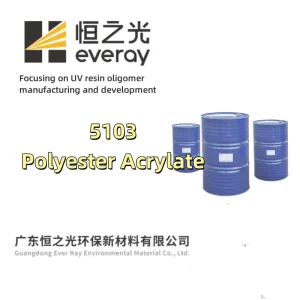
Fast-Reacting 5103 Polyester Acrylate UV Resin for Plastic Coatings
View Product Specs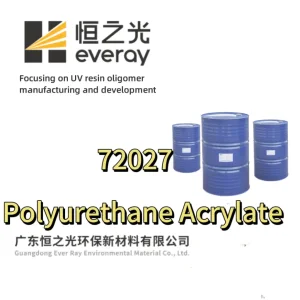
Model 72027 Weather-Resistant Polyurethane Acrylate Resin Low Yellowing PSA
View Product Specs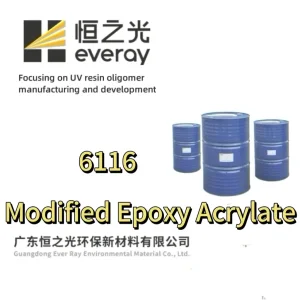
6116 Low Viscosity UV Curing Epoxy Oligomer for Matte Wood & Ink
View Product Specs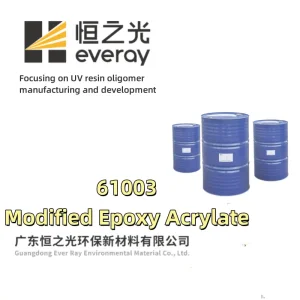
61003A UV Resin in UV Plastic-Film Varnish & LED-UV Packaging
View Product Specs
5338 UV Resin as Functional Oligomer & Active Diluent System
View Product Specs
Polyester Acrylate 5405B Multi-Field High-Efficiency UV Solution
View Product Specs
6803A Modified Epoxy Acrylate Resin High Gloss Fast Curing Oligomer
View Product Specs
High-Quality 7901B UV-Resin for Heavy Industrial Substrate Coatings
View Product SpecsFrequently Asked Questions: Chemical Engineering & Procurement
In-depth technical answers addressing resin selection, double-bond conversion, cure kinetics, and cross-border sample evaluations.
Partner with an Established UV Resin Synthesis Specialist
Whether formulating next-generation LCD 3D printing photoresins, rapid-cure offset flexographic inks, or optical grade electronic coatings, Ever Ray's engineering team provides the polymer architecture and scalable synthesis your factory demands.
