
Core UV Lithographic & Coating Formulations
Engineered for precise rheological control, instantaneous free-radical photo-polymerization, and superior interfacial bonding across metal, paperboard, plastic films, and specialized vacuum-metalized foils.
Executive Overview: Global Offset Printing & Energy-Curable Resins
Modern lithographic offset printing is undergoing a radical chemical and structural transformation. Industrial printing operations are confronted with escalating demands for zero volatile organic compound (VOC) emissions, rapid print-to-finishing cycle times, and uncompromising visual fidelity on non-absorbent synthetic substrates. As high-speed web and sheet-fed presses surpass mechanical throughput speeds of 18,000 to 20,000 impressions per hour, conventional mineral-oil and vegetable-oil oxidative inks are systematically failing to meet operational efficiency benchmarks. The global market has unequivocally shifted toward ultraviolet (UV) and light-emitting diode (LED-UV) offset systems, governed by high-performance acrylate prepolymers.
Guangdong Ever Ray Environmental Material Co., Ltd. (Ever Ray), established in 2006, operates at the convergence of macromolecular synthetic chemistry and industrial print mechanics. In the lithographic process, the fundamental chemical challenge centers around the dynamic water-ink balance (rheological emulsification equilibrium). Offset printing plates simultaneously transfer hydrophobic ink formulations and hydrophilic aqueous fountain solutions. If the primary binding resin exhibits excessive hydrophilicity, uncontrolled ink-in-water emulsification occurs, triggering severe scumming, plate blinding, and dot-gain deterioration. Conversely, excessive hydrophobicity leads to poor ink distribution along the roller train, roller stripping, and inadequate substrate transfer. Ever Ray's dedicated research program has successfully synthesized bespoke polyester acrylates, epoxy acrylates, and urethane acrylates that maintain rigorous viscoelastic integrity and controlled interfacial tension, establishing unprecedented operational reliability across high-speed commercial and packaging presses worldwide.
LED-UV Energy Efficiency
Specially synthesized backbone architectures tailored for 385nm and 395nm wavelength absorption, cutting pressroom electrical power demand by up to 65% compared to mercury vapor lamps.
Zero-VOC & Food Compliance
Complete elimination of aromatic solvents. Fully reactive oligomers with molecular weights exceeding 1,200 Da, minimizing residual photo-cleavage and migratory leachables for sensitive packaging.
Water-Ink Rheology Optimization
Precisely controlled thixotropy index (1.8 to 2.4) ensuring zero misting at 1,500 fpm while preventing dampening solution emulsification over extended manufacturing runs.
Non-Absorbent Substrate Bonding
Modified polar functional acrylate groups guaranteeing cross-hatch adhesion (ASTM D3359 5B) directly over corona-treated BOPP, PET, aluminum foil, and vacuum-metallized SBS.
Material Science Comparison: Lithographic Oligomer Families
Formulating high-performance UV offset inks and overprint varnishes (OPVs) requires a balance of chemical resistance, flexibility, tack, pigment wetting capacity, and curing kinetics. Below is our engineering comparison matrix illustrating how our monomeric and oligomeric chemistries interact across industrial printing environments:
| Polymer Chemistry Family | Tack & Viscosity Profile | Pigment Wetting Capacity | Interfacial Adhesion | LED Curing Reactivity | Primary Lithographic Role |
|---|---|---|---|---|---|
| Modified Epoxy Acrylate (e.g., 6106, 6100D) | High (25,000–45,000 mPa·s @ 25°C) | Excellent on carbon black & cyan | Medium (Paperboard, SBS, Wood) | Ultra-Fast (Surface Curing) | Base grinding varnish, rigid packaging, commercial publication inks |
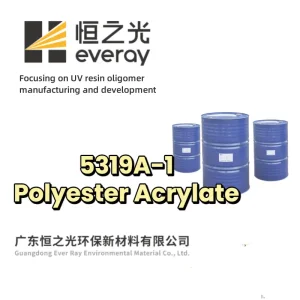
| Chlorinated/Acid Polyester Acrylate (e.g., 5319A-1, 5403-2F) | Medium (8,000–18,000 mPa·s @ 25°C) | Superior across all organic pigments | High (Untreated PET, BOPP, Metal) | High (In-Depth Curing) | Color paste binder, metal decoration printing, flexible label packaging |
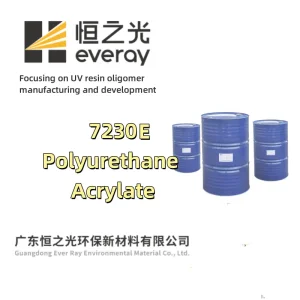
| Aliphatic Polyurethane Acrylate (e.g., 7230E, 7600) | Tunable (10,000–30,000 mPa·s @ 25°C) | Moderate to High | Maximum (Vacuum foil, PC, PP) | Balanced (Non-yellowing) | High-end cosmetic folding cartons, vacuum-plated foils, outdoor durability |
| Hyperbranched & Amino Acrylates (e.g., 7913, Amino series) | Low to Medium (1,500–5,000 mPa·s @ 25°C) | High wetting & low yield stress | Broad spectrum chemical anchor | Exceptional (Overcomes Oxygen Inhibition) | Ultra-high line speed OPVs, matte soft-touch coatings, LED print enhancement |
Localization Support, Compliance & Analytical Verification
Industrial offset packaging converters in North America, the European Union, and the Asia-Pacific region are governed by increasingly stringent international safety and environmental mandates. Ever Ray integrates regulatory testing directly into the molecular development lifecycle:
EU REACH & SVHC Free
Every raw material batch undergoes gas chromatography-mass spectrometry (GC-MS) verification ensuring zero presence of persistent organic pollutants or SVHC candidates.
Swiss Ordinance & Nestlé Guidance
Low-migration chemistries specifically synthesized with high functional crosslinking architectures to eliminate photo-byproduct migration in secondary food packaging.
Direct Local Technical Support
Formulation labs equipped with Laray viscometers, inkometers, and tack-testers provide rapid color matching, fountain-solution compatibility tests, and on-site troubleshooting.
Precision End-Use Scenarios in Industrial Offset Lithography
From rigid luxury packaging to continuous high-speed web printing, Ever Ray UV resins deliver tailored chemical mechanics adapted to specific regional press hardware.
Luxury Cosmetics & Liquor Packaging
Utilizing our 7230E and 2600UV formulations, converters achieve glass-like gloss (>95 GU at 60°), extreme abrasion durability during transit, and flawless hot-stamping receptivity over vacuum-metallized paperboard and holographic films.
Excimer Laser Soft-Touch Finishes
By implementing 53036 polyester acrylate, formulators achieve dead-matte effects (<3 GU at 60°) through 172nm excimer laser surface micro-folding without utilizing silica matting agents, yielding scratch-proof, stain-repellent, skin-feel carton coatings.
Metal Decoration & 3-Piece Can Lithography
Formulated using our flexibilized 5403-2F, offset inks withstand severe mechanical deformation, drawing, and necking processes on tinplate and aluminum sheets without micro-cracking, flaking, or post-baking discoloration.
High-Speed Commercial Publishing & Labels
Employing 6106 modified epoxy acrylate ensures instant curing response under LED pin-curing lamps across web-offset commercial presses running up to 800 m/min, preventing offset ink set-off, ghosting, and rub-off.
Technical Roadmap (2026–2030): Next-Generation Lithographic Polymers
Ever Ray’s polymer development laboratory in Yunfu is actively scaling breakthrough chemistry platforms designed to address emerging technological hurdles in industrial printing:
Photo-Thermal Dual-Curing Systems
Advancing our 72017 series dual-cure oligomers, allowing shadowed or high-density pigmented ink layers to cure completely via a secondary thermal mechanism, eliminating uncured monomer residues.
Bio-Based Sustainable Acrylates
Incorporating up to 45% bio-renewable carbon content from non-food agricultural feedstocks into polyester acrylate backbones without compromising glass transition temperature or ink tack stability.
Low-Energy LED Wave-Matching
Synthesizing novel tertiary amine synergists and hyperbranched acrylate prepolymers engineered specifically for 405nm low-intensity diode arrays, eliminating nitrogen inerting blankets in carton lines.
Dual-Curing, Functional & High-Elasticity Resins
Engineered for specialized lithographic printing, 3D photopolymer processing, anti-fouling overprint barriers, and ultra-high-definition industrial ink formulations.
Offset Lithography & UV Oligomer Formulation FAQs
Direct formulation troubleshooting and chemical guidelines addressing complex pressroom interactions, curing mechanics, and regulatory compliance.
How does polyester acrylate chemistry govern the ink-water balance on an offset press?
Polyester acrylates feature polar ester linkages and controlled carboxylic end-group concentrations. This unique macromolecular structure dictates interfacial tension against acidic or alkaline fountain dampening solutions. An optimized polyester acrylate like 5403-2F prevents excessive emulsification (water absorption held strictly under 18–22%), preventing plate blinding, ink roller stripping, and dot gain distortion during long runs.
Why is 7230E preferred for vacuum-metalized paper and plastic substrate offset printing?
Polyurethane acrylate 7230E utilizes a tailored aliphatic urethane backbone modified with specific adhesion promoters. During ultra-rapid UV polymerization, traditional acrylates suffer volumetric shrinkage rates up to 8–12%, which shears adhesive bonds at smooth non-porous interfaces. 7230E limits volumetric curing shrinkage to below 3.5%, preserving high mechanical anchoring and delivering 5B cross-hatch adhesion over vacuum-metallized layers.
How do amino acrylates mitigate atmospheric oxygen inhibition in thin offset ink films?
Atmospheric triplet oxygen readily quenches free radicals generated during photo-cleavage, yielding unreactive peroxy radicals that cause surface tackiness and incomplete curing in 1.5–2.5 micron lithographic ink films. The secondary and tertiary amino groups within our amino acrylate oligomers donate hydrogen atoms, rapidly regenerating reactive alkyl radicals while converting peroxy radicals into stable hydroperoxides, ensuring tack-free curing at maximum web speeds.
What is the mechanism behind 53036 polyester acrylate in excimer laser skin-feel coatings?
53036 is specifically synthesized to exhibit a steep curing gradient under 172nm vacuum ultraviolet excimer irradiation. The ultra-short wavelength photons possess a tiny penetration depth (<0.5 μm), curing only the top molecular skin. The contraction of this top skin over the still-liquid underlying resin causes micro-wrinkling. A subsequent medium-pressure mercury or LED lamp cures the bulk film, resulting in a permanent soft-touch matte finish without matting agents.
How do dual-curing resins (e.g., 72017) resolve curing depth issues in high-density pigmented inks?
High-opacity offset formulations, particularly opaque whites, dense carbon blacks, and metallic gold pastes, attenuate UV and LED photon transmission. Our 72017 series combines a free-radical acrylate photo-polymerization network with a secondary blocked thermal isocyanate or latent epoxy curing mechanism. The initial light exposure sets the print to eliminate set-off, while residual thermal activation completes crosslinking throughout the film depth.
What storage protocols ensure the operational shelf-life stability of Ever Ray UV resins?
Acrylate double bonds are sensitive to unintentional thermal free-radical generation and anaerobic premature gelation. All UV prepolymers should be stored in original high-density polyethylene (HDPE) containers at temperatures between 15°C and 25°C. Containers must maintain an air headspace containing atmospheric oxygen, which acts as a necessary co-stabilizer alongside the added phenolic inhibitors. Prevent direct exposure to sunlight or actinic warehouse lighting.
