
High-Performance Engineering Resins & Reactive Oligomers
Precision-synthesized for UV/EB curing coatings, functional electronics, optical bonding, and high-precision additive manufacturing.
Redefining Polymer Crosslinking: The Engineering Frontier of Radiation-Cured Oligomers
A systematic analysis of macromolecular engineering, volumetric shrinkage mitigation, and interfacial adhesion mechanics across advanced polymer matrices.
In modern chemical synthesis and material science, the nomenclature surrounding engineering plastic resins has expanded far beyond traditional thermoplastically processed granules (such as polyamides, polycarbonates, or polyphenylene sulfides). In the contemporary manufacturing landscape, liquid-state photo-curable engineering plastic resins—predominantly composed of functionalized polyurethane acrylates (PUA), modified bisphenol-A epoxy acrylates, dendritic hyperbranched polyesters, and specialized cyclic acrylate monomers—serve as the indispensable baseline for high-precision coatings, optical films, vacuum metallization topcoats, and direct additive industrial manufacturing.
Founded in 2006, Guangdong Ever Ray Environmental Material Co., Ltd. (Ever Ray) has anchored its industrial mandate on solving critical interfacial boundary failures. Standard industrial formulations consistently face trade-offs between crosslink density, glass transition temperature (Tg), cure conversion rates, and curing shrinkage stress. High functionality accelerates polymerization kinetics and elevates pencil surface hardness to 4H–6H levels; however, intense free-radical shrinkage (often exceeding 6% to 9% volumetric contraction) inevitably induces micro-cracking, delamination from inert substrates (like unprimed polypropylene, cyclic olefin copolymers, and tempered glass), and optical birefringence artifacts.
Steric Hindrance & Low Shrinkage
By grafting bulky alicyclic structures and flexible polyether-carbonate segments into the oligomeric backbone, Ever Ray effectively suppresses radical volumetric contraction below 1.8%, ensuring micro-gap dimensional stability in optical assemblies and micro-fluidic tooling.
Photopolymerization Kinetics
Incorporating amine-functionalized synergists and excimer-laser reactive end groups overcomes atmospheric oxygen inhibition. Thin-film varnishes achieve complete surface double-bond conversion (>96%) at web speeds exceeding 80 meters/minute under standard UV LED/Hg arcs.
Interfacial Mechanical Anchoring
Specialized functional oligomers leverage polar carboxyl, phosphoric acid, and alkoxysilane coupling groups to generate chemical covalent bonds across metals, high-density fiberboards, and difficult polyolefins, passing 100/100 cross-hatch tape adhesion tests effortlessly.
Macro-Industrial Engineering Solutions Across High-Reliability Sectors
Bridging synthetic macromolecular physics with Tier-1 manufacturing requirements in automotive, telecommunications, micro-optics, and digital health.
Automotive Electronics & Lidar
Tier-1 cockpit displays, optical polycarbonate lens assemblies, and automotive sensors require coating systems capable of surviving intense thermal cycling (-40°C to +125°C) and aggressive exposure to chemical cleaning solvents, gasoline, and artificial sweat.
Consumer 3C & Vacuum Metallizing
Smartphones, smartwatches, and ultra-thin laptop chassis rely on PVD vacuum sputtering on polycarbonate/ABS. Resins must provide extreme surface gloss, zero outgassing in high-vacuum chambers, and flawless intercoat adhesion for metallic topcoats.
High-Speed Graphic Inks & Packaging
Industrial flexographic and offset print lines running at 100+ m/min demand near-instantaneous radical curing, high pigment wetting without thixotropic breakdown, and precise lithographic ink-water balance without plate emulsification.
Additive Manufacturing & Elastomers
Industrial SLA, DLP, and LCD resin formulations for functional lattice structures, orthodontic aligners, and footwear midsoles. Requires dual-curing mechanics delivering >350% tensile elongation and fatigue resilience exceeding 200,000 flex cycles.
| Resin Classification | Viscosity (mPa.s @ 25°C) | Functionality (f) | Tg (°C) | Elongation at Break (%) | Target Engineering Substrate |
|---|---|---|---|---|---|
| Standard Bisphenol A Epoxy Acrylate (9105M-80) | 15,000 – 25,000 | 2.0 | 65 | 4.5% | Wood sealers, paper overprint varnish, rigid ABS |
| Aliphatic Polyurethane Acrylate (3-Functional) | 8,000 – 14,000 | 3.0 | 42 | 38% | Polycarbonate, optical films, non-yellowing 3C |
| Aromatic Polyurethane Acrylate (7296-1) | 20,000 – 35,000 | 6.0 | 85 | 8% | Heavy-duty parquet flooring, impact tooling |
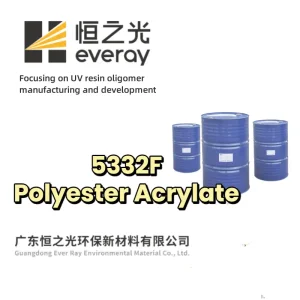
| Low-Viscosity Polyester Acrylate (5332F) | 400 – 1,200 | 4.0 | 35 | 15% | UV offset lithography, fast pigment grinding |
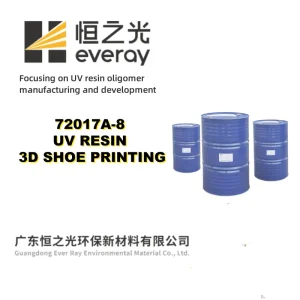
| Dual-Curing Photopolymer Elastomer (72017A-8) | 1,200 – 2,500 | Specialized | -15 | 380% | 3D printed footwear midsoles, dampening gaskets |
| Excimer Matte Polyester Acrylate (53036) | 3,500 – 6,000 | 2.5 | 28 | 45% | 172nm excimer soft-feel skin finishes, anti-glare |
Engineering Plastics Technology Roadmap & Photopolymer Horizons
Pioneering molecular architectures to address the stringent environmental, optical, and thermal boundaries of next-decade industrial production.
1. Dual-Cure Hybrid Crosslinking
Addressing deep shadowing in complex 3D engineering geometries. Ever Ray is formulating dual-path crosslinking systems combining primary UV photopolymerization (securing micro-second green strength) with secondary thermal, moisture, or anaerobic epoxy-polyaddition curing, eliminating uncured toxic resin residuals in automotive electronic potting.
2. Excimer 172nm Micro-Folding
Conventional physical matting agents (silica, waxes) compromise coating transparency, viscosity stability, and scratch resistance. Ever Ray's excimer-reactive polyester acrylates (such as grade 53036) achieve spontaneous micro-wrinkling under 172nm excimer lamps, producing a deep-matte (<3 GU at 60°), soft-touch skin finish with extraordinary self-healing resilience.
3. Bio-Based Circular Feedstocks
Targeting Scope 3 emission mandates for global Fortune 500 partners, our synthetic chemists are synthesizing functional acrylates derived from vegetable polyols, cardanol, and itaconic acid derivatives. These next-gen oligomers offer up to 45% certified renewable carbon content while maintaining optical clarity and parity in pencil hardness.
Critical Scientific Insight: Oxygen Inhibition Mitigation in LED-Curing Lines
As industrial conversion lines transition from energy-intensive medium-pressure mercury arc lamps to monochromatic UV LED systems (365nm, 385nm, 395nm), surface tackiness caused by atmospheric triplet oxygen quenching of excited radical states has become the single largest yield obstacle. Ever Ray addresses this fundamental thermodynamic limitation by structurally synthesizing active copolymerizable amine acrylates directly into oligomer backbones, which donate secondary α-amino hydrogen atoms to immediately regenerate reactive peroxy radicals into stable inert amine hydroperoxides.
China Factory 4.0: Supply Chain Resilience, Automation & Batch Repeatability
How Guangdong Ever Ray operates a fully closed-loop, DCS-automated synthesis facility in Yunfu, Guangdong to guarantee global delivery security.
For multinational procurement directors, material qualification hinges not merely on laboratory sample feasibility, but on uncompromising batch-to-batch repeatability across multi-ton production volumes. Variations in oligomer polydispersity index (PDI), residual acid value, or trace water content can destabilize downstream ultraviolet formulations, inducing unpredictable viscosity drift, nozzle clogging in 3D jetting systems, or phase separation in storage silos.
At Ever Ray’s 40,000-square-meter modern production facility in Dawan Industrial Park, Yunfu, synthesis operations are governed by an advanced Distributed Control System (DCS). Reaction parameters—including fractional feeding velocities, exotherm cooling curves, nitrogen purge purity, and esterification dehydration states—are recorded and regulated in real time.
Closed-Loop Synthesis Reactors
10+ automated stainless steel reaction vessels ranging from 5-ton pilot scale to 30-ton continuous synthesis. In-line viscometers and Fourier-Transform Infrared (FTIR) probes continuously track acrylic double-bond conversion indices.
Rigorous Raw Material Upstream Control
Dual-sourcing strategic alliances for critical building blocks—including isophorone diisocyanate (IPDI), hexamethylene diisocyanate (HDI), bisphenol-A diglycidyl ethers, and acrylic acid—insulate overseas clients from global supply chain choke points.
Automated Packaging & Purge
Every drum (200kg) and IBC tote (1,000kg) undergoes automated nitrogen purging and precision filtration down to 1.0 micron, preventing micro-particulate contamination essential for high-precision optical grade coatings and electronics.
Localization Support, Regulatory Compliance & EHS Assurance
Ensuring frictionless international trade, local chemical inventory registration, and rigorous environmental stewardship across every export destination.
REACH & TSCA Full Dossier Compliance
All Ever Ray export grades comply with the European Union's REACH regulation (EC 1907/2006) and the United States Toxic Substances Control Act (TSCA). Complete Only Representative (OR) certification guarantees uninterrupted chemical importation for European formulators.
RoHS, Halogen-Free & VOC Eradication
100% reactive solids formulations generate zero volatile organic compound (VOC) emissions during line curing. Rigorous third-party ICP testing validates non-detectable levels of heavy metals (lead, cadmium, mercury) and restricted phthalate plasticizers.
Dedicated Field Application Engineering (FAE)
Language-fluent senior polymer chemists provide comprehensive remote and on-site technical support. From starting point formulation guidance to curing troubleshooting (oxygen inhibition, orange peel defects, micro-cracks), we bridge the gap from resin drum to active manufacturing line.
Enterprise Procurement Protocol & Custom Oligomer Synthesis Lifecycle
A structured 5-stage collaborative engagement model designed for enterprise R&D groups, Tier-1 system formulators, and global sourcing directors.
Technical Needs Profiling
Comprehensive review of target substrates (plastics, glass, metals), lamp emission spectra (UV LED vs. Gallium/Mercury), web line speeds, target crosslink flexibility, solvent resistance, and regulatory boundary conditions.
Macromolecular Design & Screening
Synthesis of bench-scale trial variants (500g - 2kg). Chemists fine-tune backbone polyols, isocyanate isomer ratios, and reactive diluent matrices to nail target viscosity and tensile performance curves.
Application Testing & Free Sample Dispatch
Full laboratory characterization accompanied by comprehensive Technical Data Sheets (TDS), Safety Data Sheets (SDS), and Starting Point Formulations dispatched globally via express air-freight courier.
Pilot Scale-Up & Audit
Pilot reactor batches (500kg - 2 Tons) validating thermal exotherm control, yield stability, filtration throughput, and packaging hermetic sealing under rigorous customer Quality Assurance audit frameworks.
Continuous Mass Production & Supply Security
Full commercial production ramp-up with guaranteed safety stock warehousing, batch retention samples stored for 24 months, and long-term supply price hedging contracts for strategic partners.
Frequently Asked Technical & Sourcing Inquiries
Direct answers from our senior chemical synthesis engineers regarding oligomer performance, formulation optimization, and international logistics.
What is the key molecular structural difference between aliphatic and aromatic polyurethane acrylate oligomers?
How do Ever Ray's engineering acrylates resolve shrinkage-induced delamination on untreated polyolefins and PC/ABS?
What mechanism allows 172nm excimer-reactive acrylates to create ultra-matte, soft-touch surfaces without matting powders?
How does Ever Ray ensure batch-to-batch consistency for critical export orders?
Can Ever Ray supply custom chemical formulations and small-batch pilot samples for proprietary R&D projects?
Advanced Curable Resins, Reactive Diluents & Synergists
Engineered for high line-speed graphic printing, excimer laser finishing, dense primer adhesion, and extreme wear applications.
Empower Your Formulation With Ever Ray Polymer Innovation
Connect directly with our senior application chemical engineers. Accelerate formulation testing with customized oligomer evaluations, comprehensive regulatory dossiers, and competitive factory-direct supply contracts.
