Featured UV Acrylate Resins: High Purity, Fast Kinetics & Resilient Mechanicals
Engineered to eliminate volumetric shrinkage, prevent photo-thermal yellowing, and maximize intercoat adhesion across sensitive plastic, exotic wood, and metal substrates.
Global Acrylic Resin Market: Chemistry Evolution, Supply Resilience & Modern Economics
A comprehensive industrial white paper examining the global supply chain, regional consumption patterns, and the unstoppable transition from thermal-cured systems to 100% reactive radiation oligomers.
Market Valuation & Growth Vectors
Valued at over USD 22.4 billion globally, specialty acrylic resin derivatives are projected to expand at an annual CAGR exceeding 6.4% through 2032. Growth is disproportionately commanded by energy-cured acrylated oligomers, replacing classical alkyds and polyurethanes across industrial assembly lines in Asia-Pacific, North America, and Europe.
Regulatory Compliance Pressures
Mandates such as EU REACH Annex XVII revisions, China's strict GB 30981-2020 low-VOC standard, and US EPA Clean Air Act Title V enforce sub-100 g/L VOC caps. Industrial formulators are migrating en masse to solvent-free reactive acrylate systems that completely react into the polymer matrix upon exposure to photons, leaving virtually zero volatile footprint.
Supply Chain Consolidation
Geopolitical disruptions have revealed severe supply vulnerabilities in glacial acrylic acid (GAA), methyl methacrylate (MMA), and specialty polyols. Resilient downstream processors now require backward-integrated synthesis partners capable of stabilizing monomer purity, isomer ratios, and inhibitor dosing across multi-thousand-ton batches.
Acrylate Oligomer Backbone Mechanics: Navigating Trade-Offs in Film Dynamics
Formulators must navigate the inverse correlation between glass transition temperature (Tg), crosslink density, volumetric curing shrinkage, and ultimate tensile elasticity.
Epoxy Acrylates (EA)
Synthesized via esterification of Bisphenol-A diepoxide with acrylic acid. Delivers maximum surface hardness (pencil hardness up to 4H-5H), extreme chemical impermeability, and unmatched cure velocity. Best suited for cost-effective wood sanding sealers, paper overprint varnishes (OPV), and rigid PVC floor primers.
Aliphatic Urethane (PUA)
Constructed from IPDI/H12MDI aliphatic diisocyanates and functional polyols. Exceptional resistance to outdoor UV photo-oxidation (zero yellowing over 2,000h QUV test), high elongation at break (30% to 150%), and crack-free flexibility. The premier standard for automotive clearcoats, consumer electronics (3C), and cosmetic nail gel topcoats.
Polyester Acrylates (PEA)
Formulated with hydroxyl-terminated branched polyester backbones. Exhibits exceptionally low resin viscosity and superior pigment wettability. Crucial for offset, screen, and flexographic printing inks where precise rheological shear-thinning and stable water-ink chemical balance are required on modern presses.
Hyperbranched Acrylates
Dendritic globular architecture packed with high acrylate terminal functionality (up to 8 to 16 functional groups per macromolecule). Bypasses the classic Flory-Fox viscosity barrier, generating ultra-dense crosslinked matrices with supreme mar/scratch defense at very low application viscosities.
Polymer Chemist's Rule of Formulating Balance
In radiation-curable coatings, increasing crosslink density increases surface hardness and solvent resistance, but escalates volumetric polymerization shrinkage—often generating internal stresses exceeding 12 MPa. This causes micro-cracking and loss of peel strength on non-porous metals or cyclic olefin plastics. The Ever Ray engineering approach utilizes steric molecular modification and soft polyester/polyether inner blocks to absorb shrinkage stress internally.
| Oligomer Chemical Family | Surface Hardness | Elongation / Flexibility | Anti-Yellowing (QUV) | Curing Velocity | Shrinkage Control | Target Substrate Class |
|---|---|---|---|---|---|---|
| Bisphenol-A Epoxy Acrylate | Hardwoods, Paper, Treated Sheet Metal | |||||
| Aliphatic Urethane Acrylate | ABS, PC, PMMA, TPU, Metallic Foils | |||||
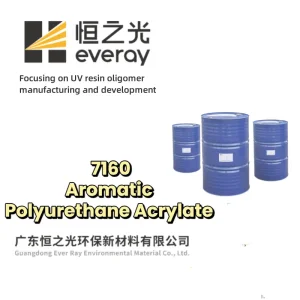
| Aromatic Urethane Acrylate | PVC Floor Tile, Heavy-Traffic Parquet | |||||
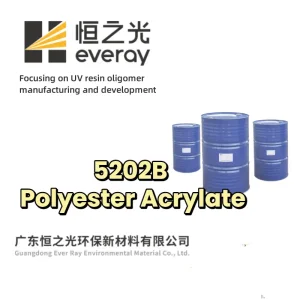
| Polyester Acrylate (Multifunctional) | Offset Inks, Flexographic Inks, OPV | |||||
| Hyperbranched Acrylate | Anti-Scratch Optical Topcoats, 3D Hardresins | |||||
| Waterborne Polyurethane Acrylate (WB PUA) | Open-Pore Wood, Natural Leather, Thin Foils |
Technological Frontiers: LED-UV Transformation, Bio-Based Resins & Dual-Cure
Examining the core research directions redefining industrial coatings and functional photopolymer resins across the next decade.
LED-UV Narrow-Band Curing Kinetics
Traditional medium-pressure mercury arc lamps (broad spectrum 200–450 nm) are being retired under the UN Minamata Convention. Formulators must adapt to monochromatic 365 nm, 385 nm, 395 nm, and 405 nm LED sources. Ever Ray designs acrylate backbones paired with proprietary amino synergists and tailored surface activity to overcome oxygen inhibition under long-wave LED photons.
Bio-Based Renewable Carbon Stocks
Accelerating the integration of bio-derived itaconates, modified soybean oil acrylates, Cardanol bio-phenols, and isosorbide polyols into resin backbones. Ever Ray's next-generation green oligomers achieve a certified renewable carbon index (RCI) between 35% and 65% while matching or outperforming conventional petroleum-derived prepolymers in weathering resistance.
Dual-Curing (UV + Moisture/Thermal)
Complex geometries, three-dimensional electronic modules, and opaque pigmented systems suffer from "shadow zones" where UV photons cannot penetrate. Ever Ray leads research in hybrid dual-cure polymers: primary UV radical polymerizations provide instantaneous handling green strength, followed by secondary thermal or moisture isocyanate post-curing for deep shadow regions.
Molecular Narrow PDI
Minimizing polydispersity index (PDI < 1.8) via controlled free-radical and catalytic transesterification, delivering repeatable Newtonian flow properties.
In-Chain Amine Synergists
Covalently reacting tertiary amines directly into the acrylic backbone to eliminate atmospheric oxygen quenching without yellowing or extractable odor.
Colloidal Nano-Silica Grafting
Direct chemical bonding of 20nm surface-functionalized silica particles to acrylate terminals, achieving optical clarity with 6H pencil scratch thresholds.
De-Crosslinkable Networks
Introducing dynamic covalent chemistries (Diels-Alder bonds or ester linkages) enabling chemical recycling of cured composite structures.
Industrial Application Scenarios: Engineered Performance in the Field
Case-verified formulations engineered around concrete manufacturing challenges—from vacuum metalizing on automotive consoles to high-speed offset printing presses.
3C Consumer Electronics & Optics
Target Substrates: Polycarbonate (PC), PMMA, ABS, Cyclic Olefin Copolymers (COP).
Formulation Hurdle: Balancing extreme anti-scratch resistance against RCA tape abrasion (>300 cycles) while preventing micro-fissuring during rapid CNC machining and drop-impact tests.
Ever Ray Chemistry: Specialized aliphatic PUA blended with hyperbranched acrylates. Yields pencil hardness >3H with high optical transparency (>92% transmission) and robust sweat/cosmetic lotion immersion stability.
Automotive Interiors & Vacuum Plating
Target Substrates: Molded ABS components, PVD aluminum coatings, alloy trim.
Formulation Hurdle: Physical vaporization vacuum metalizing requires primer coatings with outstanding leveling to avoid pinholes, zero outgassing under deep vacuum (10⁻³ Pa), and zero delamination of the top metallized layer.
Ever Ray Chemistry: 7230E series polyurethane acrylate prepolymers engineered with reactive adhesion promoters for flawless metallic luster and cross-hatch peel resistance (ISO Class 0).
Engineered Wood & Resilient PVC Flooring
Target Substrates: Solid oak parquet, SPC rigid core flooring, luxury vinyl tile (LVT).
Formulation Hurdle: Industrial roll-coater line speeds exceeding 40 m/min require rapid sandability within 1.5 seconds of UV exposure, combined with Taber abrasion survival exceeding 6,000 cycles.
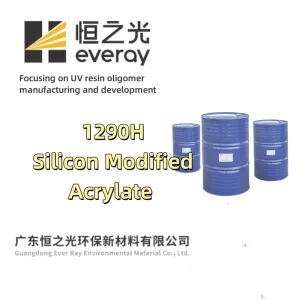
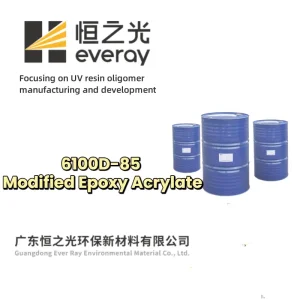
Ever Ray Chemistry: Fast-curing epoxy acrylates combined with aromatic PUAs (1290H & 6100D-85). Imparts superior stone-chip resistance, high elastic recovery, and zero edge curling.
Graphic Arts, Packaging & Overprint Varnishes
Target Substrates: Corona-treated polypropylene, metallic paperboard, blister foils.
Formulation Hurdle: Lithographic offset inks require delicate hydrophilic-lipophilic balance (HLB) to prevent ink emulsification in fountain solutions while running at 15,000 sheets/hour.
Ever Ray Chemistry: 5403DF and 5218 polyester acrylate oligomers. Unrivaled pigment grind wetting, sharp dot-gain reproduction, and rapid curing even when printing dense black and yellow inks.
Additive Manufacturing & Photopolymer 3D Resins
Target Technologies: Stereolithography (SLA), DLP, and High-Speed LCD 3D printers.
Formulation Hurdle: Requires low uncured viscosity (<350 mPa.s at 25°C), exceptional critical exposure speed (Ec), minimal z-axis overcure, and high heat deflection temperatures (HDT > 80°C).
Ever Ray Chemistry: Low-viscosity pure acrylates formulated with modified monomers, yielding toughness and impact strength comparable to injection-molded ABS and polypropylene.
Optically Clear UV Structural Adhesives
Target Substrates: Chemically strengthened glass, indium tin oxide (ITO), stainless steel.
Formulation Hurdle: Extreme shear stress build-up in bonded components during thermal shock (-40°C to +105°C), leading to hazing, bubbles, or catastrophic bond delamination.
Ever Ray Chemistry: Low-shrinkage, elastic 1762 adhesive oligomers providing refractive index matching (nD 1.48–1.52), deep anti-yellowing, and structural lap shear strength >15 MPa.
Holistic Industrial Solutions: Reducing Total Cost of Ownership (TCO)
How high-purity acrylic resin chemistry transforms the bottom line of modern high-output manufacturing plants.
90% Energy Footprint Reduction
Replacing 60-meter thermal hot-air drying ovens with high-efficiency UV LED arrays shrinks line footprint by 80% and electricity consumption by up to 90%. Ever Ray's rapid-setting oligomers cure instantly upon sub-second radiation exposure, unlocking immediate stacking and packing.
Zero Solvent Abatement Capital Cost
100% reactive non-solvent formulations completely eliminate the need for expensive Regenerative Thermal Oxidizers (RTO) and complex carbon adsorption beds. This saves millions in capital expenditure and shields manufacturers from volatile solvent carbon-emission penalties.
Batch Repeatability & Traceability
Through fully automated closed-loop synthesis systems at our Yunfu chemical park base, every batch undergoes digital monitoring of acid value, viscosity, refractive index, and residual free acrylic acid (<0.1%), ensuring zero line-stoppage variations for downstream compounders.
Frequently Asked Technical Questions: Formulations & Procurement
Direct, science-backed guidance compiled by senior formulation specialists to resolve common engineering hurdles.
How do aliphatic urethane acrylates fundamentally differ from aromatic urethane acrylates?
How can an engineer effectively mitigate volumetric curing shrinkage and intercoat delamination?
1. Select High-MW, Lower-Functionality Prepolymers: Transitioning from high-functionality monomers to flexible difunctional aliphatic polyurethane acrylates or long-chain polyester acrylates decreases double-bond concentration per unit volume.
2. Incorporate Pure Acrylate Adhesion Promoters: Incorporating oligomers with flexible polyether spacers or carboxyl/phosphate functional anchoring groups creates strong chemical bonds with substrate polar sites, relaxing cured matrix internal stresses.
3. Utilize Monomers with Bulky Rings: Monomers like Isobornyl Acrylate (IBOA) provide steric hindrance that restricts volumetric collapse while maintaining high glass transition temperatures (Tg).
What is the mechanism of amine synergists in overcoming atmospheric oxygen inhibition?
Can Ever Ray custom-synthesize bespoke acrylic oligomers for proprietary systems?
What export packaging, international compliance, and shelf-life guarantees are provided?
Accelerate Your Formulation Formulation Lifecycle
Access our technical laboratory library, sample requisition portal, and comprehensive commercial grade catalog.
Specialty Acrylate Formulations: High Compatibility, Durability & Inks
Browse our extended portfolio of modified epoxy acrylates, flexographic printing resins, and vacuum-plating adhesion grade polymers.