
High-Efficiency Reactive UV Oligomers (Part I)
Direct factory supply of high-performance polyurethane, modified epoxy, and polyester acrylates engineered for rapid crosslinking, exceptional optical transparency, and surface toughness.
Buy Durable 7200F Polyurethane Acrylate: Suitable for Heat-Resistant and Cold-Resistant UV Coatings
Explore Specifications
Wholesale 67283: Rapid-Setting Yellowing-Resistant Modified Epoxy Acrylate Solution
Explore Specifications
Buy 5335B UV-Resin in UV Color Inks, Varnishes, and Offset Inks
Explore Specifications
High-Quality 5320 Polyester Acrylate: Optimal Ink Wettability and High Gloss
Explore Specifications
High-Quality Low Heat Release 72583 Polyurethane UV Resin for Nail Extension Glue & 3C Coating
Explore Specifications
Wholesale Polyester Acrylate 5312A: High-Efficiency, Multi-Purpose UV Resin Solution
Explore Specifications
Buy 2406 UV Resin: Low Odor Solution for Rapid Paper and Plastic Varnishes
Explore Specifications
Buy 6116 UV-Resin in Most Substrate Coating and UV-Printing Ink
Explore SpecificationsGlobal UV Curing Market Architecture & Industrial Dynamics
A rigorous examination of energy efficiency mandates, operational line speeds, and advanced photochemistry transforming worldwide converting and coating industries.
Global Decarbonization Pressures
The global coatings, adhesives, and graphical inks market is shifting away from thermal solvent systems to 100% solid UV/EB curing architectures. Regulatory policies like the EU REACH restrictions and stringent US EPA VOC limits demand zero-emission processing. Manufacturers adopting photochemical curing cut energy consumption by up to 75% compared to thermal dry tunnels.
High-Throughput Integration
Continuous conversion cycles across electronics, automotive components, and flexible packaging require instantaneous green-strength curing. High-speed roll-to-roll operations running at speeds exceeding 300 m/min require oligomer backbones with sub-second free-radical or cationic initiation, eliminating downstream blocking and curing bottlenecks.
LED Spectral Transition
Transitioning from medium-pressure mercury arc lamps to narrow-band UV-LEDs (365nm, 385nm, 395nm, 405nm) drives current chemical formulation research. LED curing eliminates toxic ozone generation and substrate thermal distortion while demanding higher oligomer sensitivity and amine synergists to overcome surface oxygen inhibition.
Macro-Industry Resin Matrix: Performance Attributes
Chemical property guidelines designed for procurement managers, chemical formulators, and processing engineers evaluating our proprietary oligomer portfolio.
| Oligomer Chemical Family | Surface Hardness | Elongation / Flexibility | Yellowing Resistance | Crosslinking Kinetics | Primary Industrial Sector |
|---|---|---|---|---|---|
| Aliphatic Polyurethane Acrylate (PUA) | 3H – 5H Pencil | High (25% – 120%) | Exceptional (ΔE < 1.0) | Moderate to Fast | 3C Electronics, Optical Clearcoats, Gel Polish |
| Aromatic Polyurethane Acrylate | 2H – 4H Pencil | Medium (15% – 45%) | Standard (Indoor Stable) | Fast | Industrial Wood, Resilient Flooring, Metal Primers |
| Standard & Modified Epoxy Acrylate | 4H – 6H Pencil | Low (< 10%) | Moderate (Pigment Recommended) | Ultra-Rapid | Overprint Varnishes (OPV), Solder Masks, Rigid Plastic |
| Polyester Acrylate Oligomer | HB – 3H Pencil | Balanced (10% – 30%) | Good | High Response | Offset Printing Inks, Screen Inks, Vacuum Metalizing |
| Hyperbranched Acrylate Oligomer | 6H+ Pencil | Low (< 5%) | High | Instantaneous | Anti-Scratch Nanocoatings, Excimer Matte Hardcoats |
| Waterborne Polyurethane Acrylate Dispersion | H – 3H Pencil | Excellent (50% – 200%) | Superior Non-Yellowing | Post-Water Evaporation UV | Automotive Interior Trim, Eco-Wood, Soft-Touch Leather |
Specialty Functional UV Polymers & Monomers (Part II)
Engineered resin formulations crafted for demanding substrate adhesion, additive manufacturing lattices, scratch-resistant functional surfaces, and boiling-water immersion resistance.
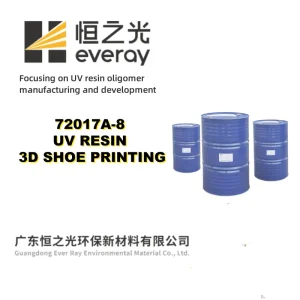
Wholesale 72017A-8 Dual-Curing UV Resin for 3D Printed Footwear | High Elasticity & Low Shrinkage
Explore Specifications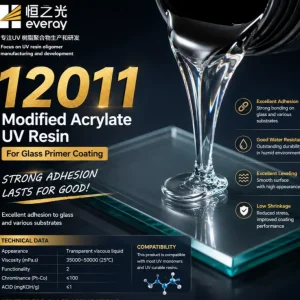
Wholesale 12011 Modified Acrylate UV Resin for Glass Primer: Adhesion & Boiling Water Resistance
Explore Specifications
Buy Polyester Acrylate 5332F – The Premium Choice for Offset Inks Supplier, Factory
Explore Specifications
Buy Fast-Cure High-Gloss Modified Epoxy Acrylate UV Resin 6805A-1 for UV Ink and Varnish
Explore Specifications
Buy Scratch Resistant 4600 Hyperbranched Acrylic UV Resin: Suitable for Varnish and Ink
Explore Specifications
High-Quality 53036 Polyester Acrylate: Excimer Laser Skin-Feel Oligomer Solution
Explore Specifications
High-Quality PUA 7291B: Empowering High-End UV Applications Across Precision Substrates
Explore Specifications
High-Quality Fast Curing and Strong Adhesion 1730 UV Resin Suitable for Vacuum Plating
Explore SpecificationsSpecialized End-Use Applications & Engineering Solutions
Bridging polymer synthesis and real-world industrial conversion across critical global manufacturing sectors.
3C Electronics & Optoelectronics
Precision consumer device enclosures made from polycarbonate (PC), ABS, and PMMA require thin-film coatings with optical clarity, sweat resistance, and pencil hardness up to 4H. Our aliphatic PUA grades deliver flexible, scratch-resistant surface protection that holds up to thermal cycling, dropping, and harsh everyday wear.
Additive Manufacturing & SLA/DLP Resins
Photopolymer additive manufacturing relies on low viscosity, low volumetric shrinkage, and rapid green-strength curing. Our dual-cure systems and hyperbranched acrylates enable ABS-like functional prototypes and flexible elastomeric lattices, such as 3D-printed footwear midsoles with reliable rebound resilience.
High-Speed Graphic Inks & OPVs
Modern lithographic offset, flexographic, and screen inks demand resin systems with balanced pigment wetting and reliable water-ink balance. Our polyester acrylates and amino-functional synergists minimize ink misting, run smoothly on high-speed presses, and overcome surface oxygen inhibition in air atmospheres.
Specialty Adhesion Primers (Glass & Metal)
Substrates with high surface energy and polar surfaces, like float glass, aluminum alloys, and stainless steel, are prone to intercoat delamination under humid conditions. Our modified functional acrylate oligomers create strong covalent bonds at the substrate interface, maintaining adhesion even after hours of boiling-water immersion testing.
Excimer Laser Soft-Feel Matting
Excimer-curable systems operate at 172nm shortwave vacuum-UV to create microscopic surface wrinkles without relying on traditional silica matting agents. Using our specialized polyester acrylates, formulators achieve uniform deep-matte finishes with a smooth soft-touch feel and superior micro-scratch resistance.
Cosmetic Gel Polishes & Nail Enhancements
Cosmetic nail gels require skin-safe ingredients, low exotherm during polymerization, and high flexibility to prevent delamination from natural nails. Our low-heat release urethane acrylates provide safe curing, excellent clarity, zero yellowing under sunlight, and easy solvent soak-off properties.
Regulatory Compliance, QA/QC & Localized Support
Ensuring end-to-end operational safety, chemical regulatory compliance, and consistent batch-to-batch quality across every international market we serve.
Global Chemical Inventory Compliance
Every commercial oligomer and monomer batch is cross-checked against major chemical regulatory inventories, including EU REACH (with SVHC screening), US TSCA, China IECSC, and Korea K-REACH. Comprehensive GHS-compliant Safety Data Sheets (SDS) and technical dossiers are provided in multiple languages to streamline international customs clearance and local compliance audits.
Advanced QC Testing Standards
Our ISO 9001:2015-certified production campus in Yunfu, Guangdong, runs rigorous quality control on every production lot. Using Gel Permeation Chromatography (GPC) for molecular weight distribution, cone-and-plate rheometers for precise viscosity matching, and FTIR spectroscopy for double-bond conversion kinetics, we guarantee batch-to-batch consistency and predictable polymerization behavior.
Dedicated Formulation Engineering Support
We do more than just supply bulk resin barrels. Our experienced application engineers partner directly with client R&D teams to refine starting formulations. Whether you need to solve surface oxygen inhibition with amino co-initiators, adjust diluent monomer ratios to control viscosity, or fine-tune photoinitiator packages for UV-LED lamps, our laboratory offers complete testing and support.
Future Technology Roadmap: Sustainable Photochemistry
Our strategic synthesis roadmap focused on reducing lifecycle carbon footprints while pushing the boundaries of photo-curing performance.
Bio-Based Carbon Feedstocks (30% to 70%)
To reduce dependence on petroleum derivatives, our polymer chemists are synthesizing polyurethane and polyester acrylate oligomers from renewable sources like succinic acid, modified vegetable polyols, and bio-derived 1,3-propanediol (PDO). These bio-based resins match the high reactivity and mechanical durability of conventional chemistries while significantly cutting lifecycle carbon emissions.
Dual-Curing Systems for Shadowed Profiles
As UV curing expands into complex 3D automotive assemblies, structural potting, and electronic encapsulation, shadow areas untouched by direct UV light present a technical hurdle. Our team is developing advanced dual-cure chemistries that pair initial UV-light gelation with secondary moisture-cure or thermal-cure mechanisms to guarantee complete crosslinking throughout the part.
Low-VOC Waterborne UV Dispersions
Combining the clean environmental profile of waterborne coatings with the high crosslinking speed of UV chemistry, our waterborne PUA dispersions allow finishers to achieve low-build, open-grain wood finishes and ultra-thin coatings on temperature-sensitive plastics without using volatile organic solvents or reactive diluent monomers.
Frequently Asked Technical & Sourcing Questions
Key information covering sample requests, custom resin synthesis, storage guidelines, and international freight logistics.
How do aliphatic and aromatic polyurethane acrylates compare in performance?
Aliphatic polyurethane acrylates are synthesized with aliphatic diisocyanates (such as IPDI or HDI), providing superior exterior weatherability and long-term resistance to yellowing. They are the ideal choice for clear overcoats, optical coatings, 3C electronics, and cosmetic nail gels. Aromatic polyurethane acrylates (based on TDI or MDI) deliver excellent tensile strength, scratch resistance, and cost efficiency, making them well suited for pigmented wood coatings, industrial floor finishes, and interior applications where sunlight exposure is minimal.
What strategies effectively address oxygen inhibition in thin-film UV curing?
Atmospheric oxygen quickly quenches free radicals generated during curing, which often leaves thin films tacky on the surface. Effective ways to overcome this include: (1) blending reactive amino acrylates or active amine co-initiators, which donate hydrogen atoms and consume local oxygen; (2) incorporating highly functional hyperbranched acrylates to increase radical density; (3) increasing the concentration of shortwave surface photoinitiators; or (4) curing under an inert nitrogen blanket in high-speed converting lines.
Can your synthesis lab engineer customized oligomer specifications?
Yes. Our in-house research and development team regularly tailors resin formulations to customer process requirements. We can adjust polymer molecular weight, resin viscosity, functional group density, and reactive diluent monomer packages (such as TPGDA, TMPTA, DPGDA, or IBOA). We can also adjust the polymer backbone to improve adhesion on difficult substrates like untreated polypropylene, float glass, or aluminum foil.
What are the recommended storage and handling conditions for acrylate resins?
UV-curable acrylate resins contain reactive double bonds that can slowly polymerize if exposed to light or excessive heat. Resins should be stored in their original light-blocking containers (typically black or opaque lined steel drums) between 5°C and 30°C, away from direct sunlight, open flames, and strong oxidizers. Acrylic systems require a small amount of dissolved oxygen to maintain stabilizer efficacy, so container headspace should never be purged with pure nitrogen during storage.
What documentation and quality certifications accompany international export shipments?
Every commercial shipment includes a comprehensive batch-specific Certificate of Analysis (COA) detailing key properties such as viscosity, Gardner color, acid value, and solid content. We also provide compliant 16-section Safety Data Sheets (GHS SDS), full REACH/RoHS compliance statements, and non-dangerous goods transport classifications whenever applicable to ensure smooth sea or air cargo clearance.
How can R&D formulators request sample quantities for lab trial evaluations?
We provide lab sample kits (typically 500g to 1kg per grade) for qualified formulation laboratories and industrial end users. Contact our technical sales group through our online portal, specify your target substrate, curing equipment (mercury arc vs. UV-LED wavelength), and required film performance, and our engineers will supply the most suitable sample grades along with starting point formulation recommendations.
