Thermal Cycling Grade
Advanced UV curable raw materials engineered for precision 3D printing lattices, heat-resistant coatings, rapid paper overprint varnishes, and low-VOC wood finishing.
How the structural selection of oligomer backbones, crosslink density parameters, and photo-initiation mechanisms dictate macroscopic industrial performance.
Acrylate free-radical conversion delivers sub-second curing velocity via homolytic cleavage of Norrish Type I/II photoinitiators. By engineering double-bond concentration (C=C mol/kg) across aliphatic polyurethane acrylates and modified bisphenol epoxy diacrylates, chemists can balance rapid vitrification against radical trapping, eliminating post-tackiness while mitigating internal volumetric shrinkage stress.
The glass transition temperature (Tg) directly determines hardness, mar resistance, and impact toughness. Combining low-Tg flexible polycaprolactone-based aliphatic PUAs with high-Tg hyperbranched polyesters produces an interpenetrating polymer network (IPN). This achieves over 4H pencil hardness while maintaining 180° mandrel flexibility on challenging polymer substrates like PC and PMMA.
Surface peroxy radical formation (ROO•) terminates radical chains, leading to sticky boundaries in thin films (<15µm). Incorporating copolymerizable amino-acrylate oligomers or sterically hindered tertiary amines provides efficient α-amino hydrogen donation. This regenerates alkyl radicals, drives tack-free curing under ambient air, and reduces overall photoinitiator concentration by up to 35%.
Next-generation photopolymer chemistries moving from laboratory synthesis to high-throughput industrial application.
Hybrid UV-thermal and UV-moisture dual curing allows immediate handling green-strength within 1.2 seconds of UV irradiation, followed by moisture-driven isocyanate/alkoxysilane secondary crosslinking inside deep shadow zones, complex 3D lattices, and opaque automotive assemblies.
Synthesized from renewable isosorbide, modified epoxidized soybean oil (AESO), and bio-succinic building blocks. Our bio-carbon content reaches 42%–68% without sacrificing the high tensile modulus, optical clarity, or weathering resilience demanded by modern eco-conscious OEM supply chains.
Short-wavelength vacuum-UV excimer technology polymerizes only the top 100–300nm boundary layer. The resulting micro-wrinkled surface produces a true super-matte finish (<3 GU at 60°) and fingerprint-resistant soft-touch haptics without requiring silica or wax matting additives.
Optimized for energy-efficient 365nm, 385nm, 395nm, and 405nm solid-state LED fixtures. Our oligomers integrate targeted absorption matching, overcoming traditional deep-cure limitations in high-opacity white bases, deep blacks, and heavily filled silk-screen inks.
Targeted chemical architectures engineered for high-throughput production lines across electronics, additive footwear, wood finishes, and specialty graphics.
| Target Sector | Critical Engineering Bottleneck | Synthesized Backbone Solution | Substrate Adhesion Scope | Standard Performance Metrics |
|---|---|---|---|---|
| Consumer Electronics & 3C | Fingerprint staining, cosmetic wear, cyclic drop cracking | High-functionality Aliphatic PUA + Hyperbranched Acrylates | PC, ABS, PMMA, Anodized Al | Pencil Hardness ≥ 4H, RCS 500g > 5000 cycles |
| Additive 3D Footwear | Tear propagation in lattice midsoles, compression set failure | Dual-Cure Elastomeric Urethane Acrylates (72017A-8) | Photopolymer resin vat (DLP/SLA) | Elongation > 280%, 100k Flex Cycles < 5% loss |
| Industrial Wood & Flooring | Deep sanding abrasion, solvent exposure, brittle edge-chipping | Polyester Acrylate 5501 + Bisphenol A Epoxy Acrylates | Natural Oak, Engineered Veneer, MDF | Taber Abrasion > 1200 revs, 0% cross-hatch loss |
| Packaging Inks & Varnishes | Oxygen inhibition in thin film OPV, ink-water misting on press | Low-viscosity Epoxy Acrylate 6300 + Amine Synergists | BOPP, PET, Metalized Board | Line speed > 180 m/min, MEK double rubs > 100 |
| Optoelectronic Potting | Thermal yellowing, micro-void stress, moisture delamination | 73008 Low-Shrinkage PUA + Functional Methacrylates | Glass, Copper, FR4, Ceramic | Shrinkage < 2.5%, ΔE < 1.2 after 1000h QUV |
State-of-the-art continuous flow esterification, DCS-automated synthesis reactors, and direct monomer-to-oligomer upstream integration delivering dependable consistency and competitive scaling.
Our production facilities operate on fully automated Distributed Control Systems (DCS). Closed-loop monitoring of temperature profiles (±0.5°C), precise feed dosing of acrylic acid, and automated catalyst addition ensure batch-to-batch polymer dispersion consistency with polydispersity indexes (PDI) held under 1.25.
Direct supply partnerships with major domestic feedstocks (acrylic acid, HDDA, TPGDA, TMPTA, IPDI, and Bisphenol A diglycidyl ether) protect our manufacturing plants from international raw material spikes, offering international blenders a structural 15%–28% cost advantage along with continuous supply security.
Every industrial batch undergoes Gel Permeation Chromatography (GPC) to verify molecular weight distribution, Fourier Transform Infrared Spectroscopy (FTIR) for double-bond conversion validation, and rotational cone-plate viscometry at 25°C and 50°C to guarantee smooth integration into your automated blending equipment.
Comprehensive regulatory support, certified technical documentation, and resilient international chemical logistics for formulators worldwide.
Our raw material platforms comply with EU REACH registration protocols (SVHC non-detectable), US EPA TSCA inventories, China MEP Order 7, and RoHS 3 Directives. Complete GHS-compliant 16-section Safety Data Sheets (SDS) are provided in multiple languages with every shipment.
Engineered for international transit stability. We offer 25kg UV-inhibiting polyethylene pails, 200kg nitrogen-purged steel drums, and 1000kg composite IBC totes, alongside bulk ISO flexitank shipments. All packaging uses light-blocking materials to prevent photo-induced micro-gelation during maritime transport through tropical routes.
Work directly with our senior photopolymer synthesis chemists. We provide starting-point formulations, monomer compatibility charts, photoinitiator dosage curve models, and tailored pigment dispersion troubleshooting for UV flexo, OPV, excimer wood finish, or SLA 3D printing lines.
Direct answers from application chemists on solving complex cure dynamics, substrate wetting, and thermal degradation issues.
Aliphatic polyurethane acrylates (such as our 7200F and 72203A) are synthesized using aliphatic diisocyanates (IPDI or H12MDI), providing stable chemical backbones that resist photochemical cleavage and UV yellowing (ΔE < 1.5 after 2,000h QUV exposure). Aromatic PUAs (synthesized from TDI/MDI) offer higher mechanical stiffness and lower raw material costs, but degrade photochemically outdoors. They are best suited for indoor furniture sealers, floor undercoats, and dark pigmented inks.
Volumetric shrinkage occurs as van der Waals gaps (0.3–0.4nm) convert into shorter covalent C-C bonds (0.154nm). To mitigate this, reduce crosslink density by blending di-functional polyurethane acrylates with ring-opening cyclic trimethylolpropane formal acrylate (CTFA) or acryloyl morpholine (ACMO). Incorporating our 73008 oligomer limits total linear shrinkage to below 2.0%, preventing substrate curling on thin polycarbonate or PET films.
Waterborne UV systems (e.g., 70601 / 70251) exist as stable aqueous polyurethane dispersions (PUDs). The application process requires a two-stage drying line: first, a mild infrared or convection pre-heat zone (50–65°C for 2–3 minutes) evaporates water, driving physical film coalescing. The coating then passes under the high-intensity UV lamp, crosslinking the acrylate double bonds into a dense, water-resistant network free from boiling pinholes.
Low surface energy substrates (<32 mN/m) like PP, alongside polar metal interfaces, require modified oligomers. We recommend introducing 5%–12% acidic phosphate acrylate esters or chlorinated functional pure acrylates. The phosphate groups establish coordinate bonding with surface oxide layers, while tailored functional monomers promote chemical wetting, achieving 5B cross-hatch adhesion without halogenated flame pre-treatments.
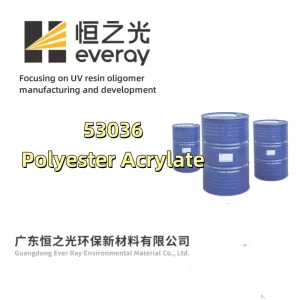
Excimer-responsive finishes (such as our 53036 polyester acrylate) must possess rapid surface crosslinking kinetics without premature bulk curing. Under a 172nm nitrogen-inerted atmosphere (<50 ppm O2), high-energy photons polymerize the uppermost 150nm layer almost instantly. As this skin crosslinks and shrinks over the mobile, uncured underlayer, controlled micro-folds form, delivering uniform deep-matte appearance (<2 GU at 60°) without chemical matting agents.
Single-cure photopolymers can become brittle over repeated dynamic impacts. Our 72017A-8 dual-curing resin uses a two-stage mechanism: first, light-activated radical polymerization cures a stable green part within a DLP/LCD 3D printer vat. Then, thermal baking activates blocked isocyanate and polyol prepolymers, forming an elastomeric polyurethane interpenetrating network. The finished lattice withstands over 100,000 compression cycles with less than 5% permanent set.
Engineered oligomer systems for structural adhesives, nail gel cosmetics, electronic potting, and high-efficiency flexographic printing inks.