High-Performance Resins & Engineering Acrylates
Explore our industrial-grade UV and DLP photopolymer formulations synthesized at our dedicated Jiangmen and Yunfu production plants for advanced additive, coating, and bonding applications.
The Global Landscape of Industrial DLP Resin Manufacturing
Digital Light Processing (DLP) has pivoted definitively from rapid visual prototyping to direct-to-consumer serial additive manufacturing across dental, electronics, microfluidics, and athletic footwear.
In the contemporary additive manufacturing marketplace, the term "Buy DLP Resin Supplier & Factory" encompasses far more than a transactional procurement inquiry. Procurement directors, optical hardware engineers, and contract formulation chemists are navigating a paradigm shift: photopolymer additive technology has evolved from low-load structural proof-of-concepts into end-use engineering applications requiring uncompromising mechanical stability, thermal endurance, and batch-to-batch chemical reproducibility.
Digital Light Processing utilizes digital micromirror devices (DMD) to project dynamic UV/visible light patterns (primarily at 385nm and 405nm optical wavelengths) across a photopolymer vat. Compared to legacy galvo-steered Stereolithography (SLA) or masked stereolithography (MSLA/LCD), industrial DLP delivers localized light intensity distributions with minimal optical scatter, enabling micron-level dimensional fidelity and accelerated layer exposure cycles (frequently under 1.2 seconds per layer). However, the ultimate engineering ceiling of any DLP hardware architecture is constrained entirely by the reactive matrix: the molecular architecture of the acrylate oligomers, reactive diluents, photoinitiator kinetics, and crosslinking density.
Additive Market Velocity
The global photopolymer market is expanding at an 18.4% CAGR toward 2032, driven by industrial direct digital manufacturing (DDM) replacing injection molding for low-to-mid volume runs.
Direct Reactor Synthesis
Tier-1 procurement demands sourcing directly from primary resin reactors (such as Guangdong Ever Ray) to bypass secondary formulator markups and ensure structural chemistry consistency.
Dual-Stage Curing Shifts
Modern applications require advanced interpenetrating polymer networks (IPNs) combining initial DLP photo-polymerization with secondary thermal curing to achieve isotropic, injection-grade properties.
Photopolymer Formulation Physics & Oligomer Architecture
A rigorous review of critical exposure energy, absorption depth, oligomer backbone mechanics, and crosslinking dynamics in industrial DLP vat photopolymerization.
1. Jacob's Working Curve & Photonic Penetration Dynamics
In DLP systems, spatial control of radical initiation dictates z-axis layer resolution and inter-layer green strength. According to the modified Beer-Lambert relationship formalized by Paul F. Jacobs:
Jacobs Photopolymer Working Formula
Cd = Dp · ln(Emax / Ec)
Where Cd represents the cured depth, Dp is the depth of penetration (governed by oligomer extinction coefficients, UV absorbers, and pigment scattering), Emax is the incident energy delivered by the DLP projector, and Ec is the critical exposure threshold energy required for gelation.
At our manufacturing facilities in Guangdong, our synthesis protocols control Dp and Ec within rigorous chemical tolerances. By fine-tuning photoinitiator pairings (such as bis-acylphosphine oxide [BAPO/Omnirad 819] for 405nm depth cure combined with diphenyl(2,4,6-trimethylbenzoyl)phosphine oxide [TPO] or ethyl (2,4,6-trimethylbenzoyl) phenylphosphinate [TPO-L] for rapid optical bleaching), we balance hyper-fast z-stacking while eliminating unwanted light bleed into unexposed pixels.
2. Backbone Selection: Epoxy Acrylates vs Polyurethane Acrylates (PUA)
The core mechanical performance of a DLP-printed component is directly dictated by the structural backbone of the primary oligomer. Selecting an appropriate resin family requires balancing modulus, elongation, thermal resistance, and volumetric shrinkage stress:
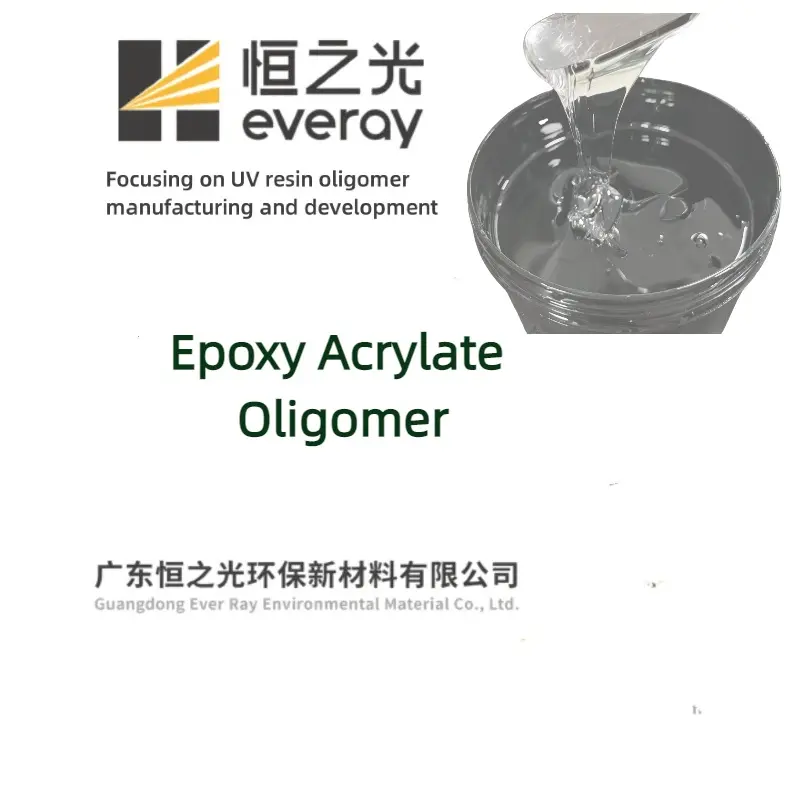
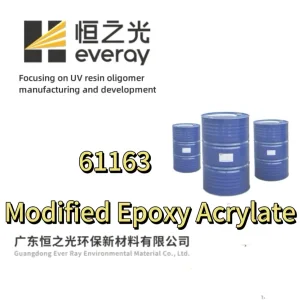
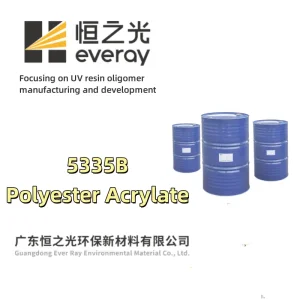
- Bisphenol A Epoxy Acrylates (e.g., Grade 9105A-80 / 9105M-80): Exhibit extreme glass transition temperatures (Tg > 110°C), rapid radical polymerization velocity, and high Rockwell hardness. Essential for dental dies, tooling molds, and high-modulus electronic jigs, though inherently prone to higher volumetric shrinkage.
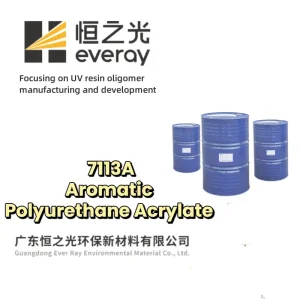
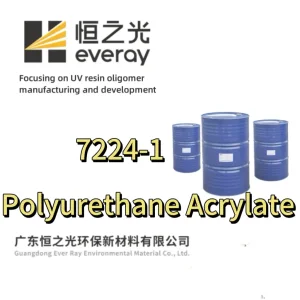
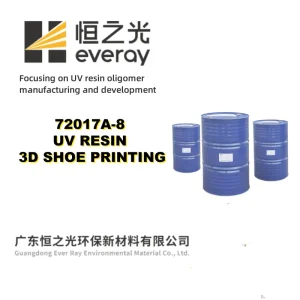
- Aliphatic Polyurethane Acrylates (e.g., Grade 72017A-8 / 72923): Synthesized utilizing isophorone diisocyanate (IPDI) or dicyclohexylmethane-4,4'-diisocyanate (H12MDI). Yield exceptional outdoor weatherability, non-yellowing optical clarity, and elastic recovery under continuous cyclical stress.
- Hyperbranched & Dendritic Acrylates: Deliver multi-functional crosslinking sites (functionality ≥ 6) with remarkably low solution viscosity, accelerating surface curing line speeds and conferring superior scratch and mar resistance without causing brittle embrittlement.
| Resin Matrix Category | Viscosity @ 25°C (mPa·s) | Tensile Modulus (MPa) | Elongation at Break (%) | HDT @ 0.455 MPa (°C) | Volumetric Shrinkage (%) | Target DLP Application |
|---|---|---|---|---|---|---|
| Rigid High-Temp Epoxy Acrylate | 800 – 1,800 | 2,800 – 3,600 | 3.5 – 6.2 | 120 – 185 | < 3.8% | Tooling, Solder Molds, Electrical Connectors |
| Aliphatic Urethane Elastomer | 1,200 – 3,200 | 120 – 450 | 180 – 380 | 45 – 65 | < 1.4% | Midsole Lattices, Gaskets, Wearable Bands |
| Tough Engineering PUA (ABS-Like) | 450 – 950 | 1,900 – 2,400 | 25 – 48 | 75 – 92 | < 2.2% | Snap-fit Assemblies, Automotive Enclosures |
| High-Speed Low-Viscosity Micro-DLP | 180 – 380 | 2,200 – 2,800 | 8 – 16 | 85 – 105 | < 2.9% | Microfluidic Chips, Hearing Aid Shells |
| Dual-Cure Photothermal Network | 2,500 – 5,500 | 1,400 – 2,100 | 65 – 110 | 130 – 165 | < 0.9% | Aerospace Ducting, Damping Mounts |
Enterprise Vertical Application Scenarios
How Guangdong Ever Ray's customized photopolymer and oligomer systems solve real-world engineering constraints across major industrial manufacturing hubs.
Athletic Footwear Midsole Lattices
Utilizing dual-cure polyurethane acrylates (Grade 72017A-8) engineered for high energy return (> 68%), low compression set (< 7% after 100k cycles), and rapid layer cure times for high-volume automated footwear production lines.
High-Precision Dental Prosthetics
Rigid, dimensionally stable resins with ultra-low thermal expansion for thermoforming aligner models, indirect bonding trays, and castable crown patterns that exhibit zero residue ash during burnout processes.
3C Electronics & Wearables
Impact-resistant formulations meeting UL94 flame-retardant standards and chemical sweat resistance tests. Ideal for earphone enclosures, wearable brackets, and structural internal jigs.
Microfluidic & Optical Devices
Extremely low-viscosity, non-yellowing acrylic matrices designed for sub-15 micron microchannel resolution, optical transparency > 92% in visible light, and biological non-cytotoxicity.
Comprehensive Customization Pipeline (OEM/ODM Formulator Support)
Whether your DLP system operates with a high-intensity 385nm industrial light engine requiring minimized radical inhibition or standard 405nm multi-array LEDs, Ever Ray's R&D team adjusts the oligomer backbone, functionality distribution, and non-reactive photo-stabilizer package to meet target line speeds, adhesion thresholds, and ISO/ASTM mechanical specs.
The Future of High-Speed Photopolymer Additive Manufacturing
Strategic technological initiatives driving the next generation of photocurable materials at our Yunfu R&D synthesis center.
Bio-Based Renewable Acrylates
Synthesizing reactive oligomers derived from cardanol, epoxidized soybean oil (ESBO), and bio-succinic acids, achieving > 45% bio-carbon content while matching the tensile modulus of traditional bisphenol A derivatives.
Ceramic & Metal Nanocomposites
Formulating sub-micron alumina (Al2O3) and zirconia (ZrO2) high-solids suspensions for Lithography-based Ceramic Manufacturing (LCM) with controlled sedimentation and clean catalytic burnout properties.
AI-Assisted Spectral Kinetics
Deploying algorithmic molecular property prediction to model oxygen inhibition thresholds, gel point kinetics, and shrinkage deformation across exotic photoactive monomer blends prior to reactor scale-up.
Specialty Oligomers, Structural Adhesives & Inks
Direct supply of pure acrylate oligomers, high-adhesion core resins, and shadowless adhesive systems formulated for extreme performance requirements.
Enterprise Factory Infrastructure & Quality Management
Operating under ISO 9001 and ISO 14001, Guangdong Ever Ray guarantees complete chromatographic traceability and strict regulatory adherence for high-volume export.
Chromatographic Quality Control
Every synthesized batch undergoes Gel Permeation Chromatography (GPC) molecular weight distribution profiling, FTIR structural fingerprint verification, and cone-plate rheometer viscosity certification to ensure zero vat inconsistency across international shipments.
Turnkey Industrial Packaging
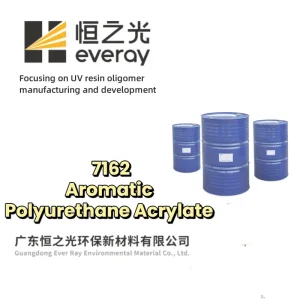
Supplying direct formulation shipments in UV-opaque 1kg aluminum containers, 25kg HDPE drums, and 200kg steel drums, as well as 1,000kg IBC totes for automated industrial 3D printing clusters with global DG export certification.
Global REACH & RoHS Compliance
Fully certified for shipment across North America, the European Union, Japan, and Southeast Asia. Formulations comply with strict chemical inventories (TSCA, REACH registration, RoHS 3, SVHC screening) and GHS SDS standardizations.
Frequently Asked Questions: Buying DLP Resin from Direct Factories
Critical considerations regarding photo-rheology, shelf-stability, MOQ, OEM contract blending, and light-engine matching.