Direct Factory Formulations
High-Performance UV Adhesive Oligomers & Precision Resins
Engineered for high adhesion, rapid kinetic photopolymerization, minimal volumetric shrinkage, and exceptional hydrolytic resistance across demanding substrates.
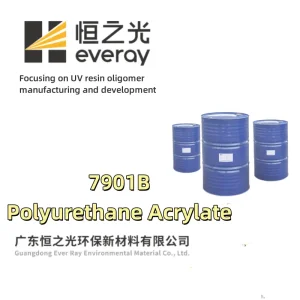
High-Quality 7901B UV-resin for industrial coatings Factory, Products
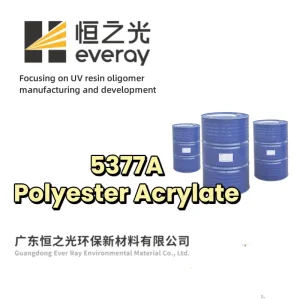
Buy Polyester Acrylate 5377A – The Ideal Choice for Flexographic UV Inks Suppliers, Factory
High-Quality A150 UV-resin for UV-ink and UV-coatings Manufacturer, Factories
High-Quality 7620 UV-curing Resin applied in UV vacuum electroplating Factories, Products
Buy Polyester Acrylate 5403-2F – A Reliable Choice for High-Quality UV Inks Suppliers, Product
Industry Macro-Dynamics
Global Adhesive Landscape: Transition to Radiation Curing Systems
In modern industrial assembly, the transition from conventional solvent-borne bonding agents to solventless, instant-curing photopolymer adhesives is an operational imperative driven by stringent VOC limits, automated high-throughput lines, and miniaturized components.
2006
Pioneering Year
40,000m²+
Chemical Plant Footprint
10+
Automated Oligomer Reactors
100%
Zero-VOC Eco Formulations
Supply Chain De-Risking & Sourcing Stability
Global original equipment manufacturers (OEMs) face raw material price volatility, monomer shortages, and geopolitical logistics hurdles. Guangdong Ever Ray Environmental Material Co., Ltd. mitigates upstream exposure through direct backward synthesis integration. By controlling intermediate acrylate esterification, polycondensation, and isocyanate functionalization in-house, we secure a stable supply chain, uniform batch purity, and guaranteed lead times.
Decarbonization & Regulatory Mandates
Global environmental protocols—such as EU REACH Annex XVII, RoHS 3 Directive 2015/863, EPA Clean Air Act mandates, and regional TSCA inventories—are accelerating the phase-out of aromatic hydrocarbon solvents (toluene, xylene, MEK). Ever Ray’s UV/EB curable and waterborne polyurethane acrylate oligomers achieve complete elimination of solvent emissions, reducing industrial carbon footprints while operating at zero volatile emissions.
Micro-Precision Automated Manufacturing
The consumer electronics, micro-optics, and clean energy battery markets require high dispense speed, rapid green strength, and ultra-low shrinkage. Ever Ray formulates reactive diluents and dendritic hyperbranched oligomers that yield viscosities low enough for sub-millimeter jetting, while mitigating internal polymerization stresses to ensure zero optical distortion or mechanical shear failure on delicate components.
Comparative Formulation Engineering
Photopolymer Resin Families: Kinematic & Structural Matrix
A quantitative comparison guide for formulation chemists, adhesive system architects, and technical procurement directors to select backbones based on critical bonding metrics.
| Resin Classification | Backbone Chemistry | Volumetric Shrinkage | Glass Transition (Tg) | Elongation at Break | Adhesion Profile | Primary Industrial Sector |
|---|---|---|---|---|---|---|
| Aliphatic Urethane Acrylates (PUA) | IPDI / HDI Oligomerized Polyols | Low (1.2% - 2.8%) | -15°C to 45°C | 80% – 320% | Optical Glass, PC, PMMA, PET | Optoelectronics, Display Bonding, Medical Wearables |
| Aromatic Urethane Acrylates | TDI / MDI Polyfunctional Oligomers | Moderate (2.5% - 4.2%) | 35°C to 85°C | 20% – 95% | Metals, ABS, Treated Polyolefins | Structural Industrial Lamination, Automotive Assemblies |
| Bisphenol A Epoxy Acrylates | DGEBA Acrylic Acid Adducts | Moderate-High (4.0% - 6.5%) | 65°C to 110°C | 2% – 8% | Glass, Ceramics, Rigid Composites | PCB Encapsulants, Chemical-Resistant Gaskets |
| Special Functional & Modified Acrylates | Phosphated / Carboxylated Adducts | Very Low (0.8% - 1.9%) | -30°C to 60°C | 40% – 180% | Untreated Metals, Glass, Gold/Nickel plating | UV Vacuum Plating, Boil-Water Resistant Primers |
| Hyperbranched Multi-Acrylates | Dendritic Polyesters / Polyethers | Controlled Stress Network | 80°C to 140°C+ | 1% – 5% | High Surface Energy Substrates | Scratch-Proof Overcoats, High-Speed UV Inks |
Real-World Deployment
Targeted Application Engineering Across High-Stress Substrates
How Ever Ray photopolymer chemistry solves specific interfacial adhesion challenges across global assembly lines, cleanrooms, and automated production facilities.
3C Electronics & LOCA Screen Bonding
Liquid Optical Clear Adhesives (LOCA) engineered with our aliphatic polyurethane acrylates (PUA) deliver 99%+ light transmittance, low refractive index mismatch, and zero yellowing over 3,000 hours of QUV-A accelerated weathering. The flexible backbone accommodates mismatched thermal expansion between cover glass and OLED display modules without delamination.
Automotive LiDAR & Sensor Assembly
Sensor housings combine engineered polyphenylene sulfide (PPS), polycarbonates, and aluminum alloys. Ever Ray carboxyl- and phosphate-functionalized acrylate oligomers promote interfacial bonding via chemical chelation. They withstand rigorous automotive thermal shock profiles (-40°C to +125°C for 1,000 cycles) while maintaining moisture sealing and electrical isolation.
Medical Device Bonding & Needles
From cannula-to-hub syringe bonding to fluidic manifolds, our pure acrylate and aliphatic polyurethane resins meet ISO 10993 cytotoxicity and biocompatibility requirements. Compatible with LED 365nm to 405nm light guides, these resins achieve tack-free cures in under 2.5 seconds and endure ethylene oxide (EtO) and autoclave steam sterilization cycles without micro-fissuring.
UV Vacuum Metallizing Primers & Topcoats
Electroplating plastics (ABS, PC, nylon) with vaporized aluminum or chrome requires pristine base-level leveling and high peel strength. Products like Ever Ray 7620 and 7162 resins provide mirror-level optical clarity, preventing outgassing during high-vacuum deposition and preserving adhesion through cross-hatch tape tests (ASTM D3359 Class 5B).
Global Compliance & Support
Technical Verification & Export Regulatory Architecture
Ensuring formulation reliability, chemical verification, and regional supply chain compliance for international chemical distribution.
Full Regulatory Certification Suite
Every commercial batch is accompanied by an authenticated Certificate of Analysis (CoA), Technical Data Sheets (TDS), and 16-section Safety Data Sheets (GHS/CLP compliant). Our products are formulated in compliance with EU REACH registration frameworks, RoHS 3 directives, halogen-free limits (IEC 61249-2-21), and are listed on global inventories (TSCA, IECSC, KECL, ENCS).
Precision Instrumental Analytics Lab
Our Jiangmen and Yunfu R&D centers use Fourier-Transform Infrared Spectroscopy (FTIR) for functional conversion monitoring, Gel Permeation Chromatography (GPC) for accurate polydispersity and molecular weight control, dynamic cone-plate viscometry for rheology profiling, and UV-Vis spectrophotometers for curing kinetics and yellowing resistance quantification.
Bilingual Application Engineering
Our senior technical service personnel work directly with client chemists and process engineers via direct digital channels and on-site consultations. From balancing photoinitiator absorption curves with modern LED 395nm arrays to mitigating oxygen inhibition through amino acrylate synergies, we provide complete, ready-to-test starter formulations.
Export Logistics & Preservation
Exporting reactive monomers and acrylate oligomers requires strict climate safeguards. We ship in UN-rated steel drums, ISO tanks, and opaque light-shielded IBC totes. Chemical inhibitors (MEHQ, BHT) are stabilized at ppm levels under oxygen-dissolved headspaces to prevent spontaneous thermal polymerization during ocean transit through equatorial routes.
Strategic Horizons
Technology Roadmap: Next-Generation Radiation Curing
Our dedicated chemical synthesis roadmap addresses green sustainability, deep-shadow curing, and functional smart materials across international manufacturing sectors.
Phase I: Current Benchmark
Dual-Cure Photothermal Resins
Pioneering dual UV/moisture and UV/heat functional resin backbones that cure within seconds under 365–405nm light, followed by secondary thermal crosslinking across shaded undercut geometries in microelectronic enclosures.
Phase II: Near Horizon
Bio-Based & Circular Acrylates
Synthesizing aliphatic urethanes and modified polyesters derived from renewable succinic acid, cardanol, and itaconic acid precursors. Our target is 45%+ biocontent without compromising tensile toughness or glass transition temperature.
Phase III: Advanced Integration
Debonding-on-Demand (DoD)
Developing photopolymers with thermally and photolytically reversible bonds (Diels-Alder adducts and cleavable diester linkages). This enables rapid consumer electronics disassembly, modular component reclaim, and simplified battery pack recycling.
Phase IV: Frontier Scale
Nano-Engineered Functional Resins
Integrating surface-functionalized silica nanoparticles and conductive metal-organic frameworks into hyperbranched acrylate matrices. This delivers high thermal dissipation (1.5+ W/mK) alongside optical clarity for high-power LED and EV power modules.
Technical Clarifications
Technical & Procurement FAQ: Adhesive Materials
Authoritative insights addressing chemical formulation, line troubleshooting, and high-volume commercial purchasing inquiries.
How do aliphatic and aromatic polyurethane acrylates differ in outdoor and clear-bond adhesive designs?
Aliphatic polyurethane acrylates are synthesized using saturated cycloaliphatic or aliphatic diisocyanates (such as IPDI or H12MDI). Because they lack aromatic benzene rings, they are chemically resistant to UV light oxidation, photo-Fries rearrangement, and solar photodegradation. This makes them ideal for optically clear laminations, electronics displays (LOCA), automotive headlights, and medical devices. Aromatic polyurethane acrylates rely on toluene diisocyanate (TDI) or methylene diphenyl diisocyanate (MDI). While they offer high tensile strength, rapid cure speeds, and favorable cost structures, exposure to light causes chromophore generation and yellowing. As a result, aromatics are best suited for indoor applications, wood sealers, pigmented adhesives, and opaque structural bonding.
What chemical strategies best counter oxygen inhibition during thin-film adhesive and coating cures?
Atmospheric oxygen rapidly quenches triplet-state photoinitiators and scavenges carbon-centered propagation radicals, forming unreactive peroxy radicals and leaving a soft, tacky surface layer. Formulators can address this by: (1) Integrating amine-modified acrylate oligomers or active amine co-initiators. The abstractable hydrogen atoms alpha to the nitrogen react with peroxy radicals, regenerating active alkyl radicals that consume oxygen; (2) Adding polyfunctional thiol chain-transfer agents that remain effective even at high air-interface velocities; or (3) Formulating with higher-functionality hyperbranched acrylates to increase crosslink density, shortening the kinetic gel window.
How can an adhesive system achieve high substrate adhesion while maintaining peelability or low shrinkage?
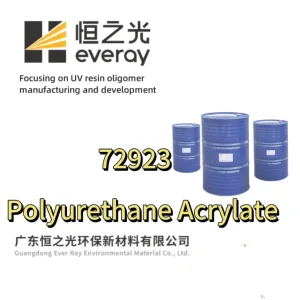
Balancing strong initial adhesion with cleanly peelable or low-stress characteristics requires careful control of molecular weight between crosslinks (Mc) and glass transition temperature (Tg). For products like 72923 UV peelable resin, we build a high-molecular-weight, flexible polyether/polyester-urethane backbone with low crosslink density. This configuration provides uniform wetting and van der Waals bonding. Upon intense irradiation, the polymer network completes crosslinking, increasing modulus and producing a controlled contraction that reduces interfacial peel resistance. For permanent bonding with minimal shrinkage, formulators can incorporate mono-functional specialty monomers (such as IBOA or cyclic trimethylolpropane formal acrylate) alongside low-shrinkage oligomers to reduce volumetric shrinkage stress below 2.0%.
What parameters must be configured to achieve boil-water resistance on glass and raw metals?
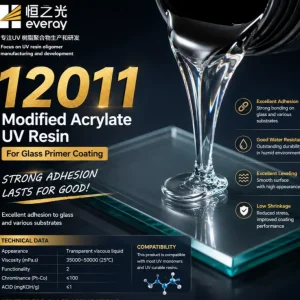
Glass and untreated metals naturally carry hydrophilic hydroxyl layers that attract atmospheric moisture, hydrolyzing conventional adhesive interfaces. Achieving long-term resistance to boiling water requires: (1) Functional groups capable of forming covalent or coordination bonds with inorganic silanols and metal oxides (such as methacrylated silane coupling agents or phosphate esters like Ever Ray 12011 modified acrylate); (2) Hydrophobic oligomer backbones (such as bisphenol A epoxy acrylates or long-chain aliphatic diols) that prevent water diffusion into the polymer boundary; and (3) High crosslink density to raise the heat deflection temperature (HDT) above 100°C, ensuring the cured film resists thermal softening during boil testing.
What is the standard procedure and lead time for ordering custom-synthesized oligomers from Ever Ray?
Custom synthesis begins with an engineering intake to review the substrate profile, spectral curing wavelength (e.g., LED 365/385/395/405nm or standard mercury lamp), target viscosities, and mechanical specifications (shear, peel, modulus, optical clarity). Our R&D center produces 1–2 kg prototype evaluation lots within 7 to 10 working days, backed by FTIR, GPC, and viscosity analytics. Following lab verification and line validation, our pilot plant handles scale-up batches (500 kg to 2 metric tons). Full-scale commercial lots (up to 20 metric tons) typically ship within 14 to 20 days, supported by complete SDS, TDS, and international shipping documentation.
Advanced Chemical Catalogue
Specialized Reactive Monomers, Acrylates & Functional Resins
Engineered for high adhesion, rapid kinetic photopolymerization, minimal volumetric shrinkage, and exceptional hydrolytic resistance across demanding substrates.