Core UV Curable Resins Selected for Bulgarian Industrial Applications
Engineered for high cure conversion, exceptional mechanical resilience, and compliance with European chemical standards.
Strategic Polymer Engineering for the Expanding Bulgarian Manufacturing Matrix
In-depth technical analysis on why dendritic macromolecular architecture is supplanting linear acrylate oligomers across Southeastern Europe's packaging, automotive component, and engineered timber hubs.
1. The Industrial Renaissance of Bulgaria & The UV Transition
Bulgaria has progressively established itself as a premier light manufacturing, automotive plastics, and specialized chemical processing corridor within Eastern Europe. Anchored by dynamic industrial zones such as the Trakia Economic Zone (Plovdiv), municipal clusters surrounding Sofia, and strategic shipping gateway facilities in Varna and Ruse, local compounders are confronting an urgent transition: pivoting from solvent-borne volatile organic compound (VOC) systems toward 100% solid, low-energy UV/EB photopolymer systems.
Stringent European environmental directives—specifically aligned with EU Green Deal carbon mandates, REACH, and strict VOC restrictions—have rendered traditional solvent-based varnishes obsolete. Simultaneously, rapid production lines require dry-to-stack speeds exceeding 50 to 100 meters per minute without compromising surface hardness or thermal endurance. Herein lies the fundamental challenge: conventional linear polyurethane acrylates (PUA) or high-viscosity epoxy acrylates necessitate massive reactive diluent dosages (such as HDDA, TPGDA, or TMPTA) to achieve sprayable or roll-coatable viscosity. These high monomer loads escalate volumetric shrinkage, inducing micro-cracks, film curling, substrate delamination, and skin-sensitization hazards for line technicians.
2. The Macromolecular Mechanism: Hyperbranched Architecture vs. Linear Entanglements
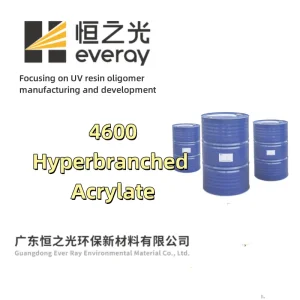
Hyperbranched Acrylate Oligomers represent a profound topological breakthrough over conventional linear and branched polymers. Synthesized through controlled, divergent pseudo-one-pot or dendritic condensation routes, these molecules feature a high degree of branching (DB > 0.65) terminating in an exterior perimeter dense with active acrylate moieties.
Because their globular, pseudo-spherical macromolecular morphology eliminates the classic chain entanglements characteristic of linear polymers, hyperbranched acrylates exhibit remarkably low intrinsic viscosities even at elevated molecular weights. When exposed to conventional medium-pressure mercury arc lamps or energy-saving 395nm LED UV sources, the dense peripheral double bonds generate an ultra-fast radical cascade. This mechanism overcomes oxygen inhibition at the air-coating interface without demanding toxic amine synergist excesses, achieving complete pencil hardness (up to 4H-5H) in fractions of a second while maintaining internal stress release mechanisms that prevent film brittle failure.
| Physical & Curing Properties | Standard Bisphenol-A Epoxy Acrylate | Conventional Hexafunctional PUA | Hyperbranched Acrylate Oligomer (Ever Ray 4600) |
|---|---|---|---|
| Theoretical Acrylate Functionality | 2 | 6 | 12 – 16 |
| Neat Viscosity (25°C, mPa.s) | 30,000 – 65,000 | 15,000 – 40,000 | 1,800 – 4,500 (Dramatically Lower) |
| Diluent Monomer Demand | 30% – 50% | 25% – 40% | 5% – 15% (Ultra-Low Shrinkage) |
| Curing Velocity (LED 395nm, m/min) | 15 – 25 | 25 – 45 | 60 – 120+ |
| Volume Shrinkage Rate | 6.5% – 8.2% | 4.5% – 6.0% | < 2.2% (Superior Substrate Adhesion) |
3. Global Supply Realities & The European Polymer Squeeze
Western European downstream formulators across Germany, Italy, and Eastern European satellite hubs such as Bulgaria have faced continuous feedstock volatility, surging energy premiums, and localized petrochemical consolidations. Major regional oligomer synthesize houses have suffered from prolonged lead times exceeding 12 to 18 weeks, frequently applying spot-market surcharges that jeopardize the profit margins of mid-tier Bulgarian contract blenders.
Consequently, global corporate procurement officers are re-architecting their chemical supply chains. Resilience is achieved through direct strategic partnerships with large-scale, vertically integrated Chinese synthetic polymer enterprises capable of providing ISO9001/ISO14001 consistency, batch-to-batch chromatographic reproducibility, comprehensive REACH documentation, and guaranteed port-to-port multimodal container logistics directly to Port Varna or Port Burgas.
Guangdong Ever Ray: Scale, Synthesizing Precision & Logistical Mastery
Bridging Chinese chemical engineering capacity with European quality assurance standards.
Automated DCS Synthesis Reactors
Ever Ray operates advanced digital distributed control systems (DCS) across our Yunfu production hub, strictly governing esterification temperatures, transesterification kinetics, and radical stabilization to within ±0.5°C tolerances.
Chromatographic Analytical Validation
Every industrial hyperbranched batch is subjected to comprehensive Gel Permeation Chromatography (GPC), Fourier Transform Infrared Spectroscopy (FTIR), and Brookfield cone-and-plate viscosity profiling, ensuring 100% batch-to-batch repeatability.
Optimized Multimodal Bulgarian Supply Lines
Direct standardized bulk packaging available in 200kg steel drums and 1000kg IBC totes. Streamlined shipping routes from Nansha/Shenzhen to Port Varna and Bourgas, supported by fully compliant SDS, COA, and EU customs documentation.
Localized Applications for Bulgarian Production Ecosystems
Precision-tailored chemistry addressing the exact performance metrics required by Bulgarian plant managers.
Automotive Tier-1 Plastics (Plovdiv)
Formulated for exterior and interior automotive trims (PC, ABS, and PC blends). Delivers extreme scratch-resistance (steel wool > 1000 rubs @ 500g load) without compromising micro-crack thermal cycling resilience (-40°C to +90°C).
High-Speed Graphic OPV & Flexo (Sofia)
For Sofia's premier packaging convertors running premium folding cartons, food secondary packaging, and label sleeves. Achieves instant tack-free surface curing under 395nm LED pinning arrays with zero residual migratory monomer odor.
Engineered Timber & Parquet (Troyan & Ruse)
Bulgaria’s extensive wood export cluster requires multi-roller applied clear UV finishes. Our hyperbranched backbones prevent film embrittlement, enhancing Taber abrasive resilience on European oak and beech veneers.
Frequently Asked Questions: Sourcing Hyperbranched Acrylates for Bulgaria
Everything procurement heads and chief polymer formulators need to know about our synthesis, compliance, and delivery protocols.
What primary advantage does a hyperbranched acrylate oligomer offer over traditional 6-functional urethane acrylates in UV coatings?
Are Ever Ray UV resins fully compliant with EU REACH regulations for import into Bulgaria?
What is the standard commercial shipping lead time and minimum order quantity (MOQ) for Sofia or Varna deliveries?
Can Ever Ray hyperbranched acrylate oligomers be cured with low-energy LED UV curing lamps (395nm or 365nm)?
Does Ever Ray offer technical guidance or tailor-made molecular weight tuning for specific Bulgarian formulation requirements?
Specialized Acrylate Oligomers & High-Bonding Resins for European Manufacturers
Explore our full spectrum of performance resins engineered for flexographic inks, optical adhesives, industrial hard coats, and peelable films.