
Special Functional Acrylate Oligomer Factory & Factories serving the Portugal market
Precision molecular design, low-VOC crosslinking architectures, and industrial-scale UV curing resins custom-engineered for Portugal's cork composites, luxury wine packaging, footwear, ceramics, and advanced automotive components.
High-Performance Acrylate Oligomers for Portuguese Converters
Targeted radiation-cured prepolymers engineered to solve adhesion to non-polar surfaces, extreme low shrinkage on flexible substrates, and scratch resistance on high-wear industrial coatings.
The Industrial Landscape of Radiation Curing in the Portuguese Market
A rigorous examination of Portugal's manufacturing evolution: shifting from conventional solvent systems to high-productivity, low-carbon UV/EB and UV-LED photocure technologies.
1. The Portuguese Manufacturing Transition: Industrial Reality & Raw Material Demands
Portugal stands as an agile, highly specialized manufacturing force within the European Union. Anchored by heavy export-oriented production clusters in the Norte and Centro regions (encompassing Porto, Braga, Aveiro, and Leiria) down to the Setúbal and Lisbon automotive and packaging corridors, Portuguese industrial formulators face strict regulatory and economic demands. The acceleration of the European Green Deal, mandatory reductions in Volatile Organic Compounds (VOCs), and stringent REACH registration requirements have accelerated the decommissioning of legacy thermal-cure solvent-borne coatings.
In response, industrial formulators in Portugal have transitioned en masse to 100% solids UV-curable, UV-LED, and waterborne UV polyurethane systems. However, this transition exposes severe raw material pain points: conventional general-purpose epoxy or polyester acrylates fail when applied to delicate natural cellular substrates such as agglomerated cork, or difficult low-surface-energy polymers used in automotive interiors and high-end footwear soles. This white paper breaks down why Special Functional Acrylate Oligomers represent the foundational backbone required by Portuguese chemical blending factories and tier-one coating operations.
Formulation Insight: For porous substrates like Portuguese natural cork and high-density fiberboards (MDF/HDF), high-shrinkage standard oligomers induce micro-warping, curl, and interfacial delamination. Modern factories must balance high crosslink density with flexible urethane-acrylate ether segments that dissipate interfacial stress.
2. Core Regional Industry Clusters Driving Oligomer Consumption in Portugal
Procurement teams and resin formulators across Portugal require specialized chemical structures engineered for highly regionalized industrial applications:
- The Cork Agglomerate & Composite Ecosystem (Santa Maria da Feira, Montijo): Portugal produces over half of the world's cork supply. From luxury wine stoppers to acoustic floor underlays and decorative architectural wall panels, cork requires UV oligomers with elastomeric recovery, low migration, zero residual odor, and rapid cure under low-temperature UV-LED lamps to prevent thermal degradation of the suberin cellular matrix.
- Luxury Packaging & Wine Label Printing (Porto, Douro Valley, Lisbon): The prestigious Portuguese wine, port, and spirit packaging sectors require high-speed UV flexographic, screen, and offset inks. Converters demand low-viscosity, high-pigment-wetting polyester and functional amino acrylates that cure without oxygen inhibition at line speeds exceeding 150 m/min, while resisting alcohol, ice-water immersion, and friction.
- Footwear, Soles & Synthetic Leather Finishing (Felgueiras, São João da Madeira): Portugal's footwear industry is recognized worldwide for premium craftsmanship. UV coatings applied to thermoplastic polyurethane (TPU), TR rubber, and molded EVA outsoles require exceptional flexing endurance (-20°C Bally flex resistance) and intense intercoat adhesion without halogenated primer pre-treatments.
- Automotive Interiors & Vacuum Metallization (Palmela, Setúbal, Mangualde): Tier-1 and Tier-2 automotive component suppliers serving domestic and export assembly plants demand dual-cure and aliphatic urethane oligomers that deliver extreme pencil hardness (>3H), scratch self-healing, and resilience against aggressive sun creams, ethanol, and interior thermal cycling.
- Glazed Ceramics & Digital Tile Printing (Aveiro, Leiria): Portugal is renowned for architectural ceramics. Next-generation UV-curable inkjet pinning resins and protective surface coats require thermal shock resistance, boiling water immersion tolerance, and hyper-wetting on non-porous vitreous surfaces.
3. Comparative Analysis: Functional Oligomers vs. Standard UV Prepolymers
The table below illustrates how chemically modified functional acrylate oligomers engineered by Ever Ray outperform standard commodity chemistries in demanding Portuguese manufacturing environments:
| Performance Metric | Standard Bisphenol-A Epoxy Acrylate | Standard Aliphatic Urethane Acrylate | Ever Ray Special Functional Acrylate |
|---|---|---|---|
| Adhesion on Untreated Plastic/Metal | Poor (Cross-hatch 1B-2B) | Moderate (3B) | Superior (5B / ISO Class 0) |
| Polymerization Shrinkage | High (7% - 10%) | Moderate (4% - 6%) | Ultra-Low (< 1.5% - 2.5%) |
| Boiling Water Immersion | Rapid delamination < 30 min | Survives 1-2 hours | Exceeds 4-8 hours continuous boil |
| Substrate Flexing (Bally / Conical) | Extremely brittle (Cracks at 1mm bend) | Good flexibility (50k flexes) | Elastomeric memory (>150k flexes) |
| UV-LED Surface Tack (Air Atmosphere) | Prone to heavy oxygen inhibition | Moderate surface cure | Instant tack-free cure at 395nm |
Why Portuguese Converters Partner with Ever Ray's Advanced Chinese Production Base
Bridging cutting-edge macromolecular synthesis with stringent European compliance to eliminate supply instability, inflated distributor markups, and chemical performance deficits.
Dedicated Synthesis Scale
Operating a 40,000 m²+ continuous polymer reactor base with dedicated lines for hyperbranched, polyurethane, epoxy, and modified functional acrylates, safeguarding Portuguese buyers against regional raw material shortages.
- Annual capacity surpassing tens of thousands of metric tons
- Multi-reactor flexibility for custom batch scaling
Molecular Tailoring & R&D Agility
Unlike rigid multinational suppliers, our senior chemical engineering team modifies molecular weight distributions, functionality counts, and reactive diluent choices in direct response to your technical parameters.
- 10+ National invention & utility patents
- Rapid lab sample turnaround within 5-7 business days
Full EU Regulatory Compliance
Formulations specifically aligned with the EU Chemical Framework, guaranteeing seamless customs clearance and frictionless implementation in Portuguese manufacturing plants.
- Full REACH registration support & complete dossiers
- Zero SVHC inclusion & RoHS/Nestlé list compliance
Macro Trends & Next-Gen Formulation Strategies
Addressing the major macro bottlenecks in UV curing: UV-LED cold retrofitting, bio-carbon content, and low-migration compliance for Portuguese brand exporters.
UV-LED Energy Retrofits
Rising industrial electricity tariffs across the Iberian Peninsula have triggered massive conversions from mercury arc lamps to narrow-wavelength UV-LED (385-395nm). Ever Ray's amino-modified acrylate oligomers act as high-efficiency internal synergists, accelerating radical generation, bypassing oxygen inhibition, and achieving instant surface dry without expensive inert nitrogen chambers.
Bio-Based & Low-Migration Chemistries
Export requirements for Portuguese premium table wines and Port wine require primary and secondary packaging that eliminates photoinitiator odor and migration risks. Our hyperbranched polyester-acrylate architectures bind all photo-reactive fragments into the cured polymer network, satisfying Swiss Ordinance and EuPIA guidelines.
Dual-Cure (UV / Moisture / Thermal)
Complex 3D automotive structures, electronic potting components, and deep blind-recess footwear geometries suffer from shadow zones. Ever Ray dual-functional oligomers feature both free-radical acrylate unsaturation and blocked isocyanate or silane termination to ensure 100% cure through shadowed substrate areas.
End-to-End Supply Chain Architecture for Portuguese Importers
A streamlined, risk-mitigated procurement framework designed specifically for Portuguese commercial chemical buyers, raw material distributors, and coating plants.
Batch-to-Batch Consistency
Every industrial production batch is subjected to rigorous GPC (Gel Permeation Chromatography) molecular weight verification, Brookfield viscosity titration, acid value testing, and double-bond density monitoring. Full Certificate of Analysis (CoA) accompanies every container shipment.
Logistics to Leixões & Sines
We maintain streamlined export channels with direct shipping routes connecting South China maritime hubs to the Port of Leixões (serving northern industrial clusters in Porto, Braga, and Aveiro) and the Port of Sines (serving central and southern industrial corridors), with flexible Incoterms including FOB, CIF, and DDP.
Senior Technical Support
Our formulation engineering team provides starting point formulations, photoinitiator package recommendations, reactive diluent optimization, and direct assistance for line speed scaling and substrate wetting trials via video consultation or on-site collaboration.
Frequently Asked Questions: Functional Acrylates for the Portuguese Market
Comprehensive engineering, regulatory, and logistics answers for R&D chemists, formulators, and procurement executives.
1. What makes Ever Ray's special functional acrylate oligomers ideal for Portugal's cork industry?
Natural and agglomerated cork substrates present high porosity, dimensional flexibility, and thermal sensitivity. Traditional rigid epoxy acrylates cause curling and adhesive failure. Ever Ray synthesizes high-flexibility, low-shrinkage functional urethane and polyester acrylate oligomers (such as Grade 1290H and Grade 1100UV) that preserve cork's elasticity, provide moisture and wine-stain barriers, and cure under low-heat UV-LED lamps to prevent thermal distortion.
2. How do your oligomers resolve adhesion failure on untreated plastics and vacuum-metallized layers?
Untreated substrates such as polypropylene, untreated PET, PC/ABS, and sputtered aluminum vacuum coatings have very low surface energy. Ever Ray integrates proprietary polar functional anchor groups (carboxyl, phosphate, and silane modifications) directly into the oligomer backbone. This creates intense chemical bonding and micro-mechanical interlocking, achieving 100% adhesion (5B cross-hatch) without chlorinated primer treatments.
3. Are your acrylate oligomers fully compliant with EU REACH and Portuguese environmental standards?
Yes. Ever Ray operates in full compliance with European chemical regulations. We provide comprehensive Safety Data Sheets (SDS) formulated according to EU REACH guidelines, and our chemical substances are fully registered or conform to appropriate pre-registration and exemption thresholds. Formulations are free of SVHCs (Substances of Very High Concern), heavy metals, and restricted monomers.
4. How does your factory counteract oxygen inhibition in low-viscosity UV-LED coating lines?
UV-LED curing systems (emitting at 365, 385, or 395nm) lack the short-wavelength UVC light that conventionally cures surface layers under air. Ever Ray offers specialty amino-modified acrylate oligomers and active amine synergists. These amine structures donate hydrogen to peroxy radicals formed by atmospheric oxygen quenching, regenerating active initiating free radicals and enabling instantaneous, tack-free surface curing at high conveyor speeds without inert nitrogen blankets.
5. Can Ever Ray formulate low-migration oligomers for Portuguese wine label printing and food packaging?
Yes. For converters in Porto, Lisbon, and the Douro wine ecosystem, we manufacture high-molecular-weight hyperbranched acrylates and multifunctional polyester acrylates with extremely high double-bond conversion rates (>98%). This eliminates unreacted monomer residue and prevents extractable migration, ensuring full alignment with Swiss Ordinance and Nestlé guidance lists.
6. What shipping ports and delivery schedules apply for bulk shipments to Portugal?
Standard sea freight shipments are loaded at major South China ports (Shenzhen/Guangzhou/Hong Kong) with direct or express transshipment to the Port of Leixões (serving northern industrial zones like Porto, Braga, and Santa Maria da Feira) and the Port of Sines (serving the Lisbon, Palmela, and southern hubs). Ocean transit typically ranges between 26 to 34 days, and air freight trial batches arrive in 4 to 6 business days.
7. How does Ever Ray guarantee batch-to-batch chemical stability across multi-ton orders?
We deploy continuous automated DCS polymerization systems with closed-loop process controls for temperature, agitation, and stoichiometric feed rates. Every manufacturing batch undergoes full quality assurance testing: Brookfield rotational viscosity, refractive index, Lovibond colorimetry, FTIR functional group tracking, and GPC molecular weight distribution. A complete batch CoA is released prior to dispatch.
8. What is the minimum order quantity (MOQ) for custom-modified acrylate resins?
For standard catalog grades, our MOQ is as low as 200 kg (standard steel drums) or 1,000 kg (IBC totes). For customized resin synthesis—where molecular weight, viscosity, or monomer dilution ratios are custom engineered—our typical pilot scale runs start at 1 metric ton, scaling seamlessly to full 20-ton ISO tank container consignments.
9. How do your products support the Portuguese footwear cluster in Felgueiras and São João da Madeira?
Footwear finishes applied to TPU, EVA, and rubber outsoles undergo relentless dynamic flexing and environmental exposure. Ever Ray manufactures high-solid aliphatic polyurethane acrylate oligomers with exceptional elongation at break (>200%) and low-temperature Bally flex durability exceeding 150,000 cycles without cracking or peeling, providing lasting scuff and hydrolytic resistance.
10. How can our laboratory request evaluation samples and technical datasheets (TDS)?
You can request 500g to 2kg evaluation samples directly by contacting our commercial engineering team through our dedicated portal at Contact Ever Ray. Samples are accompanied by comprehensive TDS, SDS, and starting point guide formulations to accelerate your laboratory screening process.
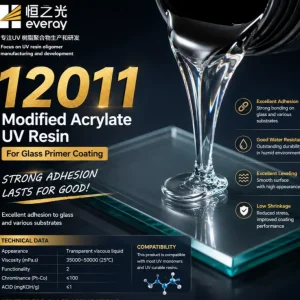
Special Functional Acrylate Oligomer Solutions Portfolio
Explore our complete industrial portfolio of low-shrinkage, boiling-water-resistant, rapid-cure, and vacuum-electroplating UV resins for European industrial manufacturing.
Partner Directly with a Leading Acrylate Oligomer Synthesis Factory
Elevate your radiation-cured coating and ink performance across Portugal and Europe. Request comprehensive technical datasheets, full batch Certificates of Analysis, or free 1kg laboratory screening samples today.
