The Northern German Manufacturing Ecosystem: Hamburg as a Radiation-Curing Vanguard
As Europe's third-largest port terminal hub and Northern Germany’s primary industrial nexus, Hamburg commands a pivotal position in advanced material conversion. The Elbe metropolitan region is not merely a logistics gateway; it houses high-concentration manufacturing clusters encompassing maritime and port cargo equipment maintenance, civil aeronautics sub-assembly (Hamburg-Finkenwerder), precision chemical processing, high-speed packaging converting (Harburg and Billbrook), and high-durability architectural wood finishing.
The regulatory and commercial demands of Hamburg-based enterprises have fundamentally transitioned toward volatile organic compound (VOC) elimination, driven by stringent European Union climate directives, German Federal Immission Control Acts (BImSchG), and stringent worker safety standards. Radiation-curable technology—specifically ultraviolet (UV) and electron beam (EB) crosslinkable acrylate oligomers—represents the definitive technological answer to this operational transition.
Modern formulators operating across the Port of Hamburg industrial parks require resin formulations that simultaneously meet ultra-rapid polymerization kinetics, complete cross-linking density under energy-efficient UV-LED light sources (365nm to 395nm), and unwavering chemical resistance against maritime salinity, hydraulic shear, and abrasive mechanical wear.
Airbus Ecosystem & Civil Aviation Coatings
Components and lightweight cabin polymers manufactured near Finkenwerder demand high-clarity aliphatic polyurethane acrylates that guarantee zero yellowing under continuous cockpit solar exposure and low outgassing characteristics under cabin pressure cycling.
Port Machinery & Marine Structural Priming
Marine atmospheric conditions in Waltershof and Altenwerder impose intensive cyclic humidity and salt corrosion. Custom-synthesized epoxy acrylate resins act as impenetrable chemical barriers, resisting electrolyte intrusion and UV degradation on metal equipment skins.
Systemic Industrial Applications
End-to-End Oligomer Solutions for German Technical Specifications
Targeted chemical architectures developed to overcome processing bottlenecks in automated production lines.
High-Line-Speed Food & Luxury Packaging
Packaging converters in Northern Germany require resins with ultra-low monomer migration profiles and negligible residual odor. Our modified polyester and hyperbranched acrylates exhibit instantaneous crosslinking under 395nm LED lamps, complying rigorously with Swiss Ordinance and Nestlé guidance standards for indirect food packaging.
Engineered Parquet & Furniture Coatings
Serving the demanding Central European architectural interior sector, our aromatic and aliphatic urethane oligomers provide outstanding Taber abrasion resistance, 4H–6H pencil hardness, and exceptional micro-scratch healing, maintaining pristine natural wood grain visuals with near-zero VOC release.
3D Photopolymer Resin Additive Formulations
Supplying the emerging rapid prototyping and additive manufacturing facilities across Hamburg and Lower Saxony, Ever Ray synthesizes low-shrinkage, low-viscosity dual-cure oligomers optimized for SLA, DLP, and LCD digital manufacturing, offering tensile modulus properties surpassing standard ABS plastics.
The radiation-cure industry is undergoing the most profound technological transformation in four decades. As Hamburg manufacturers phase out mercury-arc curing apparatus in observance of the Minamata Convention on Mercury, synthesis laboratories at Ever Ray have structured a comprehensive 5-year chemical roadmap targeting LED deep-cure efficiency, bio-renewable carbon mass balance, and circular monomer recyclability.
1. Deep-Through Curing for Long-Wavelength LED (395nm / 405nm)
Traditional oligomers synthesized for medium-pressure mercury arc lamps rely on short-wave UV light (200–300nm) for surface cure. Under mono-wavelength LED illumination, oxygen inhibition becomes a dominant operational failure mode, causing surface tackiness. Our chemical engineering team utilizes customized amino-functionalized acrylate backbones and auto-synergistic amine centers that permanently bond into the polymer matrix upon crosslinking. This chemical innovation neutralizes dissolved atmospheric oxygen without volatile amine blooming or post-cure migration.
Aligning with the European Green Deal and German Federal Climate Change Act targets, our R&D roadmap systematically substitutes petrochemical polyols and isocyanates with bio-succinic acid, cardanol derivatives, and vegetable-oil-derived polyols. Our target generation of polyester and polyurethane acrylates maintains bio-based carbon contents ranging between 35% and 65% (ASTM D6866 certified) while matching or exceeding the chemical resistance and glass transition temperature (Tg) profiles of virgin fossil-fuel equivalents.
3. Dual-Cure Hybrid & Waterborne UV-PUD Platforms
For complex three-dimensional automotive components and shadowed undercuts prevalent in Hamburg’s manufacturing facilities, single-cure radiation chemistry often encounters shadowed zones where radiation cannot reach. Our dual-cure architectures unite UV-curable acrylate unsaturation with secondary moisture-curable isocyanate or thermal-curable epoxy functionality. Simultaneously, our zero-solvent waterborne polyurethane acrylate dispersions (UV-PUD) deliver sub-micron film uniformity on heat-sensitive substrates like veneers and thermal paper.
>99.2%
Double-Bond Conversion Rate
<50 ppm
Residual Free Monomer Threshold
0.0 g/L
VOC Content in 100% Solid Systems
ΔE < 0.8
QUV 1,000hr Weathering Stability
Global Supply Chain Architecture
China Industry 4.0: Scaled Precision Synthesis & Direct Hamburg Supply Security
Established in 2006, Guangdong Ever Ray Environmental Material Co., Ltd. operates a state-of-the-art production base spanning over 40,000 square meters in Yunfu, Guangdong, complemented by corporate R&D operations in Jiangmen. Operating within modern chemical industrial parks, our facilities leverage Distributed Control Systems (DCS) for fully automated molecular weight synthesis, exothermic reaction control, and real-time vacuum distillation.
For Hamburg procurement directors, material reliability requires more than chemical perfection; it requires uninterrupted supply chain resilience. Traditional European chemical manufacturing has faced acute vulnerabilities stemming from localized energy price volatility, intermediate feedstock allocation caps, and regulatory force majeure. Ever Ray bridges this operational divide through vertical upstream integration of basic acrylic acid, polyols, and special functional monomers.
Automated Batch-to-Batch Consistency: Automated closed-loop reactor feedback eliminates operator variability, guaranteeing viscosity tolerances within ±5% and color indices within Gardner 1.0.
Dedicated Direct Logistics from Maritime Gateways: Interconnected with direct deep-sea carrier departures from Shenzhen and Guangzhou directly to Port of Hamburg container terminals (CTA / CTT) with standard ocean transit buffers.
Temperature-Stabilized Climate Cargo: Sensitive acrylate oligomers are transported in climate-stabilized ISO-tanks or nitrogen-purged 200L steel drums equipped with thermal monitoring to ensure zero premature thermal polymerization during transit.
Quality Assurance: Multi-Stage Analytical Release
Every industrial production batch undergoes rigorous analytical characterization prior to commercial export release: Gel Permeation Chromatography (GPC) for molecular weight distribution, Fourier-Transform Infrared Spectroscopy (FTIR) for functional conversion confirmation, and Brookfield viscometry under precisely regulated temperatures.
Agile Formulation Tailoring
Unlike monolithic multinational chemical conglomerates, Ever Ray provides dedicated bench-scale optimization for Hamburg customers. Whether modifying viscosity for specific gravure printing heads or adjusting hydroxyl values for intercoat adhesion, our technical team completes custom synthesis iterations in under 15 business days.
Regulatory & Quality Framework
Strict Regulatory Compliance: German DIN Standards & EU REACH Authorization
Importing high-performance industrial chemicals into the European Union and Germany demands flawless regulatory alignment. Ever Ray actively maintains comprehensive compliance structures engineered to protect downstream compounders, blenders, and brand owners in Hamburg from operational friction or non-compliance exposure.
Full EU REACH Compliance
All core acrylate oligomers, reactive diluents, and synergistic additives synthesized by Ever Ray are fully registered or conform to polymer exemption provisions under EU Regulation (EC) No 1907/2006 (REACH). We provide valid Only Representative (OR) certification and complete tonnage tracking for direct German customs clearance.
SVHC & GHS Material Safety
Zero content of Substances of Very High Concern (SVHC) per the current European Chemicals Agency (ECHA) candidate list. Complete localized 16-section Safety Data Sheets (SDS) are generated according to Regulation (EU) 2020/878 in both German and English, complete with assigned UFI codes.
DIN & ISO Standardized Testing
Our analytical and application laboratories evaluate cured cross-linked polymers against authoritative German and international standards: DIN 53150 (cure assessment), DIN EN ISO 2409 (cross-cut adhesion), DIN 68861 (furniture surface chemical resistance), and DIN 53157 (pendulum damping hardness).
Strategic Procurement Operations
Addressing the Procurement Mandates of Hamburg Chemical & Manufacturing Formulators
Empowering procurement directors, technical chemical engineers, and product managers to achieve cost containment and raw material superior performance.
Total Cost of Ownership (TCO) Optimization
By eliminating multiple European trading intermediaries and procuring directly from our primary Guangdong synthesis reactors, Hamburg manufacturing operations reduce raw material acquisition expenditure by 18% to 32% while simultaneously locking in multi-quarter price stability contracts.
Dual-Sourcing Strategic Buffer
Prudent supply chain management mandates diversification away from concentrated single-geography suppliers. Ever Ray acts as the tier-one secondary synthesis authority for multinational German corporate formulators, guaranteeing production continuity during regional plant turnarounds.
Dedicated Export Packaging & Documentation
Shipments destined for Hamburg are packed in UN-certified drums, IBC totes, or custom ISO tanks, outfitted with tamper-evident nitrogen seals, bilingual labeling, and integrated desiccant systems to maintain low moisture profiles throughout oceanic transit.
Advanced Chemical Portfolio
High-Performance Acrylate Resins & Specialty Solutions for Industrial Hamburg Lines
Engineered oligomer chemistries developed for flexography, low-shrinkage barrier coatings, vacuum metallization, and waterborne wood applications.
Frequently Asked Questions: Industrial Radiation Curable Formulations in Germany
Authoritative technical answers directly from Ever Ray's senior polymer synthesis chemists and export logistics directors.
How does Ever Ray guarantee EU REACH compliance for direct imports through the Port of Hamburg?
Every chemical product supplied by Ever Ray to customers in Hamburg, Schleswig-Holstein, and Lower Saxony is fully compliant with EU Regulation (EC) No 1907/2006 (REACH). We operate with established European Only Representatives (OR) who maintain legal tonnage registrations for our monomers and oligomer precursors. Comprehensive Certificates of Compliance (CoC), official REACH registration dossiers, and full European Safety Data Sheets (eSDS) are systematically provided alongside shipping manifests to ensure seamless clearance at the Hamburg Port Customs Office (Zollamt Hamburg).
What is the typical shipping lead time and logistical procedure from your China factory to Hamburg?
From our primary production complex in Yunfu, Guangdong, sealed export orders are transported via domestic bonded transit to either the Port of Shenzhen (Yantian) or Port of Guangzhou (Nansha). Standard deep-sea transit to Hamburg container terminals (such as CTA Altenwerder or Eurogate CTT) takes approximately 26 to 32 days via direct express shipping routes. For emergency pilot testing or urgent reformulation requirements, sample consignments (1kg–20kg) and express air-cargo shipments arrive at Hamburg Airport (HAM) within 4 to 6 business days.
Which oligomer family is recommended to replace conventional solventborne coatings on wood parquet in German facilities?
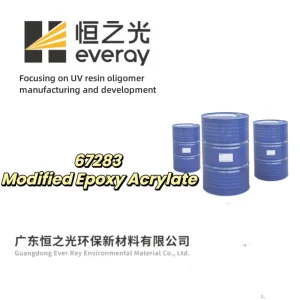
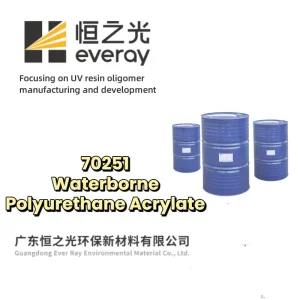
To satisfy German BImSchG VOC restrictions while meeting DIN 68861 chemical durability standards, formulators typically utilize a combination of our 67283 or 6100D-85 modified epoxy acrylates for the primary sanding sealer (providing rapid sandability, strong grain penetration, and high hardness), topped with an aromatic or aliphatic polyurethane acrylate such as 7296-1 or 7600. For zero-VOC environmental requirements, our waterborne 70251 UV-PUD dispersion offers unmatched natural grain clarity with zero hazardous air pollutants.
How do your polyester acrylates prevent ink emulsification in high-speed offset printing presses?
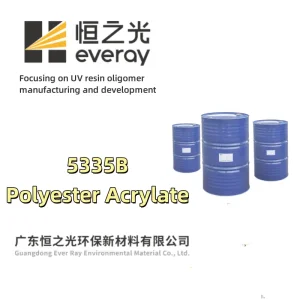
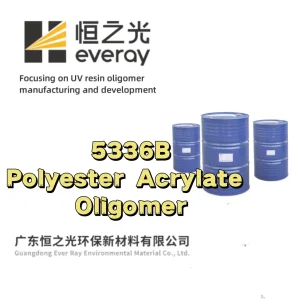
In modern commercial offset printing presses running up to 18,000 sheets per hour, excessive fountain solution uptake leads to severe emulsification, ink spitting, and scumming. Grades like 5336B and 5403-3F are synthesized with balanced hydrophilic-lipophilic balance (HLB) values. The controlled polarity of our polyester backbones ensures pristine pigment wetting while restricting water pickup within the optimal 12%–18% processing window, ensuring rapid surface cure and razor-sharp halftone dot reproduction.
Can Ever Ray customize resin viscosity and glass transition temperature (Tg) for proprietary German formulations?
Yes. Custom chemical development is a cornerstone of our enterprise capability. Our R&D team can adjust molecular weight, functionality (from difunctional to hexafunctional), isocyanate backbones (aliphatic vs. aromatic), and monomer diluent cut ratios (e.g., TPGDA, TMPTA, DPGDA, or HDDA) to achieve targeted viscosity parameters, precise Tg thresholds (from -20°C up to +105°C), and specific refractive indices for optical bonding.
What measures are taken to prevent premature thermal polymerization during oceanic transit through the tropics?
Acrylate monomers and oligomers are thermally responsive free-radical systems. For trans-equatorial maritime voyages destined for Hamburg, our synthesis protocols integrate carefully calibrated proprietary non-phenolic inhibitor systems (such as high-efficiency MEHQ derivatives combined with dissolved oxygen maintenance). All export shipments are certified via accelerated thermal storage stability tests (60°C for 30 consecutive days) to ensure absolute viscosity stability and shelf life exceeding 12 months upon arrival.
Request Technical Dossiers or Custom Batch Formulations
Connect directly with Ever Ray’s material engineers to request samples, full TDS/SDS documentation, or tailored oligomer synthesis for Hamburg operations.