Featured Engineering Grades for Automotive & High-Speed Curing
Formulated to satisfy strict VOC limits, rapid tack-free line speeds, and superior substrate adhesion on industrial plastics, metals, and composite substrates across Mexican assembly plants.
Epoxy Acrylate · Surface Leveling
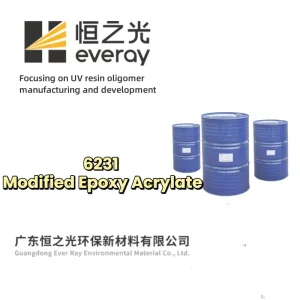
6231 Modified Epoxy Acrylate for Mexican Automotive & Industrial Clearcoats
High gloss, rapid UV cross-linking, zero cratering on automated spray and roller lines in Nuevo León and Querétaro facilities.
The Mexican Industrial Renaissance: Photopolymer Demands in the Nearshoring Era
How the global supply chain reconfiguration is driving unprecedented demand for solvent-free, fast-cure oligomers across Mexico’s premier industrial corridors.
Mexico's manufacturing base is undergoing an epochal transformation. Driven by the United States-Mexico-Canada Agreement (USMCA) rules of origin and the rapid nearshoring movement, international Tier-1 automotive conglomerates, contract electronics manufacturers (CEMs), and high-capacity packaging converters are investing billions into operations throughout Nuevo León, Coahuila, Guanajuato, Querétaro, San Luis Potosí, and Baja California. As production lines transition from legacy solvent-borne finishes to eco-compliant, energy-efficient Ultraviolet (UV) and Electron Beam (EB) curing architectures, the procurement requirements for high-performance acrylate oligomers and specialized reactive resins have reached record highs.
In Mexican assembly hubs, standard off-the-shelf resins often fail under localized production conditions. High daytime ambient temperatures in northern states like Sonora and Chihuahua, combined with severe thermal cycling across automotive interior dashboards, demand UV formulations with extreme glass transition temperatures (Tg), high chemical resistance, and non-yellowing aliphatic polymer backbones. Formulators supplying the automotive Tier-1 ecosystem require stringent compliance with OEM test specifications including ASTM D3359 cross-hatch adhesion, ASTM D523 specular gloss retention, and rigorous boiling-water vapor condensation challenges.
Automotive Tier-1 & Tier-2
Providing weathering-resistant aliphatic urethane acrylates (PUA) for exterior lighting housings, steering wheel consoles, and head-up display anti-scratch clearcoats conforming to GM, Ford, and VW standards.
3C Consumer Electronics Maquiladoras
Fast-cycling, low-dielectric constant resins for conformal electronics encapsulation, smart meter housings, telecommunications transceivers, and optical display bonding glues in Guadalajara and Tijuana.
High-Barrier Flexible Packaging
Direct low-migration polyester acrylate resins for flexographic and energy-curable offset printing presses serving Latin America’s massive food, beverage, and pharmaceutical export sectors.
Moreover, Mexican environmental oversight via SEMARNAT (Secretaría de Medio Ambiente y Recursos Naturales) and local municipal air-quality mandates have accelerated the abandonment of solvent-laden polyurethane and nitrocellulose lacquer finishes. Industrial formulators in Mexico are seeking raw material producers who can deliver consistent 100% solids UV-curable prepolymers that combine sub-second curing cycles with zero volatile organic compound (VOC) emissions.
Resolving critical engineering hurdles: overcoming oxygen inhibition, controlling shrinkage stress on polar substrates, and optimizing UV-LED 385–395nm spectrum curing.
The physics and chemistry of free-radical ultraviolet polymerization in automated high-throughput manufacturing present three persistent bottlenecks: surface oxygen inhibition, volumetric cure shrinkage, and interfacial adhesion failure on low-surface-energy polyolefins and inorganic glass. Our continuous synthesis R&D has engineered specific structural modifications within the oligomer backbone to directly neutralize these physical limitations:
Overcoming Atmospheric Oxygen Inhibition in Thin-Film Lines
In fast-moving offset printing, OPV varnishing, and spray-coating lines operating above 60 meters/min in Monterrey and Guadalajara plants, atmospheric oxygen actively quenches free-radicals at the air-coating interface, leading to incomplete conversion, tacky residual monomer, and diminished mar resistance. By incorporating built-in tertiary amino acrylate groups and high-reactivity hyperbranched dendritic polymer topologies, our resins donate labile alpha-hydrogens that rapidly react with peroxy radicals, regenerating chain-propagating alkyl radicals. This self-synergizing mechanism slashes reliance on costly photoinitiator packages while ensuring tack-free curing under standard mercury arc and energy-efficient 395nm UV-LED lamps.
Minimizing Volumetric Shrinkage to Preserve Micro-Adhesion
Standard tri- and tetra-functional acrylates frequently exhibit cure shrinkage rates exceeding 7% to 11% due to rapid double-bond conversion and van der Waals distance collapse. On rigid substrates—such as borosilicate automotive glass, cold-rolled steel, and high-crystallinity plastics (PC, ABS, PET)—this internal stress pulls the cured crosslink network away from the substrate, resulting in spontaneous delamination. Our proprietary functional modified acrylates incorporate flexible soft segments (polycaprolactone, polyether chains) and alicyclic ring structures that dramatically absorb contraction stresses, capping volumetric shrinkage below 1.5% while achieving 5B cross-hatch adhesion without requiring aggressive corona or flame pretreatment.
Phase 1: LED Optimization
365 / 385 / 395nm Narrowband Curing
Customizing oligomer double-bond reactivity and extinction coefficients to match solid-state LED arrays, slashing thermal loading on thin substrates by 65%.
Phase 2: Hybrid Systems
Photo-Thermal Dual-Curing
Combining UV front-curing for instantaneous structural locking with secondary moisture- or thermal-activated cross-linking for deep opaque cavities.
Phase 3: Eco-Dispersions
Zero-VOC Waterborne PUA
Self-emulsifying aqueous polyurethane acrylates delivering industrial solvent resistance with pure water dilution for closed-loop sustainability.
Phase 4: High-Performance Polymers
Hyperbranched Dendritic Architectures
Ultra-high functionality (6 to 12 acrylate moieties) with exceptionally low Newtonian viscosity for sprayable, diamond-hard anti-abrasion finishes.
Smart Manufacturing Excellence
China Factory 4.0: Scaled Synthesis, DCS Precision & Trans-Pacific Resilience
How Guangdong Ever Ray Environmental Material Co., Ltd. delivers rock-solid batch reproducibility, cost containment, and rapid maritime logistics directly to Mexican ports.
In specialty chemical manufacturing, raw material pricing volatility and batch-to-batch inconsistency can shut down an entire automotive assembly line or flexographic printing facility. As an established synthesis power located in Yunfu, Guangdong, with commercial headquarters in Jiangmen, Guangdong Ever Ray Environmental Material Co., Ltd. (operating since 2006) operates a specialized 40,000+ square-meter production complex equipped with 10 fully automated multi-ton synthetic reactor trains.
Our synthesis operations are managed via integrated Distributed Control Systems (DCS) and SCADA automation. Feed ratios of key precursors—including isophorone diisocyanate (IPDI), toluene diisocyanate (TDI), bisphenol A diglycidyl ether, hydroxyethyl acrylate (HEA), and chain extenders—are metered by micro-motion Coriolis mass flow controllers with an accuracy of ±0.05%. Every synthesis phase, from exothermic addition to polymer chain propagation and vacuum stripping of residual volatiles, is tracked in real-time, preventing gel formation and guaranteeing that every metric ton dispatched matches certified specifications.
Analytical QC Laboratory
Every lot undergoes Gel Permeation Chromatography (GPC) for molecular weight distribution, Fourier-Transform Infrared (FTIR) spectroscopy for acrylate conversion verification, Brookfield cone-plate rheometry, and Gardner color testing.
Trans-Pacific Freight Lanes
Streamlined logistics routes from Shenzhen, Nansha, and Hong Kong direct to Manzanillo, Colima and Lázaro Cárdenas, Michoacán, achieving port-to-port ocean transit in just 18 to 22 calendar days.
Standardized Industrial Packaging
Shipments available in UN-certified 200 kg steel drums, 1,000 kg heavy-duty intermediate bulk containers (IBCs), or temperature-monitored ISO tank containers, nitrogen-blanketed with thermal stabilizers to ensure 12+ months shelf stability.
For Mexican enterprises operating under tight JIT (Just-in-Time) production schedules, our scaled backward integration into key intermediates protects procurement directors from the supply shocks and extreme spot-market price swings typical of smaller compounders and intermediaries.
Mexican Regulatory & Customs Integration
Compliance Safeguards: NOM Standards, IMMEX Regime & Customs Clarity
Navigating Mexican hazardous material regulations, tariff classification codes (Fracción Arancelaria), and bilateral documentation seamlessly.
Importing specialized photopolymer resins into Mexico requires meticulous alignment with national safety frameworks and customs protocols. Ever Ray provides end-to-end technical and administrative documentation to support your customs broker (Agente Aduanal) and regulatory compliance officers:
NOM-018-STPS-2015 Harmonization
Every shipment is accompanied by bilingual (English/Spanish) Safety Data Sheets (Hojas de Datos de Seguridad - HDS) fully aligned with the Globally Harmonized System (GHS) mandated by the Mexican Ministry of Labor and Social Welfare (STPS).
IMMEX & PROSEC Compatibility
For maquiladora enterprises operating under the IMMEX program, our detailed Certificates of Analysis (COA) and verified Country of Origin declarations enable duty deferral and streamlined temporary importation without administrative roadblocks.
Standardized HTS Tariff Mapping
Pre-classified Harmonized System codes (e.g., Chapter 3907 and 3909 for polyurethane and polyether resins; Chapter 3208/3906 for acrylic polymers) ensure transparent customs valuation and expedited clearance through Mexican maritime customs.
Our application engineers also provide on-demand consultation in English to guide your laboratory technicians on formulation troubleshooting, cross-linker balancing, and substrate preparation, bridging geographical distances with actionable technical support.
Explore our specialized chemical grades engineered for glass adhesion, water resistance, optical bonding, plastic spray coats, and high-speed packaging inks.
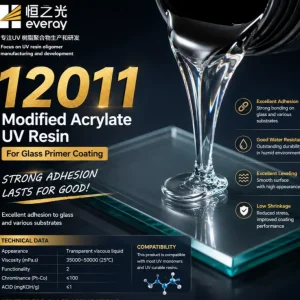
Glass Primer · Hydrothermal Defense
12011 Modified Acrylate UV Resin for Glass Primer & Architectural Panels
Surpasses 100°C boiling water immersion testing; extreme anchor adhesion to inorganic silica and smooth metals.
Strategic Procurement Standards: How Multinational Formulators Audit Ever Ray
Meeting the strict quality qualification protocols of Fortune 500 chemical companies and Tier-1 automotive coating suppliers operating throughout North America.
Corporate procurement directors and chief formulation chemists cannot afford product variability. When a multi-ton batch of prepolymer is integrated into an industrial coating formula, any fluctuation in hydroxyl value, acid value, or residual monomer content triggers viscosity shifts, cure inhibition, or catastrophic line down-time. Ever Ray adheres to rigorous international qualification procedures:
Triple-Stage Quality Auditing
Every delivery is verified against strict raw material incoming inspection (IQC), continuous in-process control (IPQC) of synthesis progress, and full outgoing quality inspection (OQC) testing with archival lot retention for 24 months.
Comprehensive Regulatory Dossiers
Full support for RoHS 3 (EU 2015/863), REACH compliance dossiers, California Proposition 65 assessments, and halogen-free certifications required by international brands selling finished goods into the US and EU markets.
Sample-to-Production Fidelity
We guarantee 100% chemical composition fidelity between 1 kg lab evaluation samples and full 20-ton commercial container shipments, eliminating the re-engineering cycles common when scaling up formulations.
Expert Knowledge Base
Frequently Asked Questions: UV Resins for the Mexican Industrial Market
Key technical, regulatory, and logistics answers for laboratory chemists, production directors, and chemical procurement officers.
What are the lead times and shipping routes for bulk UV resin shipments from China to Mexico?
Our standard production cycle for standard grades is 7 to 10 working days. Ocean freight from major Southern China ports (Shenzhen/Nansha/Hong Kong) direct to Mexico’s primary Pacific container ports—Puerto de Manzanillo (Colima) or Puerto de Lázaro Cárdenas (Michoacán)—takes approximately 18 to 22 calendar days. For urgent factory line-trials or technical qualification samples (1 kg to 20 kg), we dispatch air cargo via Guadalajara International Airport (GDL) or Mexico City (MEX), reaching your testing facility within 4 to 6 business days.
How do Ever Ray's polyurethane acrylates (PUA) perform under extreme desert heat in Northern Mexico?
In assembly centers like Mexicali, Ciudad Juárez, and Saltillo, summer manufacturing and service temperatures place heavy thermal stresses on coatings. Our aliphatic polyurethane acrylate series utilizes premium isophorone diisocyanate (IPDI) and hydrogenated backbones rather than aromatic TDI rings. This prevents thermal degradation, yellowing, and brittleness under intense solar exposure, retaining elasticity, gloss, and impact resistance across continuous operating ranges of -40°C to +120°C.
Can Ever Ray synthesize custom oligomers to match our specific viscosity and curing wavelength?
Yes. Our senior polymer chemists specialize in tailoring oligomer molecular weight, acrylic functionality, and diluent packages. If your production line is transitioning to 385nm or 395nm UV-LED curing systems, or if your automated spray machinery requires a precise viscosity window without added solvent, we can tailor the polymer architecture and provide trial batches alongside comprehensive Gel Permeation Chromatography (GPC) and rheology profiles.
What documentation is provided to clear Mexican Customs and comply with STPS safety rules?
Every shipment arrives with a complete commercial and compliance package: certified Bill of Lading (B/L), Commercial Invoice, Packing List, Certificate of Origin, and a batch-specific Certificate of Analysis (COA). Furthermore, we provide Spanish-language Safety Data Sheets (Hojas de Datos de Seguridad) formatted in strict adherence to NOM-018-STPS-2015, ensuring seamless clearance with your Agente Aduanal and immediate workplace safety compliance inside your Mexican facility.
How do your resins solve adhesion failures on inorganic glass and smooth metals?
Our specialty modified acrylate series (such as 12011 and 17730A-2) integrates specialized organosilane and phosphoric acid ester functional groups into the polymer structure. These reactive functional groups form strong covalent and coordination bonds with inorganic Si-OH groups on glass and metal oxide lattices. Simultaneously, low volumetric shrinkage eliminates internal shear stress, allowing the cured film to easily pass the ASTM D3359 5B cross-hatch tape test and resist prolonged boiling-water immersion without peeling.
Accelerate Your Mexican Manufacturing Advantage
Partner directly with a certified synthesis manufacturer for guaranteed batch stability, factory-direct pricing, and technical support.