
High-Performance Functional Resins Formulated for Thai Manufacturing
Engineered to mitigate oxygen inhibition and moisture sensitivity in Southeast Asian coastal conditions, these flagship formulations provide high curing reactivity and superior adhesion.
High Adhesion 1100UV Oligomer for Thai UV Coatings & Inks
Low Viscosity 1262B: Suitable for PVC Floor Applications
Low Shrinkage 1290H Resin for PVC & Hybrid Floor Coatings
Antifouling 1291B-1 UV Resin for High-End Topcoats
The Transformation of Thailand’s Advanced Manufacturing: Navigating High-Speed UV/EB Demands
As Thailand accelerates its "Thailand 4.0" economic model, the manufacturing core concentrated in the Eastern Economic Corridor (EEC)—spanning Rayong, Chonburi, and Chachoengsao—is witnessing an unprecedented structural upgrade. Driven by strong foreign direct investments across the automotive (the renowned "Detroit of Asia"), consumer electronics packaging, rigid PCB fabrication, and vinyl flooring export sectors, the demand for high-end specialty chemicals has evolved far beyond conventional commodity monomers.
Industrial formulators across Samut Prakan, Pathum Thani, and Rayong are confronted with a unique technical duality: they must satisfy international standards for optical clarity, scratch resistance, and chemical resilience, while operating within the demanding climatic parameters of Southeast Asia. High average relative humidity (frequently exceeding 80% RH) and elevated ambient production temperatures (32°C–38°C) fundamentally alter free-radical photopolymerization kinetics. Conventional imported resins often suffer from severe oxygen inhibition, surface micro-wrinkling, plasticizer migration, and premature thermal gelation during storage.
Our dedicated synthetic acrylate oligomers provide the necessary chemical intervention. By precisely configuring hyperbranched structures, adjusting the backbone urethane/ester molecular weights, and incorporating internal amine synergists, our materials offer Thai manufacturers robust processing windows, predictable viscosity-temperature profiles, and defect-free curing under both traditional mercury vapor arcs and modern energy-saving UV-LED lines.
Thailand EEC Operational Metrics
Key parameters required by Thai Tier-1 formulators and global brand supply chains:
- Tropical Stability: 60°C accelerated thermal aging >30 days without gelation
- Fast Line Speed: Tack-free cure at up to 60 m/min under 395nm LED UV sources
- Direct RCEP Route: Direct maritime transit from South China to Laem Chabang within 4–6 days
- Green Compliance: Zero free VOC, SVHC-compliant, conforming to Thai DIW mandates
Transit to Laem Chabang Port
Photochemical Curing Conversion
Ultra-Low Shrinkage Stress
Form-E Preferential Import Tariff
Engineering Solutions for Core Thai Manufacturing Sectors
Addressing explicit localized failure points across automotive interiors, electronic components, export flooring, and food packaging print.
Automotive Plastic & Smart Cockpit Coatings
Serving Rayong’s leading automotive cluster, our aliphatic polyurethane acrylates (PUA) achieve the delicate equilibrium required for PC/ABS cockpit components: pencil hardness >3H paired with outstanding elongation (>40%) to pass rapid thermal cycle shocks (-40°C to 85°C) without micro-cracking.
- High chemical resistance to hand creams, sweat, and sanitizers
- Extreme non-yellowing aliphatic backbones (ΔE < 0.5 under QUV)
- Superior leveling on complex molded 3C geometry
Export-Grade SPC & Luxury Vinyl Tile (LVT)
Thailand is a primary global manufacturing node for rigid vinyl flooring exported to North America and Europe. Our specialty modified acrylate oligomers resolve key SPC failure modes: heavy plasticizer migration, poor stain resistance, and surface micro-scratches from intense transit vibration.
- Taber abrasion resistance exceeding 4,000 cycles (CS-17)
- Superb micro-matting capability down to 3–5 GU at 60°
- Ultra-low shrinkage avoids substrate warping and dimensional shifts
Low-Migration UV Offset & Flexo Printing Inks
With Bangkok and Samut Sakhon housing leading food packaging converters, ink manufacturers demand oligomers with zero migratory residual components. Our amino acrylates and hyperbranched polyester acrylates yield exceptional ink-water balance, fast curing, and low odor profiles.
- Rapid free-radical initiation suppressing oxygen inhibition
- Excellent pigment wetting for carbon black and organic pigments
- Full compliance with Nestlé Guidance and Swiss Ordinance lists
Technical Specification & Performance Mapping
Comparative physical-chemical properties for resin engineers selecting optimal molecular weights and functionalities.
| Oligomer Chemical Class | Acrylate Functionality | Viscosity (mPa·s @ 25°C) | Tg (°C) | Curing Mechanism | Primary Industrial Substrates | Key Performance Attribute |
|---|---|---|---|---|---|---|
| Aliphatic Urethane Acrylate (High Functionality) | 6 – 9 | 15,000 – 35,000 | +65 | UV / LED / EB | PC, PMMA, Treated PET, ABS | Extreme Scratch & High Chemical Resistance |
| Modified Epoxy Acrylate | 2 | 4,000 – 12,000 (with TPGDA) | +52 | Broadband Arc / UV-LED | Hardwoods, MDF, Metal Primers | Fast Surface Reactivity, High Hardness |
| Hyperbranched Polyester Acrylate | 6 – 12 | 800 – 2,500 | +38 | High-Speed UV / LED | Paperboard, BOPP, Foils | Ultra-Low Viscosity, Minimal Oxygen Inhibition |
| Adhesion-Promoted Acid-Functional Oligomer | 2 – 3 | 6,000 – 18,000 | +15 | UV / Dual-Cure Moisture | Untreated Aluminum, Glass, Tinplate | 100/100 Cross-Hatch Adhesion, Boiling Water Stability |
| Aliphatic Flexible Urethane Acrylate | 2 | 8,000 – 20,000 | -25 | UV-LED / 395nm Low Energy | TPU, Soft PVC, Silicone Rubber | Elongation >180%, Zero Micro-Cracking |
| Fluorine/Silicone Modified Acrylate | 2 – 4 | 1,200 – 4,500 | +22 | UV Arc / LED Topcoat | Optical Films, Decorative Laminates | Anti-Smudge, Oleophobic (Contact Angle >110°) |
China-to-Thailand Direct Logistics Advantage
Operating out of our advanced chemical synthesis industrial parks in Guangdong, China, our supply chain is architecturally aligned with ASEAN maritime express channels:
- Port-to-Port Velocity: Nansha / Shekou to Laem Chabang Port in 4 days regular transit.
- Form E Tariff Elimination: Under China-ASEAN Free Trade Agreement (ACFTA) & RCEP, 0% import customs tariff.
- Climatic Packaging Protocol: UN-certified anti-surge steel drums (200kg) and composite IBCs (1000kg) with internal nitrogen inerting.
- Batch-to-Batch Integrity: Continuous DCS automatic control ensures viscosity variance <3% and color Delta E <0.2.
Supply Chain Resilience vs. European & US Monopolies
Historically, Thai formulators relied heavily on legacy chemical conglomerates headquartered in Europe and North America. However, frequent geopolitical chokepoints, volatile transatlantic shipping costs, and extended lead times of 8 to 14 weeks have severely disrupted just-in-time manufacturing schedules throughout Samut Prakan and Chonburi.
By partnering directly with a primary Chinese synthetic manufacturer, Thai chemical companies gain structural resilience. Our upstream integration into critical basic feedstocks—acrylic acid, isocyanates (IPDI, HDI, TDI), polyols, and specialty glycols—shields our partners from raw material market shocks. We maintain comprehensive inventory buffers and offer customized blending configurations to match specific Thai line speeds and lamp power settings.
Furthermore, each commercial export container is accompanied by complete COA documentation detailing molecular weight distribution via Gel Permeation Chromatography (GPC), residual monomer concentration via GC-MS (guaranteed <0.05%), and precise hydroxyl/acid values.
Regulatory Compliance & Local Technical Support Framework
Ensuring compliance with Thai environmental regulations and supporting rapid formula optimization.
Thai DIW & Hazardous Act B.E. 2535
All supplied acrylate polymers are pre-screened to verify non-inclusion in the Department of Industrial Works (DIW) Type 3 or Type 4 restricted chemical annexes. We provide Thai-translated GHS-compliant Safety Data Sheets (SDS) and complete CAS registration documentation for expedited customs clearance.
Formulation Troubleshooting & Lab Trials
Our dedicated technical support team works directly with Thai formulation chemists to eliminate surface wrinkling, oxygen inhibition under humid conditions, and substrate wetting issues. We offer pilot sample kits (1kg, 5kg, 20kg) with full starting point formulations for rapid laboratory replication.
Global Ecological Standard Alignment
Our resins comply fully with international consumer safety directives including RoHS 3.0, REACH SVHC <0.1% w/w, Sony Green Partner requirements, and halogen-free criteria (IEC 61249-2-21), empowering Thai manufacturers to export with complete confidence to the European Union and the United States.
Technical Roadmap: Sustainable & High-Precision UV Resins (2025–2030)
Strategic technological developments targeting energy reduction, bio-renewability, and high-frequency digital fabrication.
Pioneering Sustainable Photopolymer Chemistry for ASEAN
As international ESG mandates and carbon border adjustment mechanisms (such as the EU CBAM) redefine global trade, Thai export-oriented factories face increasing pressure to lower the embodied carbon footprint of their coatings and laminates. Our R&D pipeline has commercialized sustainable, high-performance alternatives designed for seamless integration into existing lines:
- Bio-Based Acrylate Oligomers: Resins utilizing up to 45% bio-derived carbon content (derived from modified soybean oil, itaconic acid, and bio-succinic acid) without compromising Tg or hardness.
- Ultra-Low Energy UV-LED Systems: Oligomers specifically reactive at 365nm, 385nm, and 395nm LED wavelengths, reducing operational energy consumption by over 60% compared to medium-pressure mercury lamps.
- Self-Matting Hyperbranched Resins: Innovative dendritic architectures that phase-separate at micro-scales during photocuring, providing dead-matte finishes without silica matting agents that increase viscosity.
Future-Ready Synthesis Capabilities
We are actively collaborating with advanced electronics and 3D additive manufacturing ventures in Bangkok and Rayong, developing photopolymer precursors for sub-micron SLA/DLP micro-optics and high-temperature stereolithography resins (Tg >160°C).
Our dedicated synthetic pilot plant accommodates customer-specific functionalization—including silane graftings, fluorinated end-capping, and ionic self-emulsifying waterborne UV PUD chemistries.
Inquire About Custom SynthesisFrequently Asked Questions: Chemical Formulation & Supply to Thailand
Direct technical answers to common engineering, logistical, and commercial inquiries.
High ambient humidity in tropical industrial regions accelerates the quenching of free radicals by atmospheric triplet oxygen. We solve this by chemically incorporating copolymerizable tertiary amine structures into the oligomer backbones (such as in our amino acrylate families) and engineering high double-bond conversion hyperbranched backbones. The amine donates a hydrogen atom to peroxy radicals, generating reactive aminoalkyl radicals that consume dissolved oxygen and maintain ultra-fast surface crosslinking.
Our standard commercial shipments depart weekly from Nansha or Shekou ports directly to Laem Chabang or Bangkok (Klong Toey) Port, with ocean transit requiring only 4–6 days. Our typical export MOQ is 800 kg (4 x 200kg steel drums) or 1 standard 1000kg IBC. For custom synthetic polymers, the pilot MOQ is 500 kg, and trial sample canisters (1kg to 20kg) are dispatched via DHL/FedEx within 48 hours.
Our modern synthesis facilities utilize computerized Distributed Control Systems (DCS) monitoring real-time temperature, exothermic addition profiles, and vacuum stripping rates. Each commercial batch undergoes rigorous QC testing: viscosity measured via Brookfield CAP2000+, refractive index, colorimetric evaluation (ΔE < 0.2 against retain master), and Gel Permeation Chromatography (GPC) to verify polydispersity indices (PDI) remain within ±3% tolerances.
Yes. Our specialized modified acrylate oligomer grade 12011 is engineered with covalently bonded chelation-capable phosphate and carboxyl functional groups. These groups create strong co-ordinate and covalent bonds with the silanol (Si-OH) networks on glass substrates upon photocuring, easily passing the rigorous 2-hour 100°C boiling water cross-hatch test (ASTM D3359 Method B, 5B) without requiring post-addition of fragile silane coupling agents.
Special Functional Acrylate Oligomer Grade Portfolio
Engineered monomers, modified epoxy acrylates, and specialty oligomers ready for immediate dispatch to Thai production plants.
1200A UV Resin: Density-Board & Metal Primer
17701 Low Shrinkage Modified Acrylate for Film Inks
High-Solid Low-Viscosity Highly Elastic UV Acrylic Resin
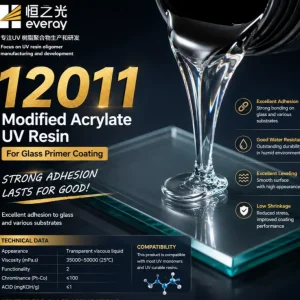
12011 Modified Acrylate Resin: Boiling Water Resistant
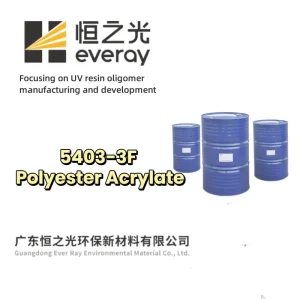
5403-3F Polyester Acrylate: Optimal Water-Ink Balance
12011 Specialized Adhesion Oligomer for Architectural Glass
1100UV High Polar Affinity Acrylate for Thai Formulators
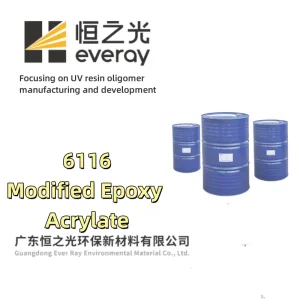
6116 Universal Multi-Substrate UV Resin for Industrial Ink
Accelerate Your UV Formulation Performance Today
Connect directly with our senior polymer synthesis team. We provide complete technical data packages, starting formulations, regulatory compliance certifications, and trial sample drums shipped directly to your manufacturing facilities in Thailand.
