Featured UV Reactive Oligomers & Functional Polymers
Engineered to overcome industrial formulation bottlenecks: eliminating substrate delimitation, suppressing volumetric cure shrinkage, accelerating dual-cure mechanics, and providing zero-yellowing optical clarity.
Global Industrial Dynamics & The Decarbonization Paradigm in UV/EB Polymer Chemistry
From thermal solvent-evaporation to near-instantaneous radiation curing: how advanced oligomer architecture powers volatile organic compound (VOC) reduction and line-speed acceleration across heavy industry.
Solvent Elimination & Zero-VOC Mandates
Global regulatory bodies including the EU European Chemicals Agency (REACH), US EPA (Clean Air Act Title V), and China's Ministry of Ecology and Environment have drastically tightened permissible thresholds for aromatic solvents, esters, and ketones. Wholesale radiation-curable acrylate oligomers provide a 100% reactive solids platform where zero volatile matter escapes into the atmosphere. The oligomer matrix forms three-dimensional covalent networks in milliseconds, transforming industrial coating facilities into carbon-neutral, low-emission operations.
- 100% Solids Formulation
- Carbon Abatement
- Zero Flash-Off Required
High-Throughput Photopolymer Dynamics
In modern industrial coil coating, 3C electronic device lines, and web-fed rotary offset printing, conversion speeds exceed 150 meters per minute. Standard thermal resins fail under these kinetic constraints due to heat transfer lag and blister formation. By tailoring double-bond functionality (f=2 to f=6) and incorporating amine synergists to eliminate free-radical oxygen inhibition, our oligomers achieve tack-free surface cures and complete deep crosslinking within 0.1 to 0.4 seconds under medium-pressure mercury or 395nm UV-LED sources.
- Sub-Second Cure Profiles
- LED 365/385/395nm Tuning
- High Double-Bond Conversion
Supply Chain Resiliency & Feedstock Synthesis
Formulation manufacturers cannot afford batch variance in raw material feedstock. Based out of our production base in Yunfu, Guangdong, Guangdong Ever Ray operates closed-loop computerized reactors managing the transesterification, polycondensation, and isocyanate addition processes from basic monomers to pure acrylic backbones. Rigorous incoming spectrographic scrutiny of TDI, IPDI, HDI, Bisphenol-A epoxies, and polyols ensures our wholesale partners receive consistent viscosity, acid value, and color indices shipment after shipment.
- Yunfu Industrial Base
- ISO 9001 Consistency
- Global Export Containers
Comparative Chemistries: Selecting Oligomer Backbones
A macromolecular benchmark to guide formulators in selecting resin backbones based on critical mechanical criteria: pencil hardness, elongation at break, weatherability, and curing energetics.
| Resin Chemistry Family | Tensile / Hardness | Elastic Elongation | Non-Yellowing Index | Polymerization Speed | Target Industrial Application Fit |
|---|---|---|---|---|---|
| Bisphenol-A Epoxy Acrylate (EA) | Rigid wood sealers, paper overprint varnishes (OPV), fast packaging inks | ||||
| Aliphatic Polyurethane Acrylate (PUA) | 3C electronics clearcoats, automotive interior trims, exterior labels, nail gels | ||||
| Aromatic Polyurethane Acrylate (PUA) | Industrial parquet flooring, pigmented furniture basecoats, abrasion-proof linings | ||||
| Polyester Acrylate (PEA) | Lithographic offset inks, high-pigment screen inks, flexographic packaging | ||||
| Hyperbranched Acrylate Oligomer | Anti-scratch glass coatings, optical hardcoats, nano-imprint lithography | ||||
| Special Functional & Pure Acrylate | Direct-to-metal (DTM) primers, untreated PP/PE/PET bonding, structural PSA |
Localized Application Scenarios & Chemical Problem Solving
How Ever Ray oligomers solve substrate-specific formulation failures across critical manufacturing verticals: electronic display bonding, high-speed press stability, boil-proof glass decoration, and additive stereolithography.
3C Electronics & Vacuum Metallization
Mobile device housings, optical lenses, and laptop chassis crafted from polycarbonate (PC) and polymethyl methacrylate (PMMA) require extreme pencil hardness (up to 4H) without interfacial brittleness. Our aliphatic urethane acrylate grades (such as Model 7200F and 7600) balance flexible polyether/polyester soft segments with rigid IPDI structures. When combined with vacuum-metallization PA primers (such as 7113A), formulators achieve mirror-like aluminum vapor adhesion that endures 1,000 cycles of steel-wool abrasion and continuous thermal shock cycling from -40°C to +85°C.
UV Graphic Inks & Offset Lithography
Formulating UV offset and screen printing inks demands precise rheology control. If an oligomer has poor pigment wetting, flocculation occurs, reducing tinting strength and causing emulsification in water-ink lithographic fountains. Ever Ray polyester acrylates (grades 5403-2F, 5403-3F, and 5336) incorporate controlled carboxyl and hydroxyl terminal groups that wet organic and inorganic pigments instantaneously. This minimizes mill-base viscosity, preserves Newtonian rheological flow under high-shear press rollers, and ensures immaculate water-ink equilibrium at speeds exceeding 15,000 sheets/hour.
Additive SLA/DLP/LCD Resins
Stereolithography and DLP 3D printing demand photopolymers with low viscosity (<300 cps at 25°C), low volumetric shrinkage (<4.5%), and exceptional green strength during layer peeling. Our specialized 71209A-1 ABS-like engineering resin systems provide balanced toughness, heat deflection temperatures (HDT > 65°C), and unnotched Izod impact resistance over 35 J/m. By synthesizing branched urethane structures with reactive monomethacrylates, printers achieve micron-level edge resolution, zero curl distortion, and prolonged photopolymer tank shelf lives.
Glass, Ceramic & Difficult Metal Primers
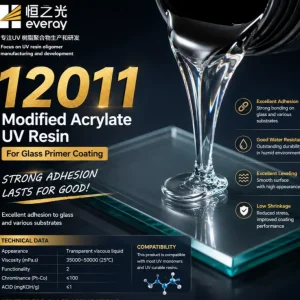
Silicate glass and polished aluminum are notorious for moisture-induced adhesion loss. Water molecules migrate to the boundary layer, hydrolyzing hydrogen bonds and causing catastrophic film delamination. Ever Ray 12011 Modified Acrylate integrates silane and phosphate functional groups directly into the oligomer backbone. When exposed to boiling water or salt spray for over 48 hours, these functional moieties form permanent covalent siloxane (Si-O-Si) and metal-chelate linkages, guaranteeing 100/100 cross-hatch adhesion after severe boiling testing.
International Regulatory Compliance & Local Technical Support
Seamless market access across North America, the European Union, and Asia-Pacific through documented chemical safety, heavy metal certification, and zero monomer volatility.
REACH / RoHS / TSCA Registered
Every commercial acrylate oligomer manufactured by Ever Ray complies with European Union REACH Annex XVII thresholds and is verified free of Substances of Very High Concern (SVHC). Products are registered on the US EPA Toxic Substances Control Act (TSCA) inventory, China's IECSC, and comply strictly with EU RoHS Directive 2011/65/EU and EN71-3 toy safety safety guidelines, ensuring effortless customs clearance and audit acceptance for multi-national chemical importers.
Batch-to-Batch Fingerprinting (GPC/FTIR)
Uncontrolled molecular weight distribution ruins customer formulation viscosity. At our Yunfu QC laboratory, every production batch is characterized using Gel Permeation Chromatography (GPC), Fourier Transform Infrared Spectroscopy (FTIR), and cone-and-plate Brookfield viscometry. We document residual acid values (<2.0 mg KOH/g) and guarantee unreacted free isocyanate (NCO) is below detection thresholds, protecting workers from respiratory sensitization and skin irritation.
Export Logistics & Dedicated Technical Hotlines
Our sales and polymer application engineers provide bilingual (English/Chinese) support spanning customized formulation drafting, starting-point recipes, and rheology modifiers. Shipments are packaged in UN-certified 200kg steel drums, 25kg HDPE pails, or 1000kg IBC totes with specialized UV-inhibited stabilization packages, preventing premature gelation during oceanic container transport across tropical or equatorial sea lanes.
Technological Horizon & Green Synthesis Roadmap
How our R&D team is developing the next era of radiation curables: bio-derived feedstocks, waterborne UV dispersions, dual thermal-photopolymer hybrids, and AI-accelerated macromolecular design.
Bio-Based Acrylate Feedstocks
Synthesizing oligomers utilizing succinic acid, modified itaconic acid, cardanol, and soy-derived polyols, yielding UV resins with certified renewable bio-carbon content between 35% and 65% without compromising mechanical tensile strength or glass transition temperatures.
Waterborne Polyurethane Dispersions (WB-UV)
Self-emulsifying polyurethane anionomers dispersed in water phases. Delivers ultra-low viscosity application for spray lines without monomer dilution, offering zero volatile skin irritation, low film build, and velvety natural-grain tactile touch for wood and synthetic leather.
Dual-Curing (UV + Thermal / Moisture)
Hybrid polymer systems resolving the shadow-zone dilemma in 3D printed components and high-density automotive sensors. UV exposure cures surface geometries instantly, while secondary moisture or thermal curing polymerizes hidden shadowed pockets completely.
AI Molecular Dynamic Formulation
Leveraging quantum mechanical simulations and predictive AI models to calculate radical propagation rates, oxygen inhibition resistance, and internal matrix stress during free-radical polymerization before initiating reactor scale-up.
Frequently Asked Formulation & Commercial Questions
Clear technical answers direct from our chemical synthesis team on shelf-life, photoinitiator pairing, shrinkage mitigation, and wholesale supply requirements.
What is the fundamental performance difference between aliphatic and aromatic polyurethane acrylates?
Aliphatic polyurethane acrylates utilize non-aromatic diisocyanates such as isophorone diisocyanate (IPDI) or hexamethylene diisocyanate (HDI). Because their chemical backbones lack aromatic benzene rings, they are impervious to photo-oxidative degradation (solar UV cleavage), making them entirely non-yellowing and suitable for clear topcoats, exterior labels, 3C electronics, and nail cosmetics. Aromatic PUAs, built on toluene diisocyanate (TDI) or methylene diphenyl diisocyanate (MDI), provide exceptional mechanical toughness, higher scratch resistance, and cost efficiencies, but tend to yellow upon prolonged UV exposure; hence they are optimal for pigmented coatings, wood primers, and indoor industrial floorings.
How does an amino acrylate or active amine synergist prevent oxygen inhibition?
During free-radical polymerization, atmospheric triplet oxygen (³O₂) diffuses into the uncured film surface, reacting with propagating carbon radicals to form stable, non-propagating peroxy radicals (ROO•). This terminates the polymer chain prematurely, leaving the top layer tacky and under-cured. Amino acrylate oligomers and active tertiary amine synergists contain abstractable hydrogen atoms alpha to the nitrogen atom. The peroxy radical abstracts this hydrogen, regenerating a reactive aminoalkyl radical (•C-N) that can re-initiate polymerization and reactivate surface cure without requiring expensive inert nitrogen blankets.
How can formulators mitigate volumetric cure shrinkage on sensitive plastics?
When acrylic double bonds (C=C) polymerize into single covalent bonds (C-C), intermolecular distances contract from van der Waals distances (~0.34 nm) to covalent bond lengths (~0.15 nm), resulting in 6% to 15% volumetric contraction. On flexible substrates like PET, PC, or thin vinyl, this shrinkage induces curling, micro-cracks, and adhesive shear failure. Formulators can resolve this by introducing pure acrylate oligomers (such as our high-flexibility low-shrinkage models) or hyperbranched acrylates. These oligomers incorporate flexible, bulky ether/ester backbones that provide steric hindrance, effectively lowering crosslink stress and reducing overall volumetric shrinkage below 3.5%.
What are the recommended storage parameters to ensure 12-month shelf stability?
Radiation-curable acrylate oligomers contain reactive acrylic esters that are thermally and photolytically sensitive. They must be stored in original, opaque, UV-blocking HDPE pails or coated steel drums between 5°C and 30°C away from direct sunlight, radiant heating pipes, and strong oxidizing agents. Crucially, acrylate free-radical inhibitors (such as MEHQ/monomethyl ether of hydroquinone) require dissolved oxygen to remain active. Therefore, drums should never be blanketed under inert nitrogen; containers require approximately 5% to 10% ullage headspace containing normal air to prevent spontaneous auto-polymerization.
Specialized UV Acrylate Resins & Engineering Oligomers
Wholesale factory supply in standard drums, totes, or customized formulation viscosity blends with complete batch analytical documentation.