High-Reactivity Fast-Curing Epoxy Resins & Acrylate Oligomers
Precision-synthesized oligomers and reactive intermediates optimized for sub-second photopolymerization, tack-free surface conversion, high shear adhesion, and zero yellowing on modern SMT dispensing lines.
Engineering Fast-Setting Epoxy Resins: Overcoming Volumetric Shrinkage and Surface Inhibition
Industrial quick-drying epoxy glues are no longer limited to standard mercaptan-curable pastes. Modern advanced adhesive manufacturing bridges free-radical photopolymerization, cationic oxirane ring-opening, and dual-curing networks to yield sub-3-second structural bonds with superior cohesive toughness.
Acrylated Epoxy Hybrid Backbone
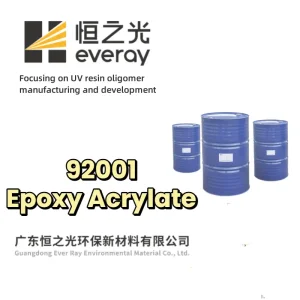
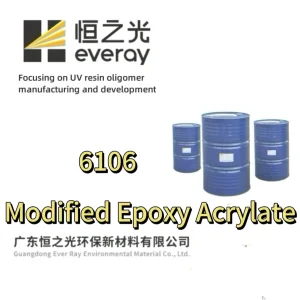
By reacting bisphenol-A diglycidyl ethers (DGEBA) or novolac resins with acrylic acid, our chemists create oligomers like Epoxy Acrylate 92001 and 6106 that integrate high-speed radical double-bond polymerization with the thermal stability, rigid aromatic rings, and chemical resistance typical of classic cross-linked epoxies.
Elimination of Oxygen Inhibition
Atmospheric oxygen acts as a radical scavenger, frequently causing incomplete curing and tacky surfaces on thin-film adhesive gluelines. Incorporating active amine synergists and hyperbranched architectures (such as Resin 4600) enables hydrogen transfer reactions that consume peroxy radicals, achieving rapid surface dryness under 365nm and 395nm LED irradiation.
Nano-Toughening & Stress Dissipation
Pure unmodified epoxies exhibit high modulus but suffer from brittleness. By grafting segmented polyurethane soft segments (aliphatic polyols) into the epoxy-acrylate backbone, our formulations dissipate cure-induced thermal and internal mechanical stresses, yielding superior impact resistance without sacrificing Tg or surface hardness.
Industrial Solutions: Where Quick Drying Epoxy Chemistry Powers Mass Production
From micro-dispensing in sub-millimeter electronic assemblies to large-scale automated potting of EV power electronics, our high-speed adhesives fulfill strict cycle-time targets and harsh lifecycle qualification regimes.
3C Consumer Electronics & Micro-Optics
Compact camera modules (CCM), active-alignment lens arrays, and miniature acoustic drivers require adhesive fixturing within 1.5 seconds. Our low-shrinkage, optical-grade formulations prevent defocusing aberrations while providing exceptional peel strength on treated LCP, anodized aluminum, and chemically reinforced cover glasses.
Automotive Electronics & EV Powertrains
Battery Management Systems (BMS), radar/LiDAR sensors, and inverter modules demand dielectric isolation combined with high thermal endurance. Our modified epoxy sealers withstand continuous operating temperatures from -40°C to 150°C, passing 1,000 cycles of thermal shock (-40°C to +125°C) and immersion in transmission fluids.
SMT High-Speed Dispensing Lines
For surface-mount tech requiring red glue or edge-bonding adhesives, rheological precision is paramount. Our resins are formulated with thixotropic index ratios (TI > 4.5) that permit high-speed non-contact jet dispensing at 30,000 dots per hour without stringing, splashing, or sagging before the UV pinning zone.
China Factory 4.0: Supply Chain Resilience & Synthetic Precision
Guangdong Ever Ray Environmental Material Co., Ltd. operates a modernized 40,000+ square meter manufacturing base in Yunan, Yunfu, engineered to meet the demanding audit standards of international Fortune 500 chemical converters.
DCS-Controlled Automated Synthesis
Our multi-ton glass-lined and stainless steel reactors are connected to centralized Distributed Control Systems (DCS). Closed-loop temperature regulation (accurate to ±0.3°C), automated raw material stoichiometry, and nitrogen-purged feed channels guarantee reproducible polymer molecular weight distributions across every production lot.
Real-Time In-Line Quality Verification
Every production batch is continually monitored via in-line Fourier-Transform Infrared (FTIR) spectroscopy, Brookfield digital rotational viscometers, and automated Gel Permeation Chromatography (GPC). We test and certify acid value, epoxide equivalent weight (EEW), moisture content (Karl Fischer), and color index prior to packaging release.
Complete Upstream Raw Material Security
Located in Guangdong’s integrated chemical infrastructure hub, we benefit from uninterrupted pipelines of critical monomers: acrylic acid, glycidyl methacrylate (GMA), isophorone diisocyanate (IPDI), and bisphenol epoxies. This domestic supply integration insulates international clients from global raw-material bottlenecks.
Epoxy vs. Fast UV Hybrids: Performance Engineering Matrix
Compare physical, mechanical, and curing attributes between legacy two-part room temperature epoxies and our modernized photopolymerized modified epoxy systems.
| Technology System | Cure Time Mechanism | Glass Transition (Tg) | Tensile Modulus | Oxygen Inhibition | Key Strengths & Primary Fit |
|---|---|---|---|---|---|
| Standard 2K Fast Epoxy (Mercaptan) | 3 - 10 Minutes Exothermic condensation |
55°C - 70°C | 1.8 - 2.4 GPa | None (Bulk Reaction) | Field repairs, broad gap filling, manual assembly fixtures. |
| UV Epoxy Acrylate (e.g., 92001 / 6106) | < 3 Seconds UV Radical (365/395nm) |
85°C - 120°C | 2.8 - 3.8 GPa | Engineered Resistance | High-speed SMT, optical disk bonding, printed circuit board encapsulation. |
| Photo-Thermal Dual-Curing System (72017) | 2s UV + 80°C Heat Photochemical + Thermal Latent |
110°C - 145°C | 2.5 - 3.2 GPa | Zero Shadow Effect | Opaque components, deep cavity potting, automotive ECU assemblies. |
| Hyperbranched Acrylate Oligomer (4600) | < 1.5 Seconds Dendritic High Functional |
95°C - 130°C | 3.2 - 4.1 GPa | Complete Surface Cure | Ultra-hard varnishes, scratch-proof optical coatings, edge-reinforcement glues. |
| Flexible Aliphatic Polyurethane Acrylate (72923) | 2 - 5 Seconds Aliphatic Urethane Matrix |
30°C - 50°C | 0.6 - 1.2 GPa | Non-Yellowing Matrix | Peelable adhesives, flexible displays, temporary protective wafer barriers. |
Localized Compliance Assurance & Technical Support
Entering tier-1 global supply chains requires uncompromised conformity to environmental, chemical, and workplace health standards. Every formulation leaves our gates backed by authenticated certifications.
RoHS & REACH SVHC Strict Compliance
Our raw materials and finished oligomers are independently audited by SGS/CTI. They strictly comply with EU RoHS Directive 2011/65/EU and contain no Substances of Very High Concern (SVHC) exceeding 0.1% w/w under Regulation (EC) No 1907/2006.
Halogen-Free & UL94 V-0 Options
For critical semiconductor, HDI printed circuit board, and high-density packaging applications, our specialized grades conform to IEC 61249-2-21 halogen-free criteria (Total Cl & Br < 900 ppm) and incorporate non-migrating organophosphorus fire-retardant groups to pass UL94 V-0 flame ratings.
Global Multilingual Documentation
We provide full 16-section GHS Safety Data Sheets (SDS) in English, Spanish, German, Japanese, and Korean, alongside comprehensive Technical Data Sheets (TDS), starting formulation guidelines, and substrate pre-treatment advice for smooth integration.
B2B Sourcing: Tailored Rheology, Gel Times & Export Packaging
We collaborate directly with corporate formulators, chemical distributors, and large contract manufacturers (CMs) requiring customized rheology profiles, curing wavelengths, and private-label packaging options.
Viscosity & Thixotropy Tailoring
From water-thin 50 mPa·s formulations engineered for capillary action underfill, up to high-viscosity 150,000 mPa·s non-slump structural pastes, we tune polymer chain weights and incorporate fumed silica or specialized active reactive monomers to match your dispensing nozzle diameter.
Custom Gel Time & Peak Exotherm Control
For thick-section potting or sensitive optical sensors, rapid uncontrolled exothermic spikes cause thermal cracking and substrate warpage. Our laboratory tailors photoinitiator packages and active amine inhibitors to moderate cure acceleration and limit internal exothermic temperatures to under 65°C.
Industrial Logistics & Bulk Containers
We support agile sample evaluation (1kg / 5kg bottles) for pilot formulations, moving seamlessly to commercial volumes in 20kg black UV-blocking HDPE jerrycans, 200kg steel drums, and 1,000kg composite IBC totes, with full temperature-controlled international sea freight options.
Frequently Answered Technical & Procurement Questions
Insights on curing kinetics, storage stability, dual-cure design, and factory sourcing straight from Ever Ray’s senior synthesis engineers.
Next-Generation Modified Acrylates & Dual-Cure Resin Systems
Specialty functional acrylates formulated for water-ink balance, heat/cold thermal stability, high gloss finishing, and photothermal 3D additive manufacturing.