
Engineered UV Resins & Precision Formulations (Part I)
Direct manufacturer supply for SLA, DLP, LCD printing platforms and performance-critical surface engineering.
Engineering High-Fidelity Functional Photopolymers
How synthesis chemistry governs tensile modulus, heat deflection, and dimensional stability across additive manufacturing cycles.
Backbone Oligomer Synthesis
Functional prototype resins differ fundamentally from commodity decorative coatings. The backbone architecture—whether built on aliphatic urethane acrylates, cycloaliphatic epoxy hybrids, or hyperbranched polyesters—dictates the crosslink density, fracture toughness, and glass transition temperature (Tg). Our Yunfu synthesis facility controls molecular weight distribution (Mw/Mn) within tight polymer dispersity indexes to prevent brittle failure under cyclical mechanical loads.
Shrinkage & Internal Stress Mitigation
During free-radical photopolymerization, van der Waals distances transition to covalent carbon-carbon bonds, inducing volumetric shrinkage. Our industrial wholesale formulations incorporate special ring-opening monomers and steric hindered multi-acrylate oligomers that reduce conversion contraction below 1.2%, eliminating the internal residual stress that causes dimensional warping, curl, and tolerance drift in precision assembly prototypes.
Dual-Cure & Hybrid Networks
Addressing the limitations of conventional UV single-cure systems, our factory manufactures advanced interpenetrating polymer networks (IPN) combining fast UV-triggered acrylate initiation with thermal secondary polycondensation. This dual-action curing allows complex hollow geometries and deep undercuts to achieve isotropic tensile strength equal to injection-molded engineering thermoplastics.
Global Enterprise Procurement Criteria for Prototype Resins
A quantitative comparison framework for engineering departments, procurement directors, and tier-1 manufacturing hubs.
| Resin Chemistry Family | Tensile Modulus (MPa) | Elongation at Break (%) | Heat Deflection Temp (0.45 MPa) | Primary Industrial Use-Cases | Formulation Stability (Months) |
|---|---|---|---|---|---|
| Rigid Polyurethane Acrylate (ABS-Like) | 2,200 – 2,800 | 12 – 22% | 65°C – 80°C | Consumer 3C housings, snap-fit clips, enclosures | 12 Months @ 25°C |
| Aliphatic Urethane (Tough/Impact Resistant) | 1,600 – 2,100 | 35 – 55% | 55°C – 68°C | Automotive interior prototypes, living hinges | 14 Months @ 25°C |
| High-Temperature Ceramic/Epoxy Acrylate | 3,500 – 4,800 | 2.5 – 5.0% | 180°C – 280°C | Wind-tunnel aerodynamic models, solder test jigs | 9 Months @ 20°C |
| Elastic / Flexible Acrylate Polymer | 25 – 80 | 120 – 220% | N/A (Shore 60A - 85A) | Gaskets, fluid seals, wearable elastomer models | 12 Months @ 25°C |
| Optically Clear Acrylic Oligomer | 1,900 – 2,400 | 8 – 15% | 58°C – 70°C | Headlight lenses, fluidics, clear inspection tooling | 12 Months @ 25°C |
Supply Chain Dominance & Large-Scale Reactor Capacity
Guangdong Ever Ray Environmental Material Co., Ltd. provides upstream integration that isolates global buyers from supply shocks.
Upstream Chemical Integration
Unlike repackaging suppliers and secondary blenders, our factory operates direct synthesis reactors synthesizing base acrylate oligomers from basic chemical feedstocks. We control everything from polyol condensation to isocyanate esterification, eliminating middleman markups and guaranteeing raw material purity with zero batch contamination.
Batch-to-Batch Rheological Consistency
In high-speed industrial printing machines, viscosity shifts of even ±50 mPa·s cause layer recoating defects or peeling failures. Our computerized automated reactor lines, equipped with in-line viscometers and GPC molecular weight monitors, maintain viscosity tolerances strictly within ±3% across 20-ton single-batch synthesis runs.
Global Export Ready Logistics
Situated in the industrial chemical heart of Guangdong with close proximity to Nansha and Shenzhen ports, our factory maintains UN-certified packaging (25kg pails, 200kg drums, 1,000kg IBC totes). Our dedicated hazardous chemicals export compliance unit expedites international sea and air freight with pre-cleared customs documentation.
International Regulatory Standards & Local Technical Support
Strict environmental and regulatory alignment ensuring zero supply interruptions in regulated western markets.
REACH & RoHS SVHC Compliance
Every commercial resin batch manufactured at Guangdong Ever Ray is thoroughly audited against EU REACH SVHC lists (Substances of Very High Concern) and RoHS directives. We strictly avoid toxic organotin catalysts, persistent phthalates, and banned volatile monomers, certifying full documentation for automotive and medical consumable compliance.
US TSCA & GHS-Compliant SDS
We supply standardized 16-section Safety Data Sheets (SDS) in multi-language formats aligned with OSHA and GHS Rev. 8 protocols. Our active chemicals are registered within the EPA TSCA Inventory, enabling seamless transatlantic chemical clearance for North American wholesale clients and original equipment manufacturers (OEMs).
On-Site Formulation Engineering
Our senior chemical engineers provide direct formulation optimization for enterprise procurement partners. Whether matching photosensitivity to novel 385nm vs 405nm UV-LED light engines, altering shear thinning behavior, or tailoring thermal post-cure recipes, our laboratory team acts as your dedicated upstream formulation division.
Localized Application Scenarios in High-Precision Manufacturing
Real-world engineering implementations across automotive, consumer electronics, tooling, and medical prototyping sectors.
Automotive Under-The-Hood
Engine intake manifolds, cooling system baffles, and sensor brackets prototyped with high-heat epoxy-acrylate matrices that withstand synthetic oils, coolant fluid splash, and thermal chambers up to 150°C continuous operation.
Consumer 3C Jigs & Enclosures
Ultra-fine dimensional reproduction for smartphone shells, wearable acoustic nozzles, and production testing fixtures requiring tight snap-fit mating tolerance within ±0.03mm without post-assembly creep.
Precision Microfluidic Channels
Non-cytotoxic, optically transparent acrylic formulas engineered for sub-100-micron lab-on-a-chip channels, diagnostic cassettes, and transparent optical chambers exhibiting minimal auto-fluorescence.
Short-Run Injection Tooling
High-modulus, composite-filled oligomers formulated specifically for 3D printed mold inserts, allowing injection molder trials with standard polypropylene, polyethylene, and ABS resins at clamping pressures up to 40 MPa.
Emerging Trends Reshaping Functional Resin Chemistry
Strategic technological developments establishing the next generation of photopolymer additive manufacturing.
Bio-Based & Sustainable Acrylates
Driven by global carbon reduction mandates, our chemical R&D group is actively introducing renewable soy-, cardanol-, and itaconate-derived acrylated prepolymers. These sustainable backbones deliver performance metrics rivaling petrochemical bisphenol-A epoxy acrylates while cutting fossil carbon dependency by up to 45%.
High-Viscosity Hot-Lithography Resins
Next-generation industrial printers now operate heated vats at 50°C–80°C, unlocking the ability to photopolymerize ultra-high molecular weight polyurethane oligomers that are completely unprintable at ambient temperatures. This breakthrough achieves impact resistances surpassing 70 kJ/m²—matching true injection molding.
Nano-Particle Reinforced Hybrid Suspensions
Integrating surface-functionalized silica, silicon carbide, and alumina nanoparticles into low-viscosity monomer matrix systems allows photopolymers to demonstrate extreme thermal stability, low thermal expansion coefficients (CTE < 35 ppm/K), and flame retardancy adhering to strict UL94 V-0 safety criteria.
Engineered UV Resins & Precision Formulations (Part II)
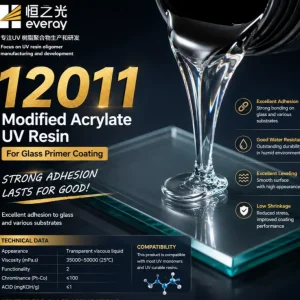
Specialty grades engineered for surface leveling, multi-substrate priming, shadowless bonding, and deep thermal cycling.
Frequently Asked Questions from Enterprise Procurement Teams
Authoritative technical clarifications on photopolymer chemistry, MOQ thresholds, and custom synthesis pipelines.
What minimum order quantities (MOQ) apply to wholesale custom resin synthesis?
For standard catalog oligomers and functional prototype resins, our factory supports evaluation sample quantities from 1kg to 25kg pails. For custom synthesized chemical modifications (e.g., tailored refractive index, custom molecular weight distribution, or proprietary photoinitiator packages), our synthesis reactor pilot MOQ begins at 200kg, scaling up to 20-ton continuous synthesis runs for ongoing industrial production contracts.
How does Ever Ray guarantee batch-to-batch consistency in viscosity and curing speed?
Every synthesis batch is verified using Gel Permeation Chromatography (GPC) to inspect molecular weight dispersity, Brookfield rotational viscometers calibrated at standard 25.0°C ± 0.1°C, and differential photocalorimetry (Photo-DSC) to benchmark radical conversion speed under standardized 385nm and 405nm UV irradiance. A comprehensive Certificate of Analysis (COA) accompanies every single shipping pallet.
Can your formulations be customized for specific additive manufacturing wavelengths?
Yes. While 405nm is standard across LCD and DLP printers, industrial SLA laser systems operate at 355nm and high-performance DLP engines utilize 385nm. Our synthesis lab adjusts the photoinitiator absorption spectrum (combining TPO, BAPO, and amine synergists) and extinction coefficients to match your exact engine wavelength, preventing light bleeding and ensuring crisp z-axis cure depth.
What is the typical shelf-life stability and temperature storage tolerance?
Our standard functional prototype resins have an ISO-audited stable shelf life of 12 months when stored sealed between 15°C and 28°C in UV-opaque containers. We formulate our products using proprietary polymerization inhibitors (MEHQ and sterically hindered nitroxide free radicals) that prevent dark-polymerization and viscosity increase even during prolonged container ocean transit across tropical equatorial routes.
Initiate Direct Factory Technical Evaluation
Connect with our Senior Application Chemists and Global Supply Chain Specialists to request custom technical data sheets (TDS), complete chemical safety packages (SDS), or project-specific prototype pilot samples.
