Featured Structural Resins & Oligomers
High-reactivity functional resins tailored for structural adhesive syntheses, UV-curable glues, vacuum metallization, and composite bonding.
Technical Whitepaper: Epoxy Resin as High-Performance Industrial Glue
An authoritative overview of Bisphenol A epoxy acrylates, aliphatic/aromatic modifications, curing kinetics, and boundary adhesion mechanisms.
Bisphenol A Epoxy Backbones
Standard diglycidyl ether of bisphenol A (DGEBA) functionalized with acrylic acid forms the backbone of modern rapid-curing structural epoxy adhesives. The planar benzene rings deliver unyielding shear resistance, elevated glass transition temperatures (Tg up to 110°C), and uncompromising barrier resistance against solvents, acids, and thermal dissipation.
When utilized as glue matrices, these crosslink systems exhibit micro-tensile shear numbers surpassing 22 MPa, ensuring mechanical interlock with rough or pre-treated metallic and ceramic substrates.
Combating Shrinkage & Brittleness
Pure epoxy acrylates, while exceptionally hard, inherently experience 6% to 9% volumetric shrinkage during free-radical polymerization. In precision adhesive lines, shrinkage triggers internal boundary stresses, leading to micro-cracking and interfacial de-lamination.
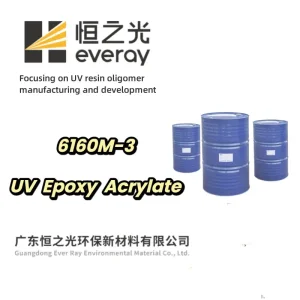
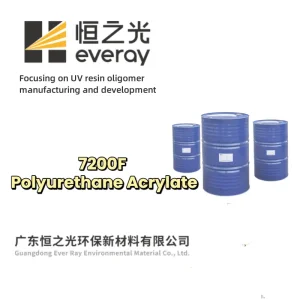
Ever Ray mitigates this through rubber/polyurethane-modified epoxy acrylates (such as our 6160M-3 and 7200F series). Incorporating soft segment polyurethane linkages absorbs mechanical impacts, dramatically lowers shrinkage to under 2.1%, and maintains flexible bondlines over broad thermal cycling ranges (-40°C to +130°C).
Dual-Curing & Shadow Area Assembly
Complex structural assemblies frequently feature non-translucent substrates (e.g., anodized aluminum to carbon fiber) where actinic UV radiation cannot reach shadow zones. To guarantee zero uncured residue, modern formulations exploit photo-thermal dual-cure epoxy systems.
Initial UV radiation secures line positioning in 3–5 seconds (green strength), while secondary thermal latency triggers deep crosslinking throughout the unexposed bondline, resulting in a cohesive structural monolith.
Direct China Factory & Supply Chain Strengths
How Guangdong Ever Ray delivers direct-from-reactor cost efficiency, agile monomer customization, and resilient export pipelines.
Raw Material Upstream Integration
Situated in Guangdong's premier chemical innovation corridor, our Yunfu production hub operates direct, high-volume pipeline access to bisphenol A, epichlorohydrin, acrylic acid, and specialty aliphatic diisocyanates (IPDI/HDI). This upstream integration buffers international procurement partners against global petro-chemical market volatility.
Rigorous QA & Process Control
Batch-to-batch consistency is ensured through automated DCS-monitored reactor systems. Each production batch undergoes strict evaluation for acid value, hydroxyl index, residual monomer content, Gardner color, and viscosity stability under 60°C accelerated thermal aging regimens.
High-Volume Container Export
We supply epoxy resin glues and oligomers in standard 25kg HDPE jerrycans, 200kg steel drums, and 1000kg ISO-certified IBC totes. Located less than 120km from primary Pearl River export ports, our dispatch logistics routinely support full container loads (FCL) destined for North America, Europe, Southeast Asia, and the Middle East.
Technical Comparison: Resin Oligomer Formulations for Adhesives
Selection matrix utilized by application engineers to engineer adhesive formulas for optical, structural, and flexographic bonding.
| Resin Chemistry | Tensile Strength (MPa) | Shrinkage Rate (%) | Glass Transition (Tg °C) | Adhesion Profile | Recommended Industrial Glue Use |
|---|---|---|---|---|---|
| Standard Bisphenol A Epoxy Acrylate | 55 – 70 | 6.0 – 8.5% | 85 – 110 | Metals, Glass, Composites | Rigid structural joining, high-speed circuit encasement |
| Modified Flexible Epoxy Acrylate | 35 – 50 | 2.0 – 3.8% | 45 – 75 | Metals, Pre-treated Plastics | Thermal-shock resistant adhesive, vacuum metallization base |
| Aliphatic Polyurethane Acrylate | 20 – 40 | 1.2 – 2.5% | 20 – 60 | PC, ABS, PMMA, Glass | Optical clear adhesives (OCA), camera lens barrel bonding |
| Polyester Acrylate Oligomer | 30 – 45 | 3.5 – 5.0% | 30 – 65 | Paperboard, Treated PET, Metals | Laminating adhesives, high-gloss overprint sealers |
| Dual-Curing (UV + Thermal) Oligomer | 48 – 65 | 1.8 – 3.0% | 70 – 95 | Opaque Composites, Ceramics | Automotive electronic sensor pots, shadow-zone assemblies |
Localized Support & Regulatory Compliance Assurance
Navigating complex international chemical frameworks with comprehensive documentation and on-the-ground support.
Full REACH & RoHS Compliance
All export resin batches are strictly tested to comply with EU REACH SVHC restrictions, RoHS directive 2011/65/EU, and TSCA inventory requirements. We actively maintain low halogen content (<900 ppm) and zero intentionally added phthalates or volatile benzene derivatives, allowing formulators to seamlessly pass stringent third-party tests (SGS/TUV).
Multilingual Formulation Support
Ever Ray maintains a specialized technical desk proficient in English and Chinese, offering live consultation on viscosity thinning using reactive acrylate monomers (TPGDA, DPGDA, TMPTA) without reducing curing reaction rates. We supply tailored Technical Data Sheets (TDS), GHS-standard Safety Data Sheets (SDS), and custom lab formulation guidelines.
Rapid Pilot Sampling Delivery
We eliminate trial delays by dispatching qualified sample kits (1kg to 5kg) within 48 to 72 hours via international air couriers (FedEx/DHL/UPS) directly to research laboratories in Europe, the Americas, and APAC, complete with certificates of analysis (COA) for rapid bench-scale testing.
Industrial Application Scenarios for Epoxy Adhesives
Matching exact formulation demands across automotive electronics, consumer hardware, optical lenses, and renewable energy equipment.
3C Consumer Electronics Assembly
Modern smart wearables, mobile phone frame seals, and acoustic speaker diaphragms require epoxy glue matrices that combine microsecond UV pinning with resistance to synthetic sweat and drop impact. Our modified low-shrinkage resins prevent frame distortion while achieving IP68 waterproof ratings.
Automotive LiDAR & Sensor Potting
Autonomous driving cameras and radar casings operate in punishing environments. Using epoxy acrylate systems with optimized crosslink densities provides superior dielectric breakdown resistance, zero moisture permeation, and exceptional endurance through -40°C to +125°C thermal shock cycles.
Renewable Energy & Photovoltaics
Solar junction boxes, inverter potting, and wind turbine blade root inserts rely on modified epoxy glues capable of resisting intense UV radiation without chalking, micro-cracking, or losing adhesion on aluminum profiles and glass backsheets.
High-End Wood & Furniture Sealing
In heavy-duty roller and curtain coating lines, our epoxy oligomers penetrate wood grain pores instantly, hardening into sandable primers that stop resin bleed-through, minimize shrinkage cracks, and provide an immovable anchor for urethane topcoats.
Industry Trends & Global Procurement Strategies
Strategic purchasing forecasts for corporate procurement officers and formulation chemists looking ahead to 2026–2030.
Shift Towards Low-Odor & Eco-Monomers
Regulatory pressure in the European Union and North America is expediting the phase-out of high-odor, irritating low-molecular-weight reactive diluents. Procurement managers are prioritizing alkoxylated monomers, low-viscosity hyperbranched oligomers, and water-dilutable polyurethane acrylate dispersions.
LED-UV Curing (365nm / 385nm / 395nm)
Energy efficiency initiatives have propelled the industrial transition from medium-pressure mercury lamps to narrow-band LED-UV light sources. Because LED lacks short-wave UVC radiation (200–280nm), oxygen inhibition at the surface is a common challenge. Formulations now mandate inclusion of amino acrylate synergists and active amines to secure high-speed, tack-free surface cure.
Long-Term Annual Supply Agreements
Multinational adhesive blenders are shifting away from spot purchases toward structured annual allocation contracts with vetted manufacturers. Direct manufacturer partnerships eliminate trading house surcharges, guarantee reserved synthesis capacity in Guangdong, and lock in technical formulation troubleshooting for rapid scale-up.
Frequently Asked Questions (FAQ) for Chemical Formulators & Buyers
In-depth technical answers addressing user intent, chemical properties, formulation challenges, and wholesale ordering logistics.
What distinguishes epoxy acrylate resins from standard two-part epoxy glues?
Traditional two-part epoxies rely on slow polyaddition reactions between epoxy resin and polyamine or polyamide hardeners, taking anywhere from 30 minutes to 24 hours to achieve operational strength. Epoxy acrylates are acrylated epoxy polymers that cure via free-radical polymerization triggered by actinic light (UV or electron beam) within fractions of a second, massively elevating assembly line throughput.
How do you resolve adhesion failure on low-surface-energy plastics like PP or untreated PE?
Untreated polyolefins possess low surface energy (<30 mN/m), preventing spontaneous wetting. We recommend combining special functional acrylate oligomers (carboxyl or phosphate modified) with a corona or plasma pre-treatment. Alternatively, integrating pure acrylate oligomers or promoting monomers helps lower surface tension and creates micro-mechanical anchoring.
What is the standard lead time for wholesale export orders from Guangdong?
Standard stocked catalog grades ship within 5 to 7 business days from receipt of confirmed purchase order. Tailored synthesis grades (modified viscosity, altered monomer dilution packages) take approximately 12 to 18 business days from reactor pilot confirmation to port arrival in Guangzhou or Shenzhen.
How does Ever Ray guarantee shelf life and prevent spontaneous gelation during ocean transit?
Acrylate free-radical polymerization can be inadvertently triggered by prolonged exposure to high ambient heat. We integrate high-efficiency sterically hindered phenolic and nitroxyl radical stabilizers (such as MEHQ and customized polymer inhibitors) that preserve reactive double bonds under temperatures up to 50°C during trans-equatorial container transit for a guaranteed shelf life of 6 to 12 months.
Can you provide custom reactive diluent packages (e.g., non-TMPTA or low-viscosity solutions)?
Yes. Due to regulatory or skin-sensitization restrictions on certain monomers (like standard TMPTA), our synthesis facility can pre-dilute epoxy acrylates using TPGDA, DPGDA, HDDA, or specialty alkoxylated monomers such as PPTTA or EO-TMPTA to balance both regulatory compliance and application viscosity.
What documentation accompanies commercial shipments for customs clearance?
Each commercial shipment includes a verified Certificate of Analysis (COA) specifying exact batch viscosity, acid value, and color metrics, an updated 16-section GHS Safety Data Sheet (SDS) in English, non-dangerous goods declaration or certified packaging certification, along with standard commercial invoices and packing lists.
Specialty Formulations, Resins & Monomers
High-performance reactive systems for excimer matting, 3D printing photo-thermal curing, water-transfer primers, and anti-yellowing coats.