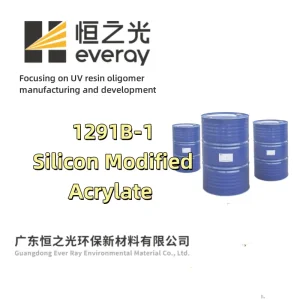
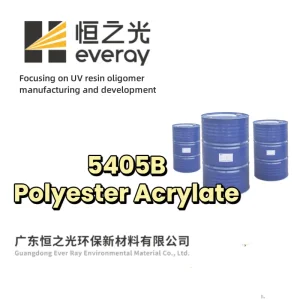
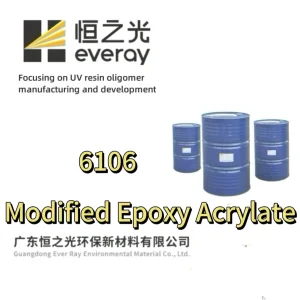
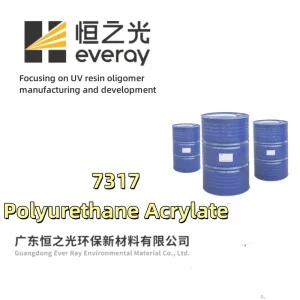
Featured High-Performance UV Resins (Batch 1)
Explore our core commercial-grade UV oligomers engineered for extreme gloss, scratch prevention, and rapid photocuring response.
China Factory Advantages & Synthesis Infrastructure
Why Tier-1 industrial paint manufacturers and international photopolymer blenders partner with Guangdong Ever Ray for scalable resin synthesis.
In modern industrial coating procurement, securing wholesale acrylic resin paint and UV oligomers requires far more than basic blending capabilities. It demands raw material self-sufficiency, precision esterification, and controlled free-radical copolymerization. Operating from an expansive 40,000 m²+ synthesis plant in Yunfu, Guangdong, Guangdong Ever Ray Environmental Material Co., Ltd. (established in 2006) leverages high-volume upstream chemical integration. By securing direct pipeline supplies of key precursors including acrylic acid, bisphenol A diglycidyl ethers, and specialty isocyanates (IPDI, HDI, and TDI), we eliminate international supply chain vulnerabilities while driving batch-to-batch polymer repeatability.
Our intelligent DCS-automated reactors strictly monitor critical reaction parameters—temperature profiles within ±0.5°C, exothermic feed curves, inhibitor balances, and hydroxyl-to-acrylate conversions. This industrial precision resolves common field problems like premature gelation, high residual monomer odor, and post-cure hazing.
Fully Automated Synthesis Lines
Over 10 fully enclosed stainless steel reactor lines (from 5-ton pilot vessels to 30-ton commercial units) configured with continuous condensation and vacuum stripping arrays for low volatile organic content (VOC).
10+ Patented Backbone Designs
Backed by over 10 proprietary invention patents covering dendritic hyperbranched acrylates, dual-curing alkoxysilane-functionalized urethanes, and high-efficiency tertiary amine synergies for non-oxygen-inhibited curing.
Rigorous Analytical QA/QC
Every industrial batch is subjected to complete spectral and rheological profiling via Gel Permeation Chromatography (GPC), Fourier-Transform Infrared (FTIR), and Brookfield cone-and-plate viscometry before release.
Next-Generation Polymer Trends & Global Procurement Requirements
Aligning resin performance with evolving environmental mandates, carbon neutrality goals, and advanced digital manufacturing specifications.
Transition to Waterborne UV Dispersion
Global architectural and furniture brands demand non-hazardous, low-odor manufacturing. Our water-dilutable polyurethane acrylate dispersions eliminate volatile monomers while maintaining rapid crosslinking and open-grain wood clarity.
LED-UV & Low-Energy Curing Chemistries
With international shift away from high-pressure mercury arc lamps, our amino acrylates and active amines boost surface electron-transfer kinetics, curing 365nm to 395nm LED systems without oxygen-induced surface tackiness.
High-Resolution Photopolymer Additive Printing
Custom-tailored low-shrinkage urethane oligomers engineered specifically for continuous SLA/DLP 3D printing, enabling isotropic mechanical properties, thermal deflection stability, and rapid layer refresh cycles.
Substrate-Specific Formulations & Macro-Engineering Solutions
How Ever Ray customizes functional acrylic backbones to overcome tough substrate adhesion and environmental degradation.
3C Electronics & Vacuum Metalizing
Formulated for PC, ABS, and PMMA housings. Provides superior intercoat adhesion with basecoat and topcoat layers in PVD vacuum metalizing, ensuring exceptional sweat, cosmetics, and abrasion resistance.
High-Speed Graphic Inks & Varnishes
Polyester acrylates provide superior pigment wetting and lithographic water-ink stability for offset and flexographic printing on non-porous films and folding cartons.
Industrial Flooring & Engineered Wood
Multi-coat roll coating systems combining fast-curing epoxy acrylate sandable sealers with flexible, abrasion-resistant polyurethane acrylate topcoats capable of enduring heavy foot traffic.
Glass, Metal & Optical Adhesion
Specialty functional acrylates modified with silane coupling and carboxyl groupings, providing continuous boiling-water resistance and salt-spray protection on stainless steel and architectural glass.
Frequently Asked Questions (Technical Sourcing Guide)
In-depth chemistry and logistics insights for formulation chemists and global purchasing directors.
What is the fundamental difference between aliphatic and aromatic polyurethane acrylate oligomers?
How do amino acrylates mitigate atmospheric oxygen inhibition in UV formulations?
What resin system is recommended for high-abrasion UV-curable wood and floor sealers?
Can Ever Ray chemically engineer custom resin viscosities and functionality windows?
What regulatory compliance documentation and export testing data sheets are provided?
How does Ever Ray guarantee batch-to-batch polymer consistency across multi-ton shipments?
Specialty Polymer Grades & Functional Acrylates (Batch 2)
Explore specialized modified acrylates, anti-fouling oligomers, low-exotherm resins, and high-elasticity curable solutions.