
Procurement Dynamics in High-Performance Polyurethane Resins
As worldwide industries transition toward zero-VOC profiles, ultra-fast line throughput, and extreme durability, polyurethane acrylate (PUA) and modified oligomers serve as the molecular bedrock for next-generation coatings, microelectronics, and additive manufacturing.
High-Performance UV Oligomers & Resins
Explore our top-tier synthesized resins engineered for chemical resistance, rapid curing kinetics, and low volumetric shrinkage.
Macro-Industry Solutions: Chemistry Tailored to Substrate
From ductile aliphatic matrices that withstand prolonged solar UV radiation to dense aromatic urethanes engineered for deep abrasion resistance, Ever Ray provides the molecular architecture for challenging surface engineering.
Aliphatic PUA Systems
Synthesized with hexamethylene diisocyanate (HDI) or isophorone diisocyanate (IPDI) backbones. Delivers zero-yellowing clarity, maximum outdoor weatherability, exceptional flexibility, and hydrolytic stability for optical films, mobile electronics, and high-gloss nail systems.
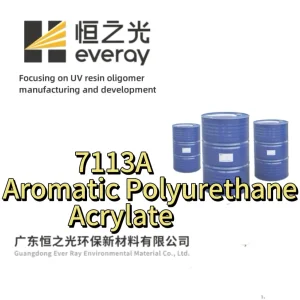
Aromatic PUA Formulations
Built upon toluene diisocyanate (TDI) and methylene diphenyl diisocyanate (MDI) segments. Delivers superior tensile modulus, excellent chemical solvent barrier performance, and unmatched surface hardness for industrial wood, commercial resilient flooring, and structural coatings.
Waterborne PUD Hybrids
Environmentally compliant UV-curable polyurethane aqueous dispersions (UV-PUD). Engineered for thin-film applications requiring near-zero VOC emissions, rapid flash-off drying, non-grain raising on fine timbers, and gentle soft-touch tactile skin coatings on luxury automotive components.
Polyurethane Acrylate Comparative Property Matrix
Analytical comparison of prepolymer architectures used in high-line-speed industrial UV curing systems.
| Oligomer Chemical Architecture | Typical Functionality | Tensile Strength (MPa) | Elongation at Break (%) | Yellowing Resistance (ΔE) | Core Industrial End-Use |
|---|---|---|---|---|---|
| Difunctional Aliphatic PUA | 2.0 - 2.2 | 15 - 35 | 60 - 180% | < 1.0 (500h QUV) | Screen protectors, optical adhesives, flexible packaging, 3D printing |
| Hexafunctional Aliphatic PUA | 6.0 | 55 - 90 | 2 - 8% | < 1.5 (500h QUV) | 3C electronics anti-scratch topcoats, vacuum metallizing base coats |
| Aromatic Urethane Acrylate | 2.5 - 3.5 | 40 - 65 | 15 - 45% | > 4.0 (Sun exposure) | Heavy-duty commercial parquet flooring, offset/screen UV printing inks |
| Waterborne UV Polyurethane (PUD) | 2.0 - 4.0 | 25 - 45 | 40 - 120% | < 1.2 (UV weathering) | Low-VOC interior wood primer, synthetic leather coatings, film lamination |
Technical Roadmap & Sustainable Future Outlook
Our Yunfu R&D base is pioneering the synthesis of bio-circular building blocks, dual-stage curing lattices, and LED-reactive photoactive resins.
Bio-Based Polyols
Synthesizing isocyanate prepolymers using 40% to 65% plant-derived renewable polyols (castor, succinic, dimer fatty acid bases) without compromising tensile toughness or glass transition temperature.
Dual-Stage Curing (UV + Thermal)
Developing hybrid photocurable polyurethane networks with secondary isocyanate/hydroxyl or moisture reactions, enabling complete shadow curing in complex 3D automotive structures.
Long-Wavelength LED Reactivity
Adapting acrylic double-bond sensitivity and molecular steric hindrance for rapid polymerization under 365nm, 385nm, and 395nm low-energy LED light engines, mitigating substrate heat distortion.
Self-Healing Nanostructures
Embedding dynamic reversibly bonded hydrogen networks into polyurethane chains, providing protective coatings with autonomous self-repair of micro-scratches under moderate ambient warmth.
Supply Security, Localization & Quality Traceability
Reliable raw material sourcing, stringent reactor process automation, and multi-tier international compliance guarantee uninterrupted supply continuity for Tier-1 supply chains.
Full Regulatory Dossiers
Every batch shipped globally comes with comprehensive, region-specific documentation: SDS compliant with GHS Revision 8, certificates of analysis (COA) specifying viscosity, residual monomer, and color grade (APHA), along with full REACH and TSCA compliance registration records.
Global Export Logistics
Strategic maritime logistics hub located adjacent to major South China shipping ports. Export options include temperature-regulated shipping containers, nitrogen-purged 200L steel drums, and 1000L IBC totes designed to avoid polymerization during tropical intercontinental transport.
Application Support Labs
Our senior formulation chemists provide collaborative pilot-line testing. We assist in matching photoinitiator absorption profiles, managing active diluent selection, evaluating substrate surface energy, and resolving intercoat delamination hurdles.
Acrylates, Monomers & Specialty Oligomers
Engineered for precise performance targeting, ink-water equilibrium, superior adhesion, and boiling-water resistance on refractory substrates.
Frequently Asked Technical Questions
Comprehensive engineering guidance to optimize formulations, reduce surface oxygen inhibition, and match polymer backbones to substrates.
