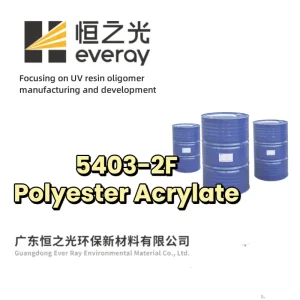
Featured UV Curable Resins & Acrylate Oligomers
Precision-synthesized polyester acrylates, epoxy modified backbones, and aliphatic polyurethane acrylates delivering balanced lithographic performance, reactive dilution efficiency, and fast cure kinetics.
Polyester Acrylate: The Macromolecular Backbone of Modern Radiation Curing
Polyester acrylates (PEAs) represent one of the most versatile and chemically agile polymer backbones within radiation-curable coatings, printing inks, functional varnishes, and electronic encapsulants.
Pigment Wetting & Dispersion Energy
Formulated with polycarboxylic acid linkages and polyol ester domains, polyester acrylates exhibit unmatched compatibility with organic and inorganic colorants. Unlike high-molecular-weight epoxy oligomers that resist shear distribution, our ester bonds provide low steric hinderance and optimal wetting thermodynamics. This prevents pigment agglomeration, lowers yield value in high-speed offset inks, and yields brilliant color fidelity even at heavy carbon black or phthalocyanine pigment loadings.
Tunable Functionality & Crosslink Density
From difunctional linear esters yielding elastomeric elongation to tetra- and hexa-functional branched hyper-structures, Ever Ray controls crosslink networks with pinpoint accuracy. High functionality grades drive rapid surface tack reduction under ambient UV-LED irradiation (365–395 nm), overcoming atmospheric oxygen inhibition without excessive radical initiator dosages. Difunctional grades mitigate shrinkage stress on thin substrates such as BOPP, PET, and metallized foil.
Viscosity-Reduction Without Solvent Dilution
Environmental regulations (EU REACH, South Coast AQMD Rule 1113, China GB 38507-2020) mandate volatile organic compound (VOC) elimination. Ever Ray’s low-viscosity polyester acrylate grades serve dual utility as both primary film-forming binder and intrinsic reactive diluent. By reducing the dependence on irritant, high-volatility mono-functional acrylates (such as IBOA or ACMO), formulators achieve ultra-low vapor pressures, safer plant handling, and reduced toxicological profiles.
Global Market Dynamics & Supply Chain Resilience
As manufacturing paradigms migrate towards LED-UV curing systems, energy conservation, and ultra-high processing speeds, the global demand for engineered polyester acrylates is outperforming conventional solvent-borne chemistries.
The Shift toward Next-Gen Radiation Curing
The transition from medium-pressure mercury arc lamps to narrow-band UV-LED chips has created a technological imperative. Traditional free-radical systems often suffer from poor depth-cure or persistent surface tack due to the absence of short-wavelength UVC light. Ever Ray synthesizes polyester acrylates with specialized amino-modified backbone modifications and ester link configurations designed to minimize oxygen quenching at 385 nm and 395 nm.
Furthermore, supply chain localization and raw material integration determine market resilience. Operating our primary production base in Yunan Industrial Zone, Yunfu, Guangdong, with over 40,000 square meters of specialized reactor infrastructure, Ever Ray guarantees batch-to-batch polymer uniformity, tightly held acid values (≤ 2.0 mg KOH/g), and dependable lead times for international converters.
- Over 40,000 Metric Tons annual synthetic capacity across 10+ automated stainless steel reaction vessels.
- Complete Upstream Verification: Direct procurement of adipic acid, phthalic anhydride, trimethylolpropane, and acrylic acid.
- Global Distribution Footprint: Supplying key manufacturing hubs across Southeast Asia, North America, the European Union, and South America.
Lithographic Water-Ink Balance Performance
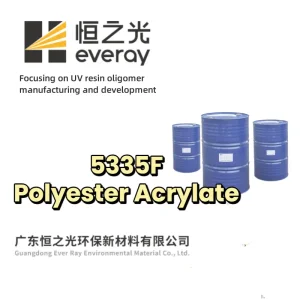
In offset lithography, emulsification resistance is critical. Poor resin choice triggers plate scuffing, ink misting, and tinting. Ever Ray’s 5335F and 5403-2F series feature carefully tuned hydrophobic/hydrophilic balance, sustaining rheological elasticity under high dampening-solution shear rates.
Targeted Industrial Use Cases for Polyester Acrylates
Deploying polymer architectures calibrated to substrate surface energies, mechanical wear regimes, and processing thermal constraints.
High-Speed UV Offset & Sheetfed Inks
Offset lithography requires resin binders that display pseudoplastic shear thinning behavior combined with rapid recovery on the ink duct roller. Polyester acrylates such as Ever Ray 5335F and 5336B impart superior tack stability, controlled emulsification rates with fountain solutions, and immediate curing under high-power mercury or low-energy iron-doped lamps, preventing ink setoff on high-speed presses running up to 15,000 sheets/hour.
Overprint Varnishes (OPV) & Paper Finishing
In commercial packaging and high-end magazine publishing, overprint varnishes must deliver mirror-like gloss (>90 GU at 60°), rapid slip, and non-blocking properties immediately after UV curing. Ever Ray’s highly functional polyester acrylates provide tight crosslink networks that resist fingernail scratch, water spotting, and solvent rub (MEK rubs >100), while their low viscosity profile minimizes or eliminates solvent addition.
UV Flexographic Inks for Flexible Films
Printing on untreated polyolefin substrates (corona-treated PE, PP, oriented BOPP) demands elastic elongation to withstand post-cure web tension and die cutting. By synthesizing modified polyester acrylates incorporating flexible polyether or aliphatic polyester diol soft segments, Ever Ray delivers inks that balance flexibility with rapid cure response on narrow and mid-web flexo presses.
Wood & Flooring UV Topcoats
In industrial roller-coating lines for parquet and vinyl flooring, polyester acrylates serve as cost-effective workhorses blended with polyurethane acrylates. They contribute significant surface hardness (pencil hardness up to 3H), abrasion resistance (Taber abrasion CS-17), and sandability in intermediate primer formulations, dramatically improving sanding dust extraction without clogging abrasive belts.
Screen Printing Inks on Plastics & Metals
Screen printing deposits heavy ink films (10 to 30 microns). This thickness challenges through-cure and exposes the layer to shrinkage shearing. Ever Ray PEA formulations feature optimized molecular weight distributions that limit volumetric shrinkage down to <6%, preventing edge curl on thin polycarbonate plaques, membrane switches, and aluminum foil nameplates.
Photopolymer 3D Printing Formulations
In stereolithography (SLA) and digital light processing (DLP), resin viscosity must remain below 1200 mPa.s at 25°C to allow swift recoater blade leveling. Ever Ray's low-viscosity polyester acrylates act as high-reactivity crosslinkers that accelerate vat printing cycles while providing high heat deflection temperatures (HDT > 75°C) in engineered prototypes.
Representative Ever Ray Polyester Acrylate Specifications
Chemical and physical metrics measured under ISO standard testing protocols (25°C, Brookfield rotational viscometry).
| Grade Code | Functionality (f) | Viscosity (mPa.s @ 25°C) | Color (Gardner) | Acid Value (mg KOH/g) | Key Strengths & End-Use Focus |
|---|---|---|---|---|---|
| PEA 5335F | 4.0 | 15,000 – 25,000 | ≤ 1.5 | ≤ 2.0 | UV offset lithographic inks; ideal water-ink balance; high pigment wetting |
| PEA 5336B | 4.0 | 8,000 – 16,000 | ≤ 1.0 | ≤ 1.5 | Ultra-fast curing UV flexo & offset inks; high transfer efficiency; glossy OPVs |
| PEA 5351 | 3.0 | 4,000 – 9,000 | ≤ 1.0 | ≤ 2.5 | High flexibility plastic coatings; thermoformable screen inks; low shrinkage |
| PEA 5403-2F | 6.0 | 45,000 – 65,000 | ≤ 2.0 | ≤ 2.0 | High hardness overprint varnishes; fast scratch resistance; high density cure |
| PEA 5320 | 2.0 | 800 – 1,800 | ≤ 1.0 | ≤ 1.0 | Low viscosity reactive diluent replacement; pigment wetting agent; 3D printing |
| PEA 5403-3F | 5.0 | 30,000 – 45,000 | ≤ 1.5 | ≤ 2.0 | Heavy offset ink systems; anti-misting; high-speed roller shear resilience |
Global Chemical Governance & Localized Regulatory Compliance
International procurement requires full conformity with evolving health, safety, and environmental protection frameworks.
EU REACH & RoHS Compliance
All monomer constituents and additives utilized in Ever Ray polyester acrylate oligomers are compliant with Regulation (EC) No 1907/2006 (REACH). We ensure our formulations are free from Substances of Very High Concern (SVHC) on the ECHA Candidate List above 0.1% w/w. Furthermore, strict ICP-OES monitoring ensures compliance with Directive 2011/65/EU (RoHS) regarding lead, mercury, cadmium, hexavalent chromium, and phthalate plasticizers.
US TSCA & FDA Indirect Food Contact
For formulators supplying the North American market, our oligomers are inventoried under the United States EPA Toxic Substances Control Act (TSCA). Select low-migration grades are synthesized using starting substances listed under FDA 21 CFR 175.300 and 175.105, supporting indirect food contact packaging varnishes when formulated with appropriate photoinitiators and fully cured under certified manufacturing conditions.
GB Standards & VOC Directives
In our domestic market and for firms exporting to China, our 100% solids UV-curable polyester acrylates meet or surpass GB 38507-2020 (Limits of Volatile Organic Compounds Contents in Inks) and GB/T 23986-2009. By excluding volatile benzene, toluene, xylene, and glycol ethers from our synthetic pathways, we deliver formulations with measurable VOC content well below statutory threshold limits.
Technological Roadmap & Next-Generation Synthesis
Forward-looking innovations shaping the radiation curing horizon over the coming decade.
Bio-Based & Circular Monomer Platforms
In alignment with global decarbonization initiatives, Ever Ray R&D is synthesizing polyester acrylate backbones utilizing bio-succinic acid, itaconic acid, dimer fatty acids, and bio-1,3-propanediol (PDO). These renewable monomers achieve bio-carbon content exceeding 40% without compromising glass transition temperature (Tg), hardness, or curing reactivity.
Waterborne Radiation-Curable PUD Hybrid Systems
By combining the low viscosity of aqueous dispersions with the rapid crosslinking of acrylates, our upcoming waterborne polyester-polyurethane hybrid dispersions eliminate reactive diluents completely. This delivers extremely thin film coats (<5 microns) with zero tack before curing, perfect for open-grain luxury wood furnishings and interior automotive trims.
Dual-Cure (UV / Moisture & Thermal) Architectures
Addressing shadowed areas in complex 3D parts and electronic potting assemblies, our dual-cure polyester acrylate systems combine free-radical UV curing with secondary moisture-curing alkoxysilane or blocked isocyanate mechanisms. This ensures complete substrate anchoring and uncompromised bond integrity even where ultraviolet radiation cannot penetrate directly.
Frequently Asked Technical & Procurement Questions
Clear, chemical-level answers from our application laboratories for senior coating chemists, technical formulators, and global purchasing managers.
What are the definitive performance advantages of polyester acrylates compared to epoxy acrylates in UV inks?
How do you mitigate oxygen inhibition when curing polyester acrylates under UV-LED (395 nm)?
What packaging options, shelf life, and storage conditions apply to export containers?
Can Ever Ray customize acid value and hydroxyl value for specific specialty applications?
What documentation and sample trial support is available for international procurement teams?
Specialized UV Acrylate Resins & Specialty Functional Monomers
Explore our full line of functional UV-curable chemistries: high-impact polyurethane acrylates, hyperbranched scratch-resistant oligomers, and customized monomers.