Precision UV & LCD Curable Resins for Industrial Manufacturing
Formulated with exact molecular weight distribution, strict radical cure kinetics, and high chemical resistance across consumer electronics, coating systems, and precision additive lines.
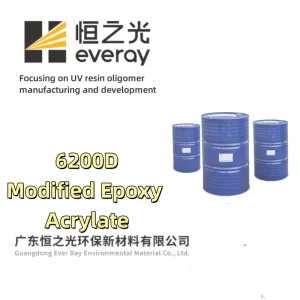
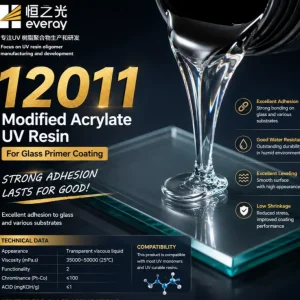
Wholesale 12011 Modified Acrylate UV Resin for Glass Primer Coatings | Excellent Adhesion & Boiling Water Resistance Manufacturer, Product
View Product Details
High-Quality 7620 UV-curing Resin applied in UV vacuum electroplating Factories, Products
View Product Details
High-Quality Low heat release 72583 polyurethane UV resin for nail extension glue and 3C coating Supplier, Product
View Product Details
Buy Aromatic Polyurethane Acrylate Oligomer – High-Adhesion Acrylic Resin for UV Vacuum Metallizing & Topcoats on ABS/PC Manufacturer, Suppliers
View Product Details
Buy 17701 Low Shrinkage Modified Acrylate Oligomer - Resin for Offset and Film Inks Factories, Product
View Product Details
Wholesale Bisphenol A Epoxy Acrylate Resin 9105M-80: A Versatile Core Resin for Durable and Glossy UV Coatings Manufacturer, Suppliers
View Product Details
Wholesale 6851A High-Performance Modified Epoxy Acrylate Resin | For UV Coatings, Inks & Gel Polishes | High Transparency & Yellowing Resistance Manufacturers, Factories
View Product DetailsThe Global Commercial Reality of Industrial LCD Photopolymers
Liquid Crystal Display (LCD) stereolithography—frequently categorized under masked stereolithography (mSLA)—has evolved from consumer rapid prototyping into a multi-billion dollar manufacturing discipline. Industrial formulators, chemical synthesis plants, and Tier-1 hardware integrators now demand photopolymer resins that satisfy extreme mechanical, optical, and thermal criteria.
In the contemporary additive manufacturing sector, the shift from conventional laser-based SLA (Stereolithography Apparatus) and digital micro-mirror DLP (Digital Light Processing) engines toward high-transmittance monochrome LCD light engines operating at 405nm is accelerating. Modern industrial monochrome screens boast resolutions exceeding 8K, 12K, and 14K, delivering pixel pitches below 18 microns. This physical hardware evolution exposes the critical limiting factor: photopolymer chemical formulation integrity.
A high-quality LCD resin is no longer merely a basic blend of monomeric diluents and standard photoinitiators. Rather, it represents an intricately engineered suspension of specialized acrylate oligomers, functionalized hyperbranched structures, free-radical photoinitiators tuned precisely to the 405nm optical emission spike, light-diffusing suppressors, and internal stress release additives. In global factories across East Asia, North America, and Western Europe, formulators are confronted with stringent production demands: reducing volumetric shrinkage below 1.5%, suppressing parasitic light bleed across micro-voids, and accelerating vat refill dynamics via sub-300 cps fluid viscosity at ambient operational temperatures.
Photopolymer Curing Law (Jacob's Equation): The cure depth ($C_d$) within LCD masked stereolithography follows the fundamental logarithmic profile $C_d = D_p \cdot \ln(E_{max} / E_c)$, where $D_p$ represents penetration depth governed by UV absorptivity and $E_c$ denotes the critical energy required for crosslinking. Premium LCD resin factories synthesize custom oligomers to stabilize $D_p$ across long continuous build batches.
As contract manufacturers transition LCD resin technology into dental bridges, hearing aid shells, automotive micro-connectors, and end-use consumer electronics, the baseline standards for resin factories have multiplied. Global supply chains mandate uncompromising batch-to-batch repeatability (Cpk > 1.33), zero heavy-metal contamination, rigorous volatile organic compound (VOC) compliance, and predictable long-term aging characteristics against thermal distortion and UV photolytic yellowing.
Precision Oligomer Architecture: Inside the Synthesis Laboratory
Behind high-performance LCD resins lies the foundational organic synthesis of acrylate oligomers. At Guangdong Ever Ray Environmental Material Co., Ltd., polymer chemistry and mechanical engineering coalesce to produce resins of exceptional stability.
Aliphatic Polyurethane Acrylates (PUA)
Synthesized utilizing high-purity aliphatic diisocyanates (such as IPDI and H12MDI). Essential for formulations requiring zero yellowing, weatherability, and balanced elongation-at-break.
- Tensile elongation: 40% – 180%
- Extreme yellowing resistance index (ΔYI < 1.0)
- Dampens internal stress in mSLA layer peeling
Modified Epoxy Acrylate Networks
Engineered via epoxy ring-opening reactions with acrylic acid, balancing rapid radical cure speed with elevated mechanical surface hardness and chemical immersion resistance.
- Pencil hardness ratings reaching 3H – 5H
- Fast double-bond conversion under 405nm light
- Impermeable to industrial solvents and acids
Hyperbranched Dendritic Acrylates
Multi-functional dendritic topologies that provide exceptionally high crosslinking density while keeping polymer solution viscosity manageable without excessive volatile solvents.
- Functionality ranges from 6 to 16 reactive sites
- Overcomes oxygen inhibition in thin cross-sections
- Elevates Heat Deflection Temperature (HDT > 110°C)
Macro Trends Reshaping Industrial LCD Resin Production
Photopolymer research is advancing beyond mechanical prototyping toward biocompatibility, green chemistry, flame-retardant industrial grades, and sub-second exposure cycle times.
1. Nanocomposite LCD Suspensions
By suspending surface-functionalized silica ($SiO_2$) or alumina nanoparticles within low-viscosity acrylate bases, factories create ceramic-like photopolymers with flexural moduli surpassing 5,000 MPa and continuous thermal resistance above 220°C for semiconductor burn-in sockets and aerodynamic test rigs.
2. Dual-Cure Hybrid Chemistry
Next-generation LCD resins feature sequential curing mechanisms: an initial 405nm radical photocure defines the green part geometry on the LCD screen, followed by a secondary moisture or thermal cure triggering blocked polyurethanes or epoxies, eliminating isotropy weaknesses and achieving true injection-molded toughness.
3. Bio-Based & Low-Sensitization Monomers
Driven by EU-REACH mandates and medical device requirements, leading synthesis plants are substituting petro-derived isobornyl acrylate (IBOA) and ethoxylated bisphenol A with isosorbide-, cardanol-, and soybean-derived oligomer backbones, achieving over 45% bio-carbon content without compromising cure speed.
Industrial Resin Chemistry Performance Comparison
A reference table utilized by chemical formulation architects to specify oligomer backbones against target mechanical, optical, and thermal criteria.
| Resin Chemistry Class | 405nm Cure Speed | Tensile Modulus (MPa) | Linear Shrinkage | HDT @ 0.45 MPa | Viscosity (25°C) | Primary Industrial Sector |
|---|---|---|---|---|---|---|
| Aliphatic PUA Oligomer | 1.2 – 2.0 s / layer | 1,800 – 2,400 | 1.1% – 1.4% | 65°C – 80°C | 1,200 – 3,500 cps | Optically clear optics, dental guides, 3C housings |
| Aromatic PUA Oligomer | 0.8 – 1.5 s / layer | 2,200 – 3,100 | 1.4% – 1.8% | 75°C – 95°C | 2,000 – 5,500 cps | Automotive jigs, floor primers, heavy impact tooling |
| Modified Epoxy Acrylate | 0.6 – 1.1 s / layer | 3,200 – 4,200 | 1.8% – 2.4% | 90°C – 115°C | 800 – 2,200 cps | High-rigidity tooling, microfluidics, chemical valves |
| Hyperbranched Acrylate | 0.4 – 0.8 s / layer | 3,800 – 4,800 | 1.2% – 1.6% | 120°C – 145°C | 400 – 1,100 cps | Anti-scratch coatings, electronic encapsulation, cast master |
| Polyester Acrylate | 1.0 – 1.6 s / layer | 1,500 – 2,200 | 1.6% – 2.1% | 55°C – 70°C | 300 – 900 cps | Offset UV inks, high-pigment suspensions, rapid flex prototypes |
Engineered Resin Applications in Precision Manufacturing
How tailor-made LCD photopolymer resins perform across complex real-world manufacturing environments.
Medical & Digital Dentistry
Class I and IIa biocompatible photopolymers for surgical implant drill guides, orthodontic models, and provisional crowns requiring autoclave survivability, water absorption under 15 µg/mm³, and absolute non-cytotoxicity.
3C Electronics & Wearables
Miniaturized connectors, optical housings, and sensor fixtures that demand tight dimensional tolerances (±15 µm), high dielectric breakdown strength, and drop-impact resistance on polycarbonate/ABS assembly lines.
Jewelry Investment Casting
Ultra-high-definition castable resins loaded with micronized wax blends that exhibit clean burnout without expanding, leaving <0.01% residual ash for defect-free investment casting in platinum, gold, and fine silver.
Technology Roadmap: Next-Gen Formulations (2025–2030)
The progression of chemical development shaping the next five years of LCD vat photopolymerization.
High-Aspect mSLA Monomers
Stabilization of rapid-wetting diluents tailored for 12K+ mono-screens, reducing peel delamination forces by over 35% through fluorinated additive incorporation.
Continuous Release Photopolymers
Oxygen-permeable vat interface matching resins, engineered with specialized chain-transfer agents that enable continuous z-axis printing without individual layer pauses.
UL94-V0 Flame-Retardant Systems
Non-halogenated, phosphorus-nitrogen synergized oligomer structures engineered for commercial aviation cabins and high-voltage rail electronic enclosures.
Autonomous Self-Healing Polymers
Photopolymers incorporating dynamic covalent bond networks (Diels-Alder adducts) that reverse micro-cracking and mechanical fatigue when subjected to low-energy thermal anneals.
Macro Industrial Solutions: Securing High-Volume Supply
Reliable LCD resin manufacturing requires steady raw material synthesis, strict analytical QC, and agile toll manufacturing solutions.
Global brand owners and additive hardware manufacturers face severe risks when sourcing off-the-shelf resins from regional repackagers. Inconsistent raw material feedstocks cause variations in double-bond density, monomer conversion ratios, and trace moisture—leading to print failures, cracked parts, or altered dimensional geometry. Guangdong Ever Ray Environmental Material Co., Ltd. resolves these systemic vulnerabilities through end-to-end integration:
Custom Backbone Synthesis
Our chemical synthesis reactors formulate target resin backbones directly from raw monomeric precursor blocks, fine-tuning molecular weights (Mw/Mn) to match customer-specified mechanical envelopes.
Analytical Quality Control
Every industrial production batch undergoes Gel Permeation Chromatography (GPC), Fourier Transform Infrared (FTIR) double-bond kinetics tracking, and dynamic rotational viscometry before release.
Private Labeling & Global Logistics
Equipped with automated bottling, inert gas purging, and full UN/DOT chemical compliance, we offer turnkey contract packaging, global warehousing, and SDS localization across 30+ countries.
Frequently Answered Questions for Engineers & Formulators
Addressing essential considerations regarding photocuring chemistry, storage stability, equipment matching, and contract synthesis.
High-Performance Acrylate Resins & Industrial Oligomers
Explore our specialized range of fast-curing, anti-yellowing, and high-adhesion oligomers engineered for demanding industrial coating, ink, and photopolymer applications.
High-Quality 6160M-3: Fast curing modified epoxy acrylate for improved performance Manufacturer, Supplier
View Product Details
High-Quality 6803A Modified Epoxy Acrylate Resin High Gloss Fast Curing Oligomer for UV Ink Varnish & Plastic Coating Factory, Factories
View Product Details
Buy Polyester Acrylate 5319A-1–A Reliable Solution for High-Performance UV Coatings Manufacturers, Suppliers
View Product Details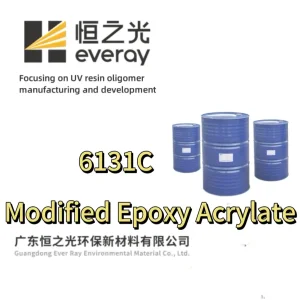
Buy Fast Curing Modified Epoxy Acrylate Oligomer - High Flexibility Acrylic Resin for UV Plastic Coating & Furniture Supplier, Product
View Product Details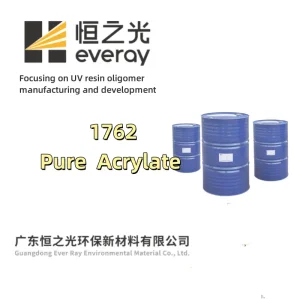
Wholesale 1762 UV resin as adhesive: durable and anti-yellowing, high bonding strength Manufacturers, Factory
View Product Details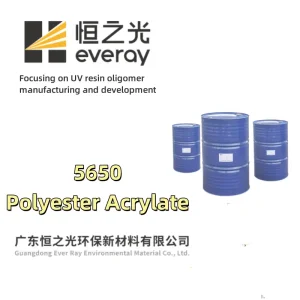
High-Quality 5650F UV resin for UV varnish and printing ink Manufacturer, Product
View Product Details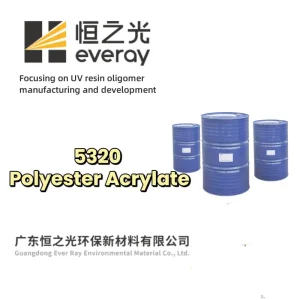
High-Quality 5320 polyester acrylate: optimal ink wettability and high gloss Factory, Factories
View Product Details