
High-Performance Epoxy Acrylates & Functional Resins
Selected high-solid, fast-cure monomers and prepolymers engineered for harsh thermal, mechanical, and boiling water exposure environments.
Engineering the Epoxy Curing Matrix: Acrylation, Crosslink Density, and Curing Kinetics
A rigorous examination of reaction mechanics that govern hardness development, adhesion promotion, shrinkage compensation, and thermal transition temperatures ($T_g$).
Free-Radical vs. Cationic Epoxy Acrylate Crosslinking
Standard Bisphenol-A diglycidyl ether (DGEBA) derived epoxy acrylates cure predominantly via free-radical polymerization initiated by Norrish Type I or Type II photoinitiators. When exposed to ultraviolet radiation ($\lambda = 254-405\text{ nm}$), acryloyl double bonds ($C=C$) rapidly polymerize within milliseconds. However, unreacted oxirane rings can be utilized in hybrid curing architectures.
In dual-cure mechanisms, cationic photoinitiators (such as triarylsulfonium hexafluoroantimonate salts) activate the underlying epoxy groups via ring-opening polymerization. This post-thermal or dark-reaction phase relieves localized shrinkage stress, boosting tensile elongation without sacrificing Shore D hardness or glass transition values.
Overcoming Oxygen Inhibition and Shrinkage Brittleness
A fundamental flaw in conventional epoxy acrylates is their high volume shrinkage (typically 6% to 9%), which causes micro-cracking and loss of adhesion on smooth inorganic surfaces like glass, passivated steel, and polyolefin plastics.
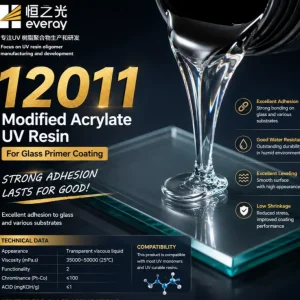
By chemically modifying the epoxy backbone with flexible aliphatic polyether segments, hyperbranched polymers, or carboxylic acid adducts (as seen in our proprietary 6203F and 12011 grades), free volume is preserved during crosslinking. Furthermore, introducing active amine synergists or amino acrylates scavenges ground-state triplet oxygen ($^3\text{O}_2$), eliminating surface tackiness even under low-energy LED-UV lamps.
Chinese Factory Supply Chain Advantages & Synthesis Capabilities
How our automated manufacturing infrastructure in Yunfu and Jiangmen delivers superior batch consistency, cost resilience, and scale advantages over localized compounders.
Upstream Chemical Integration
Operating directly in Guangdong's specialized chemical corridors gives us direct pipeline access to key precursors: high-purity Epichlorohydrin (ECH), Bisphenol-A, acrylic acid, and diverse aliphatic glycols. By buffering against raw material volatility, we offer contracted tier-one clients locked annual pricing agreements and rock-solid raw material supplies.
Precision Synthesis & Automation
Our synthesis reactors range from 5-ton pilot synthesis kettles to 30-ton automated stainless steel reactors equipped with distributed control systems (DCS). Closed-loop monitoring of esterification exotherms, acid values, and residual monomer content guarantees that acid numbers remain strictly below 2 mg KOH/g and moisture levels below 0.1%.
Stringent Lot Traceability & QA
Every batch undergoes automated Gel Permeation Chromatography (GPC) molecular weight distribution profiling, cone-and-plate rheology checks, and Fourier-Transform Infrared (FTIR) spectral verification. Retained samples from each ISO 9001 certified production lot are preserved for 24 months, ensuring complete backward traceability.
Global Enterprise Procurement: Meeting Rigid Technical and Statutory Demands
Bridging Chinese chemical synthesis with multinational environmental directives, regulatory registries, and global logistical protocols.
Statutory Certifications & REACH/TSCA Alignment
For global specialty formulators operating across the EU, North America, and Japan, regulatory compliance is non-negotiable. Ever Ray ensures all supplied epoxy acrylates and monomers comply with:
- EU REACH Registration: Pre-registered and full dossier registrations for key oligomer compositions, strictly maintaining Substances of Very High Concern (SVHC) under threshold limits (<0.1% w/w).
- US EPA TSCA & Canadian DSL: Verified chemical inventories permitting seamless commercial importation without unexpected customs holds.
- RoHS & Halogen-Free Mandates: Complete absence of restricted heavy metals (Cd, Pb, Hg, Cr VI) and total halogens controlled below 900 ppm for microelectronics application.
Dual-Sourcing Security & Audit Governance
Modern corporate risk mitigators require resilient supply chains that survive geopolitical and logistics volatility. Partnering with Ever Ray provides:
- Comprehensive TDS, SDS & COA: Standardized 16-section GHS-compliant Safety Data Sheets and Certificate of Analysis tailored to individual client specification brackets.
- Export Packaging Standards: UN-certified epoxy-lined steel drums (200 kg), UN-approved IBC containers (1000 kg), and ISO-tank bulk configurations with nitrogen blanket preservation.
- Virtual and On-site Factory Audits: Complete transparency into our synthesis halls, automated QC labs, explosion-proof storage facilities, and effluent treatment systems.
Comparative Performance Architecture of Core Curing Resins
Analytical reference parameters evaluating glass transition temperatures, dynamic viscosities, functionality metrics, and mechanical properties across industry-standard curing matrices.
| Resin Chemistry Family | Acrylate Functionality ($f$) | Viscosity (mPa·s @ 25°C) | $T_g$ (°C, DMA) | Volumetric Shrinkage (%) | Core Application Fit |
|---|---|---|---|---|---|
| Standard Bisphenol A Epoxy Acrylate | 2.0 | 15,000 – 30,000 (80% in TPGDA) | +65 to +85 | 7.5 – 9.0 | Wood Sealers Paper OPV |
| Modified Low-Viscosity Epoxy Acrylate (61163) | 2.0 – 2.4 | 3,500 – 6,500 (100% Solid) | +45 to +60 | 4.8 – 6.2 | Sprayable UV Coatings Anti-Yellowing Topcoats |
| Boiling-Water Resistant Modified Acrylate (12011) | 2.0 | 8,000 – 16,000 | +55 to +70 | 3.5 – 4.8 | Glass Primers Vacuum Metallization |
| Hyperbranched Multi-Functional Acrylate (4600) | 6.0 – 12.0 | 1,200 – 2,800 | +90 to +115 | 5.2 – 6.8 | Anti-Scratch Varnishes High-End Inks |
| Low-Shrinkage Adhesion Prepolymer (6203F) | 2.0 | 6,000 – 12,000 | +35 to +50 | < 3.0 | Optical Adhesives Plastics (PC/ABS/PET) |
Emerging Industry Trends in Epoxy Curing & Photopolymerization
The evolutionary trajectory of radiation curing materials: shifting toward lower carbon footprints, deeper substrate transmission, and near-zero volatile organic footprints.
LED 395nm/405nm Curing Optimization
The global phaseout of mercury arc vapor lamps under the Minamata Convention requires oligomers that respond cleanly to narrow LED emission bands (365 nm, 385 nm, 395 nm). Modern formulations integrate photosensitizers and modified backbones that prevent chromatic absorption blockades.
Bio-Based Carbon Feedstocks
Substituting petrochemical bisphenols with natural cardanol, epoxidized soybean oil (ESBO), and isosorbide derivatives allows formulators to attain up to 45% bio-based carbon content without compromising chemical resistance or surface hardness metrics.
Dual-Stage Thermal/UV Architectures
Shadow curing in complex geometry components—such as automotive camera assemblies and encapsulated microchips—relies on secondary thermal latent hardeners (such as dicyandiamide micro-dispersions) that cure shielded sections after high-speed UV tacking.
Hyperbranched Rheology Modifiers
Hyperbranched structures provide ultra-high functional group density within a globular nanoscale architecture, offering massive scratch resistance and chemical barrier properties while keeping system viscosities fluid without needing solvent addition.
Engineered Epoxy Curing Across Demanding Industrial Segments
Specific formulation chemistry optimized for surface tension, polar bonding sites, and tough environmental tolerances.
Precision 3C Consumer Electronics
Polycarbonate (PC) and anodized aluminum casings require optical-grade finishes that withstand cosmetic sunscreen, alcohol rubbing, and artificial sweat. By combining non-yellowing epoxy acrylates with hyperbranched resins, formulators achieve pencil hardness up to 4H with zero crosshatch peel.
Automotive Headlamp & Trim Metallization
Vacuum aluminum deposition primers require extreme surface smoothness and zero thermal outgassing. Our specialized adhesion oligomers anchor tenaciously onto BMC composite and polycarbonate substrates, surviving rigorous thermal shock cycles from -40°C to +125°C.
Heavy-Duty Wood & Flooring Sealers
Industrial roller-coating lines operating at >40 m/min require rapid cure response and instant sandability without clogging sandpaper. Fast-curing modified bisphenol-A epoxy acrylates provide deep pore-filling and chemical stain resistance against solvents, coffee, and household alkalis.
Frequently Asked Questions on Industrial Epoxy Curing
Comprehensive engineering clarity regarding viscosity stability, cure speed optimization, adhesion promotion, and inter-batch reproducibility.
Engineered Prepolymers for Specialized Coating & Bonding Lines
Complete your chemical toolset with targeted prepolymers for offset inks, multi-substrate bonding, and ultra-low shrinkage applications.
Collaborate with Direct UV Resin Synthesis Engineers
Whether qualifying a drop-in second-source oligomer to optimize raw material procurement or engineering a completely bespoke hyperbranched resin matrix, our senior polymer chemists are ready to review your parameters.
