
Dual-Curing & Specialty Oligomer Formulations (Series 01)
Explore high-performance UV and thermal hybrid resins optimized for rapid tack-free surface curing coupled with deep shadowed zone cross-linking.
Global Industrial Landscape of Dual-Curing Polymeric Resins
Overcoming the fundamental geometric limitations of pure photo-polymerization across automotive, optoelectronics, and advanced additive manufacturing.
Mechanistic Dual Polymerization
Traditional pure ultraviolet (UV) curable systems require uninhibited optical line-of-sight. Dual curing resins merge Photo-Thermal (UV/Heat), UV-Moisture, or UV-Anaerobic pathways. A rapid UV pulse (365nm to 405nm) initiates immediate green-strength immobilization within 2–5 seconds, while a secondary chemical condensation or radical propagation finishes the cure in unexposed, opaque, or heavily shadowed undercuts.
Volumetric Shrinkage Mitigation
Standard monofunctional acrylates exhibit volumetric polymerization shrinkage upwards of 6% to 12%, introducing significant internal micro-stresses and interfacial bond failures. By synthesizing hyperbranched oligomers, aliphatic polyurethane backbones, and blocked-isocyanate functional terminations, dual-cure resins control shrinkage to < 1.5%, providing dimensional fidelity essential for optical lens bonding and micro-fluidic channels.
High-Density Crosslink Networks
The post-thermal or moisture-activation stage triggers secondary network formation, dramatically elevating the glass transition temperature (Tg > 135°C) and heat deflection temperature (HDT). This dual-network architecture resists automotive solder-reflow cycles (260°C peak), harsh hydrolytic immersion, and cyclic thermal shocks from -40°C to +150°C without micro-cracking.
Direct-From-Factory Chemical Engineering & Operational Efficiency
How our Jiangmen R&D center and Yunfu production base deliver cost-optimized, batch-stable dual curable monomers and oligomers to international buyers.
Supply Chain Cluster Integration
Situated within the Greater Bay Area chemical corridor in Guangdong, China, our manufacturing facilities source primary chemical feedstocks—such as isophorone diisocyanate (IPDI), hydroxyethyl methacrylate (HEMA), and bisphenol-A diepoxide—with zero transshipment delay. This domestic integration secures raw material cost stability and eliminates overseas supply chain bottlenecks.
Automated DCS Process Management
Over 10 dedicated reaction kettle systems are managed by a centralized Distributed Control System (DCS). Exothermic esterification, addition, and end-capping steps are continuously monitored with real-time FTIR spectroscopy, achieving tight control over acid value (< 1.0 mg KOH/g), residual isocyanate (NCO < 0.1%), and a consistent batch-to-batch Cpk exceeding 1.33.
Rapid Tailored Customization Cycle
Our Jiangmen synthesis laboratory custom-engineers monomer viscosity diluents, molecular weight distributions (Mw/Mn), and photoinitiator packages within a 7-day lab screening turnaround. We scale formulations from 500mL pilot testing straight into 200kg drums or 1000kg IBC totes with rigorous batch verification.
Localized Applications & Industrial Performance Profiles
Engineering cross-reference for dual-cure formulations deployed across harsh automotive, microelectronics, footwear, and optoelectronic assemblies.
| Application Domain | Cure Chemistry Pair | Critical Processing Problem Solved | Key Mechanical / Thermal Target | Recommended Ever Ray Grade |
|---|---|---|---|---|
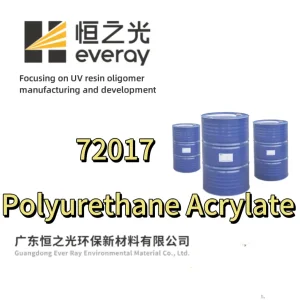
| Additive Footwear & Lattices | Photo-Thermal (Free Radical + Polyurethane) | Eliminates green-state sagging; secondary heat activation unlocks true elastomeric rebound. | Elongation at Break > 350%, Tear Strength > 35 kN/m | Wholesale 72017 |
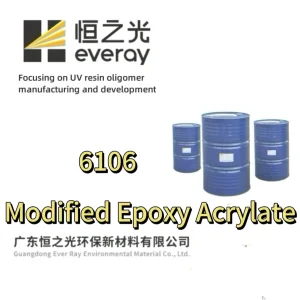
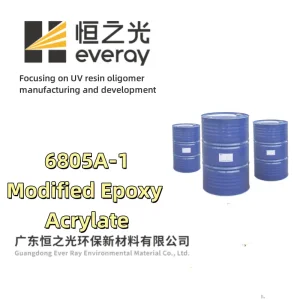
| Automotive Camera & LiDAR Active Alignment | UV-Thermal (Acrylate + Epoxy Ring-Opening) | Zero optical drift during sub-micron positioning. Full deep cure behind opaque metal housings. | Volumetric Shrinkage < 1.2%, CTE < 35 ppm/°C | Wholesale 6106 Modified Epoxy |
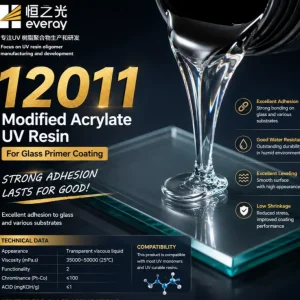
| Consumer Electronics (3C) Glass Primer | UV-Moisture / Organosilane Dual Promoted | Direct covalent Si-O-Si coupling with vitreous surfaces without yellowing or boil delamination. | Boiling Water Immersion > 4 hrs without cross-hatch loss | Wholesale 12011 Modified Acrylate |
| PCB Conformal Coatings & Potting | UV-Moisture Polyurethane Acrylate | Instant UV freeze prevents edge run-off; ambient humidity crosslinks hidden areas under dense BGA chips. | Dielectric Strength > 22 kV/mm, UL94 V-0 Compliance | 7600 Multifunctional Oligomer |
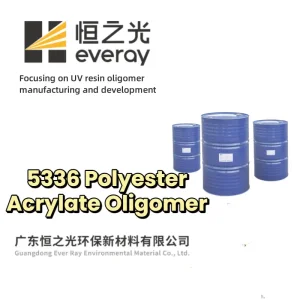
| High-Speed UV Offset Packaging | Polyester Acrylate + Amine Radical Synergism | Eliminates oxygen inhibition on high-speed lines (600 m/min) while maintaining stable water-ink balance. | Viscosity Stability @ 45°C > 180 days, Zero Tack | Polyester Acrylate 5336 |
Global Enterprise Procurement Specifications & Quality Control
Essential validation criteria, testing protocols, and compliance benchmarks for multinational Tier-1 chemical procurement teams.
International Chemical Governance
Ever Ray supplies raw materials compliant with EU REACH SVHC (Regulation EC 1907/2006), RoHS 3 (Directive 2015/863), TSCA (USA), IEC 61249-2-21 (Halogen-Free), and regional VOC reduction guidelines. Every export shipment is accompanied by complete GHS-compliant multilingual Safety Data Sheets (SDS) and lot-specific Certificates of Analysis (COA).
Thermal Stability & Cold-Chain Packaging
Dual curing resins containing latent crosslinkers (such as blocked polyisocyanates, thermal peroxides, or cationic sulfonium salts) require controlled shipping conditions. We package products in UV-shielded, fluorinated HDPE drums and nitrogen-purged carbon steel containers equipped with irreversible temperature data loggers to guarantee zero premature gelation during sea freight.
Traceability & Statistical Process Control
Every commercial production batch undergoes strict quality gates: Brookfield dynamic viscosity testing (at 25°C ± 0.1°C), refractive index, Gardner color scale analysis, non-volatile content titration, and UV curing reactivity indexing under standard 395nm LED arrays. Samples from every batch are cataloged in retained cold storage for a minimum of 24 months.
Emerging Technology Trends in Radiation & Dual Curing Chemistry
Key evolutionary trajectories shaping the next decade of photopolymerization and sustainable chemical synthesis.
Long-Wavelength LED Photopolymerization
Global regulations are rapidly phasing out toxic mercury-arc UV lamps in favor of energy-efficient UV LED arrays (385nm, 395nm, and 405nm). Modern dual curing resins incorporate bis-acylphosphine oxide (BAPO) and camphorquinone-amine initiation complexes optimized for deep photon penetration through highly pigmented or scattering matrices without surface wrinkling.
Bio-Based & Monomer-Free Hyperbranched Architecture
Mounting regulatory scrutiny regarding free monomer migration (such as IBOA, HDDA, and TPGDA) has driven our development of bio-derived, renewable polyesters and hyperbranched urethane acrylates. These deliver fluid process viscosities without solvent dilution, drastically reducing skin-sensitization risks and ensuring strict consumer safety compliance.
Cationic-Radical Interpenetrating Networks (IPN)
Combining free-radical acrylic curing with cycloaliphatic epoxy cationic curing creates a synchronized dual-network structure. The radical phase cures within milliseconds to capture profile geometries, while the cationic phase continues living ring-opening polymerization for hours, virtually eliminating shrinkage stress and delivering exceptional metal adhesion.
Specialty Oligomers, Diluents & Functional Resins (Series 02)
Engineered monomers, pure acrylates, and high-tensile resins tailored for UV coatings, offset inks, metallization primers, and composite matrices.
Frequently Asked Questions on Dual Curing Resin Synthesis & Procurement
In-depth technical answers addressing polymer conversion rates, shadow kinetics, shelf-life stabilization, and application tuning.
How does the photo-thermal dual curing mechanism ensure complete polymer conversion in undercut shadow zones?
Photo-thermal dual curing resins contain two functionally decoupled reactive pathways. During initial irradiation (365–405nm), the primary free-radical photoinitiators dissociate to trigger immediate acrylic chain cross-linking, providing green strength in line-of-sight zones within 2–5 seconds. Shadowed regions remain uncured until secondary thermal activation (typically 80°C to 130°C for 15–40 minutes) triggers latent thermal initiators, blocked isocyanates, or epoxy hardeners. This heat-induced chain propagation and transesterification drives total double-bond and epoxide conversion upwards of 98.5%, completely eliminating uncured monomer migration, contact leaching, and outgassing failures.
What strategies are used to prevent dark reactions and premature polymerization during ocean transit?
To prevent uncontrolled thermal cross-linking or radical initiation during high-ambient maritime transport, Ever Ray employs a specialized stabilizer system. We balance steric-hindered phenol antioxidants (such as BHT or Irganox 1010) with quinone-type radical scavengers (MEHQ, phenothiazine, or nitroso compounds) and Lewis acid quenchers. By maintaining dissolved molecular oxygen concentrations through gas-permeable headspace management, the shelf life of these reactive oligomers extends reliably to 12 months when stored below 25°C in opaque, moisture-sealed containers.
Why is dual curing resin superior to one-part cyanate esters or two-component polyurethane in SLA/DLP 3D printing?
Conventional single-cure light resins achieve quick print speeds but generate inherently brittle parts characterized by low impact toughness and high internal shrinkage stresses. Two-component polyurethane chemistries, while tough, exhibit short pot lives (15–45 minutes), making them unsuitable for open vat printing. Dual curing polyurethane acrylates (such as Ever Ray grade 72017) resolve this compromise: the vat fluid maintains room-temperature viscosity stability for days, allowing high-resolution laser or DLP vat photopolymerization. Subsequent post-print thermal curing (120°C for 60 minutes) builds a secondary interpenetrating urethane network, yielding engineering elastomeric properties comparable to injection-molded TPU or vulcanized rubber.
Can Ever Ray customize viscosity and reactivity profiles for roll-to-roll or high-speed precision dispensing lines?
Yes. Our application laboratory customizes resin rheology to match your exact application hardware. For high-speed jetting and micro-dispensing valves, we blend hyperbranched acrylates or low-molecular-weight reactive diluents to achieve Newtonian viscosities from 150 to 800 cP at 25°C. For screen-printing, roller coating, or vertical dam-and-fill potting, we introduce thixotropic agents to produce pseudoplastic shear-thinning behavior, preventing slump or spread before UV pinning.
What documentation and technical data packages are provided to multinational procurement teams?
For international formulation formulators and enterprise buyers, we supply comprehensive Technical Data Sheets (TDS), complete with DSC thermal cure profiles, DMA glass transition charts, UV absorption curves (nm), dynamic viscosity vs. temperature curves, and cross-hatch adhesion data across various substrates (PC, ABS, aluminum, float glass). We also provide full compliance statements covering RoHS 3, REACH SVHC, halogen content, VOC content according to ASTM D2369, and conflict mineral reporting.
