
Featured Optical & UV Curable Formulations
Engineered for high cure conversion, exceptional mechanical rigidity, and deep crystal transparency across extreme environments.
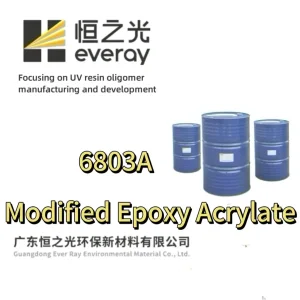
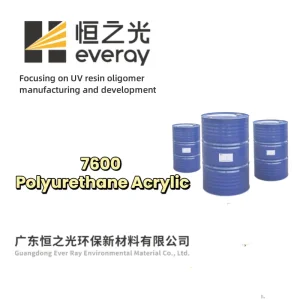
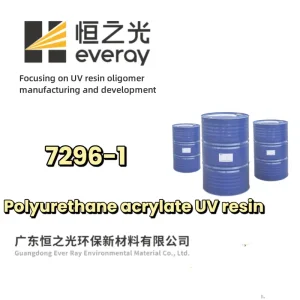
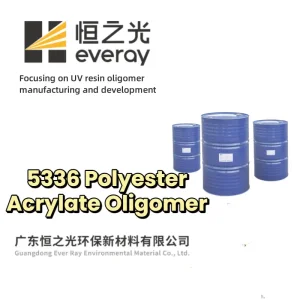
Engineering White Paper: Macromolecular Chemistry of Crystal Clear Epoxy
A comprehensive analysis of photopolymer kinetics, crosslink network topology, and thermal degradation mitigation.
Optical Clarity & Anti-Yellowing Kinetics
Standard aromatic bisphenol A backbones feature chromophoric units susceptible to radical-induced photo-oxidation, manifesting as chromatic shifts (delta E > 3.5). Ever Ray utilizes aliphatic modifications and hyperbranched cycloaliphatic backbones to truncate quinoid formation, ensuring light transmittance exceeding 92.5% at 400–700nm wavelengths across extended ASTM G154 accelerated weathering cycles.
Oxygen Inhibition Counteraction
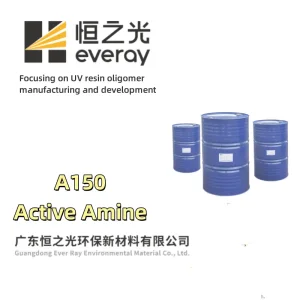
Thin film coatings and surface varnishes frequently suffer from tacky surface layers resulting from atmospheric ground-state triplet oxygen quenching triplet photoinitiators. By integrating specialized amino-functionalized acrylates and reactive active amine synergists into the resin matrix, our systems rapidly scavenge peroxy radicals, accelerating tack-free curing speeds up to 60 meters per minute.
Shrinkage & Internal Stress Dissipation
Volumetric shrinkage during rapid free-radical polymerization frequently causes micro-cracking and loss of interfacial adhesion on difficult substrates such as polycarbonate, PMMA, and untreated glass. Through precise synthesis of flexible polyurethane segments with moderate functionality (f=2 to 4), Ever Ray polymers minimize internal stress buildup, keeping shrinkage under 1.8%.
Formulation Compatibility Notice for Industrial Compounders
Our modified epoxy acrylates and hyperbranched oligomers exhibit complete thermodynamic miscibility with diverse reactive diluents, including TPGDA, DPGDA, TMPTA, and IBOA. When formulating clear topcoats or composite encapsulants, maintaining a stoichiometric resin-to-diluent balance guarantees optimized viscosity control without compromising chemical hardness or Tg thresholds.
Material Performance Matrix: Comparative Chemistry Data
Quantitative empirical parameters evaluated under standard laboratory testing criteria (25°C, 55% RH, UV-LED 395nm / Fusion H-Bulb).
| Resin Classification | Viscosity (mPa.s @ 25°C) | Refractive Index (nD25) | Glass Transition (Tg °C) | Pencil Hardness | Elongation at Break (%) | Recommended Industrial Applications |
|---|---|---|---|---|---|---|
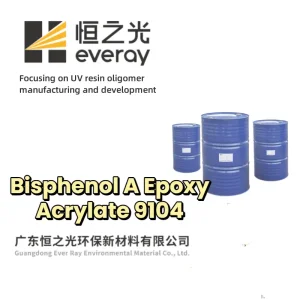
| Standard Bisphenol A Epoxy Acrylate | 15,000 - 35,000 | 1.545 | 65 - 85 | 3H - 4H | 1.5 - 3.0 | Rigid wood primers, overprint varnishes, screen inks |
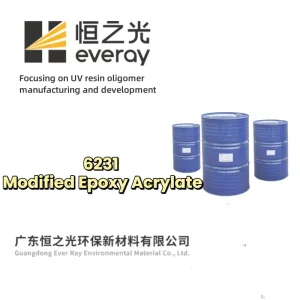
| Modified Low-Shrink Epoxy Acrylate (6102/6231) | 8,000 - 18,000 | 1.530 | 45 - 60 | 2H - 3H | 4.5 - 8.0 | Dimensional wood topcoats, composite edge sealing, PVC sheets |
| Aliphatic Polyurethane Acrylate (Non-Yellowing) | 5,000 - 25,000 | 1.485 | 20 - 45 | HB - H | 35.0 - 120.0 | 3C consumer optics, cosmetic gel, outdoor protective films |
| Aromatic Urethane Acrylate (7296-1 Series) | 12,000 - 40,000 | 1.520 | 50 - 70 | 2H - 3H | 8.0 - 18.0 | Industrial parquet coatings, heavy-duty floor lacquers |
| Hyperbranched Multi-Functional Acrylate | 1,200 - 4,500 | 1.510 | 90 - 115 | 5H - 6H | 0.8 - 2.0 | Ultra-scratch-resistant electronics hard coats, functional 3D resins |
| Waterborne Polyurethane Acrylate Dispersion | 50 - 500 | 1.470 | 15 - 35 | F - H | 50.0 - 180.0 | Eco-compliant zero-VOC finishes, synthetic leather, luxury packaging |
Localized Application Engineering & Strategic Scenarios
Formulating dynamic chemical systems tailored to regional climate variations, regulatory limits, and localized substrate behaviors.
North American & European 3C Electronics
stringent scratch test standards (RCA abrasion > 300 cycles and steel wool 1000g > 500 cycles) demand hyper-dense crosslink matrices. Our aliphatic epoxy-acrylate systems prevent hairline fracture formation in handheld smart devices, wearables, and displays subjected to intense hand perspiration and thermal shocks (-40°C to 85°C).
Southeast Asian High-Humidity Wood Finishing
Tropical climates in Vietnam, Malaysia, and Indonesia present severe blushing, hazing, and delamination risks during UV curing of teak, oak, and engineered timber. Ever Ray's moisture-insensitive epoxy acrylates ensure absolute optical transparency, zero phase separation, and outstanding deep-pore adhesion under relative humidities exceeding 85%.
High-Precision Global Additive Manufacturing
For industrial SLA, DLP, and LCD resin developers across Germany, Japan, and the United States, our modified low-viscosity acrylate oligomers guarantee critical curing depth control (Dp) and low critical exposure (Ec), preventing z-axis bleed and delivering isotropic tensile toughness exceeding 55 MPa for engineering prototypes.
China Factory Advantage: Supply Chain Resilience & Scale
Harnessing complete upstream chemical clusters in the Greater Bay Area to ensure pricing stability, continuous raw material synthesis, and uninterrupted international logistics.
40,000 m²+ Production Base
Our centralized manufacturing park in Yunfu, Guangdong operates heavy industrial polymer synthesis reactors ranging from 5-ton to 30-ton individual vessel capacities with automated DCS thermal control systems.
Upstream Feedstock Integration
Direct pipeline and strategic bulk partnerships for raw materials like acrylic acid, bisphenol A diglycidyl ether, and isocyanates (IPDI/HDI) cushion global clients against extreme market spot price surges.
Batch-to-Batch Repeatability
Automated inline viscosity monitoring, differential scanning calorimetry (DSC), and gel permeation chromatography (GPC) guarantee molecular weight distribution (Mw/Mn) variance remains strictly below 3%.
Multi-Modal Global Logistics
Proximity to Jiangmen, Nansha, and Shenzhen deepwater ports allows rapid chemical container loading, ISO-tank dispatch, and temperature-controlled Hazmat shipping across Europe, the Americas, and the Asia-Pacific.
Global Regulatory Assurance & Technical Localization
Ensuring frictionless international trade, regulatory transparency, and turnkey localized custom compounding support.
REACH & TSCA Inventory Compliance
All monomer components, photoinitiator syndicates, and functional crosslinkers are pre-registered and compliant under European EU REACH, US EPA TSCA, Korea K-REACH, and Japan CSCL regulatory mandates for hassle-free chemical importation.
Full Dossier: TDS, SDS & GC-MS Data
Every commercial order is backed by comprehensive, multi-language 16-section GHS Safety Data Sheets, certified Certificates of Analysis (COA), residual monomer GC-MS profiles, and standardized Technical Data Sheets.
Custom Synthesis & Starting Formulas
We do not just supply drums; our PhD-led formulation teams provide turnkey drop-in formulation blueprints, advice on photoinitiator pairings (e.g., TPO, 1173, DETX), and custom viscosity adjustment via specialized reactive monomers.
Technology Roadmap: Next-Generation Radiation Curing
Strategic advancements advancing circular economies, bio-based sustainability, and high-efficiency photonic reactions.
Bio-Based & Circular Monomers
Synthesizing epoxy and polyurethane oligomers derived from renewable vegetable fatty acids and epoxidized vegetable oils. Our 2026–2030 roadmap targets an audited bio-carbon content exceeding 45% without reducing glass transition temperature or surface mechanical hardness.
UV-LED Long-Wavelength (365–405nm) Curing
Eliminating mercury-arc discharge lamps reduces facility energy footprints by up to 75%. Ever Ray's latest oligomer matrices are specifically tailored for high-absorption crosslinking under narrow-band LED emission spectra without surface oxygen tackiness.
Dual-Cure (UV/Thermal & UV/Moisture) Systems
Pioneering dual-cure backbones to solve shadow-area curing bottlenecks in 3D-stacked semiconductor packaging, complex automotive headlamp lenses, and deep-section optical composite potting.
Specialty Functional Oligomers & High-Performance Resins
Engineered for high adhesion on exotic substrates, impact shock absorption, and long-term non-yellowing durability.
Frequently Asked Technical & Commercial Questions
In-depth insights addressing formulation challenges, chemical resistance, and international bulk procurement.
Collaborate Directly with Resin Synthesis Chemists
Accelerate your product development cycles. Whether engineering next-generation 3D printing photoresins, ultra-clear electronic adhesives, or VOC-free industrial coatings, our application laboratory delivers candidate samples within 7 business days.
