High-Efficiency Resins & Polyurethane Acrylate Oligomers
Engineered at our Jiangmen and Yunfu chemical reactors to resolve yellowing, interfacial adhesion, tensile brittleness, and extreme boiling water delamination.
Global Landscape of Acrylic Polyurethane (PU/PUA) Industrial Formulations
Acrylic polyurethane coatings represent the pinnacle of chemical engineering in high-durability surface finishes, bridging extreme mechanical elasticity with hyper-dense crosslinked weatherability. Across global supply chains, chemical procurement officers and coating formulators evaluate acrylic polyurethane factories through two distinct macroeconomic categories: traditional two-component (2K) hydroxyl-functional acrylic polyols cured with aliphatic polyisocyanates, and 100% reactive radiation-curable (UV/EB) polyurethane acrylate oligomers.
As environmental mandates such as the European Union’s REACH Annex XVII and the U.S. EPA’s Clean Air Act Title III enforce stringent thresholds on VOC (Volatile Organic Compounds) and hazardous air pollutants (HAPs), the global industrial coating sector is experiencing an unprecedented structural transition. Formulators are systematically replacing high-solvent aromatic polyurethanes with high-solids solventless systems, waterborne polyurethane dispersions (PUDs), and photopolymerizable acrylated urethane matrices. Modern high-quality acrylic polyurethane factories no longer compete solely on volume; competitive advantage is strictly determined by backbone architecture engineering, polydispersity index (PDI) control, stoichiometry precision, and sub-ambient reaction kinetics.
In demanding commercial spaces—such as Tier-1 automotive clearcoats, aerospace exterior liveries, consumer electronics 3C finishes, and optical films—polyurethane acrylic polymers must withstand continuous cycles of thermal shock (-40°C to 120°C), hydrolytic exposure, acid rain etching, and sustained photolytic degradation under UV radiation (UV-A and UV-B). Delivering these complex performance targets requires specialized synthesis facilities equipped with automated distributed control systems (DCS), thin-film evaporative degassing, and multi-stage purification protocols.
Information Gain: Molecular Balance in Urethane-Acrylate Hybridization
Unlike pure acrylic resins which provide hardness and rapid physical drying but suffer from brittle film characteristics, the integration of urethane linkages (–NH–COO–) provides intermolecular hydrogen bonding. This unique morphological network enables exceptional energy dissipation upon physical impact, yielding pencil hardness ratings of up to 4H to 6H without sacrificing reverse-impact flexibility (>50 kg·cm).
Chinese Manufacturing Efficiency: Scaled Supply Chain & Process Precision
How state-of-the-art Chinese synthesis facilities achieve world-class batch-to-batch repeatability, superior stoichiometric yield, and aggressive international lead times.
Upstream Chemical Vertical Integration
China’s domestic chemical clusters provide immediate geographical access to primary feedstocks: acrylic acid (AA), methyl methacrylate (MMA), butyl acrylate (BA), caprolactone, and isocyanates (IPDI, HDI, TDI). Guangdong Ever Ray’s Yunfu manufacturing base leverages localized raw material networks, eliminating maritime shipment delays, stabilizing cost structures, and buffering global formulators against international supply crunches.
- Localized Isocyanate Pipelines
- Cost Amortization
- Zero Feedstock Interruption
DCS Automated Synthesis Reactor Arrays
Our dedicated chemical reactor halls utilize Distributed Control Systems (DCS) monitoring real-time reaction temperatures within ±0.5°C tolerances. Radical polyaddition reactions involve delicate thermal thresholds; automated liquid-phase dosing and exothermic suppression protocols prevent thermal runaways, suppress cross-dimerization impurities, and strictly control the polymer’s final polydispersity index (Mw/Mn < 1.8).
- Exothermic Peak Damping
- Mw/Mn Tight PDI Bounds
- Continuous In-Line IR Sensors
Precision Batch Scale & Fast-Track Export
Operating 10+ scalable reaction lines ranging from 5-ton pilot units to 30-ton continuous synthesis reactors, the Ever Ray facility facilitates seamless scale-up from experimental 1 kg bench samples to multi-container commercial shipments. Strategic positioning in the Greater Bay Area permits 48-hour containerization to Nansha and Shenzhen ports, backed by complete UN-standard packaging, REACH registration, and GHS-compliant SDS documentation.
- 5-Ton to 30-Ton Scalability
- Guangdong Port Logistics
- Full REACH & GHS Compliance
Aliphatic vs. Aromatic Acrylic Polyurethanes: Backbone Selection Guide
A rigorous chemical breakdown designed for technical directors and formulators balancing QUV photo-oxidation resistance against mechanical tensile modulus and raw-material economics.
The performance envelope of an acrylic polyurethane system is primarily dictated by the chemical structure of its diisocyanate building block. While both classes form the signature urethane linkage (–NH–C(=O)–O–), their chemical reactivity, steric hindrance, and photo-oxidative degradation pathways diverge substantially:
| Chemical Family | Core Monomer Precursors | QUV Weatherability (ΔE) | Pencil Hardness | Flexibility & Elongation | Key Industrial Applications |
|---|---|---|---|---|---|
| Aliphatic PUA (Urethane Acrylate) | IPDI, H12MDI, HDI Trimer | Zero Yellowing (>3000 hrs) | 2H – 4H | 15% – 120% | Automotive OEM, 3C Clearcoats, UV Nail Gels, Optical Lenses |
| Aromatic PUA (Urethane Acrylate) | TDI, MDI Pure / Polymeric | Fast Yellowing (Photolytic Cleavage) | 3H – 6H | 5% – 45% | Industrial Wood Primers, Abrasion Floor Finishes, Heavy Machinery |
| Hyperbranched Acrylic Urethane | Dendritic Polyols + Acrylates | Highly Weatherable | 4H – 6H | 5% – 15% | Anti-Scratch Varnish, Display Touchscreens, Optical Hardcoats |
| Waterborne PUD (Polyurethane Dispersion) | DMPA, Polycarbonate, HDI | Outstanding Non-Yellowing | H – 2H | 80% – 300% | Eco Leather, Waterborne Automotive Interiors, Architectural Finishes |
Chemical Mechanism of Photolytic Degradation: Aromatic diisocyanates like toluene diisocyanate (TDI) contain benzene rings directly bonded to the urethane nitrogen atom. Upon irradiation by solar UV light (λ < 340 nm), the urethane group undergoes a photo-Fries rearrangement or photo-oxidation, forming quinoid chromophore structures. These chromophores cause intense yellowing (high ΔE values within 200 hours of accelerated weathering) and film embrittlement. Therefore, high-quality acrylic polyurethane factories strictly reserve aromatic polyurethanes for dark, pigmented, or interior substrates.
Conversely, aliphatic isocyanates—specifically isophorone diisocyanate (IPDI), hexamethylene diisocyanate (HDI), and hydrogenated MDI (H12MDI)—contain no aromatic rings adjacent to the nitrogen center. They resist UV photon energy absorption, maintaining water-white optical transparency (>99% transmittance), exceptional gloss retention (>90% at 60° geometry), and negligible color shift (ΔE < 0.5) over thousands of testing hours in accordance with ASTM G154 protocols.
Targeted Industrial Application Scenarios for Acrylic Polyurethanes
Analyzing interfacial adhesion chemistry across metals, non-polar thermoplastics, silica glass, and engineered architectural substrates.
1. Automotive OEM & Refinish Clearcoats
Modern automotive topcoats demand simultaneous mar resistance (resisting automated car wash micro-scratching) and high Distinction of Image (DOI > 95). Aliphatic acrylic polyurethanes provide rapid chemical crosslinking that forms an elastomeric surface network. When micro-scratched, the soft segments of the urethane backbone exhibit thermal reflow ("self-healing"), eliminating shallow abrasions under sunlight exposure while presenting complete barrier protection against bird dropping etching, motor fuel splashes, and hydraulic fluid attack.
- Self-Healing Micro-Reflow
- DOI > 95 Optical Clarity
- Acid-Etch Resistance
2. 3C Consumer Electronics & Wearables
Handheld consumer electronics (smartphones, laptop bodies, VR headsets) manufactured from polycarbonate (PC), ABS, or PMMA require coatings that pass severe artificial sweat tests (ISO 3160-2) and cyclic RCA abrasion (up to 300 cycles @ 175g). Formulating with specialized aliphatic polyurethane acrylates (such as Ever Ray Model 7600 or 73008) eliminates volatile solvent attack on stress-prone plastics, preventing environmental stress cracking (ESC) while delivering a premium tactile feel.
- RCA Abrasion > 300 Cycles
- Artificial Sweat Resistance
- Zero Micro-Cracking on PC/ABS
3. Heavy Industrial, Marine & ISO 12944 C5 Protective
Offshore wind towers, maritime vessels, and chemical storage reservoirs operate within aggressive ISO 12944 C5-I and C5-M atmospheric corrosivity zones. A 2K high-solids acrylic aliphatic polyurethane topcoat applied over an epoxy-zinc barrier system acts as the sacrificial UV and weather barrier. It prevents atmospheric oxygen and chloride ions from permeating down to the epoxy primer, preserving the anti-corrosive system for design lifespans exceeding 15 to 25 years.
- ISO 12944 C5-M Certified
- Chloride Ion Shield
- Salt Spray > 5,000 Hours
4. UV-Curable Optical Films & 3D Photopolymers
In precision additive manufacturing (SLA, DLP) and roll-to-roll optical display films (PET, TAC), polyurethane acrylates govern curing speed and volumetric shrinkage. Low-shrinkage PUA oligomers (e.g., Ever Ray 73008) mitigate internal stress buildup during radical photopolymerization, guaranteeing high bonding strength, curl-free film edges, and tensile tear resistance in flexible wearable displays and functional footwear midsoles.
- Shrinkage < 2.5%
- High Optical Transmittance
- DLP/SLA 3D Polymer Toughness
5. Precision Glass & Ceramic Primers
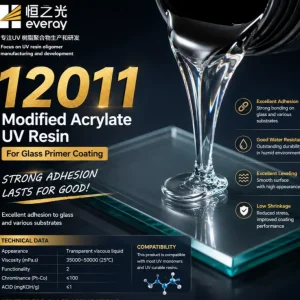
Inert silicate substrates such as tempered architectural glass, solar panels, and cosmetic perfume flacons present minimal polar anchor points for organic polymers. Employing silane-modified and carboxyl-functionalized acrylic polyurethane oligomers (such as Ever Ray 12011) triggers covalent siloxane bonding (Si–O–Si) directly to the glass surface, allowing clearcoats to withstand severe 100°C boiling water immersion without blistering or peeling.
- Boiling Water Resistant (2-4 hrs)
- Direct Covalent Siloxane Link
- Cross-Hatch Adhesion 0B/5B Pass
Emerging Technology Trends & Enterprise Procurement Protocols
Navigating bio-based feedstocks, dual-cure photopolymer systems, and rigorous analytical quality parameters for international raw material sourcing.
Enterprise procurement executives sourcing polymer resins face escalating complexity regarding green chemistry mandates, regulatory compliance, and mechanical specifications. Forward-thinking acrylic polyurethane factories are aggressively commercializing three key technology vectors:
Bio-Based & Circular Polyols
Substituting petrochemical-derived polyesters with renewable polyols sourced from succinic acid, dimer fatty acids, and bio-1,3-propanediol (PDO). These bio-sourced segments contribute up to 45% bio-carbon content (certified via ASTM D6866) while matching the flexibility and chemical resistance of standard industrial coatings.
Dual-Cure Chemistry (UV + Thermal/Moisture)
In complex 3D structures with shadow zones where actinic UV radiation cannot reach, dual-cure polyurethane systems utilize an initial ultra-fast UV tack-cure followed by secondary isocyanate-hydroxyl (NCO-OH) condensation or moisture-induced crosslinking, achieving 100% cure depth.
Waterborne UV Polyurethane Dispersions (UV-PUD)
Combining the zero-VOC environmental profile of water-dilutable dispersions with the instant physical handling of ultraviolet radiation. UV-PUDs dry physically via water evaporation and achieve ultimate solvent and mar resistance upon passing through the UV lamp chamber.
Procurement Director’s Analytical Acceptance Checklist
When validating an Acrylic Polyurethane Factory, Tier-1 formulators must demand batch Certificates of Analysis (CoA) containing strict parameters: (1) Gel Permeation Chromatography (GPC) molecular weight distribution curve; (2) Residual Free Monomer Content (<0.1% via GC-MS to ensure low odor and worker safety); (3) Viscosity Profile measured via rotational cone-and-plate rheometer at 25°C; (4) Stoichiometric Isocyanate/Hydroxyl Index verification; and (5) Color Gardner Index (<1 for optical clearcoats).
Frequently Asked Questions: Acrylic Polyurethane Chemistry & Sourcing
Exhaustive engineering solutions addressing formulating obstacles, stoichiometric calculations, curing kinetics, and long-term shelf stability.
What is the stoichiometric ratio required for formulating 2K acrylic polyurethane clearcoats?
In two-component (2K) solventborne systems, the stoichiometric ratio of isocyanate groups to hydroxyl groups (NCO:OH ratio, also known as the isocyanate index) typically ranges between 1.05:1.00 and 1.15:1.00. Formulating with a slight excess of isocyanate (5% to 15%) accounts for side reactions with trace ambient moisture and ensures all hydroxyl groups of the acrylic polyol are completely crosslinked, maximizing pencil hardness, chemical solvent resistance (MEK rubs > 200), and eliminating residual unreacted polyol plasticization.
How does an Acrylic Polyurethane Factory prevent oxygen inhibition in thin-film UV curing?
Atmospheric oxygen scavenges free radicals generated by photoinitiators, forming unreactive peroxy radicals and leaving a tacky, under-cured surface layer. Ever Ray counters oxygen inhibition via chemical modification: introducing amine synergists (such as Amino Acrylates and Active Amines) into the resin structure. The tertiary amine donates a hydrogen atom to peroxy radicals, regenerating active alkyl radicals that consume local oxygen and accelerate tack-free surface curing even under thin-film (5–15 μm) and low-energy LED-UV curing lamps.
Why do aliphatic polyurethane acrylates cost significantly more than aromatic grades?
The cost disparity stems from the synthesis chemistry of the diisocyanate raw materials. Aromatic diisocyanates (TDI, MDI) are produced in mass volume from benzene and phosgene with high reaction kinetics. Aliphatic precursors (IPDI, HDI, H12MDI) require intricate multi-step catalytic hydrogenation, phosgenation, and fractional distillation processes under elevated pressures. However, this premium is essential for outdoor coatings because aliphatic backbones offer permanent UV stability without color degradation.
What is the standard shelf life and storage protocol for UV polyurethane acrylate resins?
Pure polyurethane acrylate oligomers typically possess an unopened shelf life of 6 to 12 months when stored between 10°C and 30°C in opaque containers. Because these resins contain reactive acryloyl functional groups, they must be shielded from direct sunlight and UV radiation. In addition, free-radical polymerization inhibitors (such as MEHQ) require trace dissolved oxygen to remain active; storing resins under 100% inert nitrogen blankets is discouraged, as it can deplete the stabilizer mechanism and trigger spontaneous gelation.
Can Ever Ray engineer custom viscosities and molecular weights for specific formulator lines?
Yes. Ever Ray’s R&D team adjusts the polymer chain length, branching architecture, functional acrylate density, and dilution packages (e.g., HDDA, TPGDA, IBOA, or solvent-free liquid oligomers). Whether your application involves high-viscosity roller coating for dense flooring or low-viscosity spray coating for consumer electronics, we can calibrate resin viscosities across a broad window from 500 mPa·s to 80,000 mPa·s (at 25°C).
High-Performance Functional Resins & Epoxy/Polyester Acrylates
Engineered for high-speed offset inks, rapid-setting clearcoats, weather-resistant outdoor PSA tapes, and LED-UV wood curing systems.