Featured Industrial Resins & Acrylate Oligomers
Engineered to deliver exceptional inter-layer cohesion, low volumetric shrinkage, and rapid photochemical reactivity under 365nm–405nm UV wavelengths.
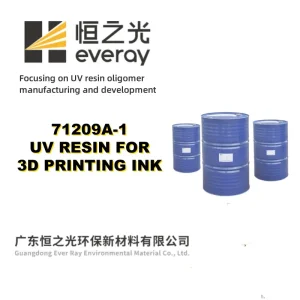
Defining Modern ABS-Like Photopolymers: Microstructure & Engineering Properties
Bridging the mechanical performance gap between thermoformed Acrylonitrile Butadiene Styrene (ABS) polymers and UV-curable crosslinked acrylate resins.
| Property Parameter | Standard SLA Craft Resin | Ever Ray ABS-Like Resin (71209A-1) | Injection Molded ABS (Reference) | Test Standard |
|---|---|---|---|---|
| Tensile Strength (MPa) | 28 – 38 | 42 – 55 | 40 – 50 | ASTM D638 |
| Elongation at Break (%) | 3% – 8% | 18% – 32% | 15% – 30% | ASTM D638 |
| Notched Izod Impact (J/m) | 14 – 22 | 38 – 52 | 45 – 65 | ASTM D256 |
| Heat Deflection Temp (HDT @ 0.45 MPa) | 48°C | 68°C – 78°C | 82°C – 95°C | ASTM D648 |
| Volumetric Linear Shrinkage (%) | 1.8% – 2.6% | < 0.45% | 0.4% – 0.7% | ISO 2577 |
| Viscosity @ 25°C (mPa·s) | 600 – 1200 | 280 – 450 | N/A (Solid Pellets) | Brookfield DV2T |
Solving Critical Global Procurement Challenges in Additive Photopolymers
Enterprise procurement teams across North America, Europe, and the Asia-Pacific face severe bottlenecks when scaling from benchtop additive trials to million-part production.
Severe Part Warpage & Creep
Standard acrylate resins warp during post-curing due to unresolved residual internal stress. Ever Ray's customized low-shrinkage oligomer formulations lock in precision geometry for snap-fit assemblies and complex screw bosses.
Batch Heterogeneity
Uncontrolled polymer molecular weight distributions cause unpredicted changes in exposure time (Ec & Dp values). Our factory utilizes automated DCS chemical reactors ensuring batch-to-batch consistency with guaranteed spectral curing responses.
Embrittlement Over Time
Photopolymer parts commonly degrade and crack after 30 to 60 days of shelf exposure. Our specialized aliphatic polyurethane acrylate backbones prevent secondary oxidative embrittlement and resist UV yellowing over extended functional lifecycles.
Prohibitive Resin Costs
Western brands charge up to $120–$200/kg for basic functional resin. Direct factory procurement from Guangdong Ever Ray drops material acquisition costs to $18–$35/kg, transforming high-mix additive manufacturing into an economically viable alternative to tooling.
China Factory Integrated Supply Chain Advantages
Vertical synthetic integration from basic chemical precursors to finished high-performance 3D printing formulations at industrial scale.
Upstream Synthesis
We synthesize our own polyurethane acrylates, epoxy acrylates, and hyperbranched polymers, directly controlling monomer purity, branching degree, and cost without reliance on third-party chemical blenders.
Massive Capacity
Our 40,000 m² chemical production base in Yunan County, Yunfu City operates over 10 high-tonnage stainless-steel reactors, easily fulfilling 200+ metric ton monthly orders for global distribution partners.
Pearl River Delta Logistics
Situated within the Greater Bay Area manufacturing hub, we leverage direct multimodal access to Shenzhen, Guangzhou, and Hong Kong ports, guaranteeing rapid containerization and air cargo dispatches.
Hazmat Certified Export
Equipped with complete UN-approved packaging certifications, sea cargo dangerous goods declarations (Class 9 / Non-regulated alternatives), and worldwide air freight documentation readiness.
Private Labeling (OEM/ODM)
We supply turnkey white-label bottling, custom bottle molding, specialized laser engraving, custom pigment matching, and localized labeling for tier-one 3D printer hardware brands globally.
High-Value Localized Engineering Applications
From precision consumer electronics enclosures to functional under-the-hood automotive prototypes, our ABS-like resins replicate true thermoplastic performance.
Automotive Functional Prototyping
Ideal for intake manifolds, dashboard ventilation louvers, clips, and interior brackets. Parts withstand vibration, engine compartment heat cycles, and mechanical cyclic stresses without brittle fracture.
3C Electronics Enclosures
Cell phone bezels, laptop chassis, and acoustic earphone shells require crisp edge definitions and repeatable snap-fit interlocks. Grade 71209A-1 provides the necessary modulus to flex during assembly and rebound into position.
Jigs, Fixtures & Manufacturing Aids
Replaces costly CNC machined Delrin and aluminum fixtures on assembly lines. Chemical resistance to cutting oils, industrial solvents, and frequent ultrasonic wash cycles keeps operational downtime at zero.
Rapid Bridge Tooling & Mold Inserts
Employed in low-pressure reaction injection molding (RIM) and short-run silicone molding masters. The high surface hardness and smooth micro-curing profile eliminate print layer stepping on molded parts.
Emerging Trends in Industrial Photopolymer Formulations
The additive manufacturing chemical landscape is rapidly shifting beyond hobbyist desktop resins toward end-use industrial polymers.
Dual-Cure Photothermal Resins
By blending UV-initiated acrylates with thermally latent secondary chemistries (such as epoxy or polyurethane networks), parts achieve true isotropic mechanical strength equal to injection molding.
Bio-Based & Ultra-Low VOC
Ever Ray R&D is formulating acrylated epoxidized soybean oils (AESO) and cardanol derivatives to deliver sustainable industrial resins characterized by negligible odor, low dermal sensitivity, and reduced carbon footprints.
High-Flow Low-Viscosity Dynamics
Next-generation high-speed LCD printers require ultra-fast vat resin recoating times. Formulating functional monomers with viscosities below 200 mPa·s dramatically cuts print cycle times by up to 45% without sacrificing green part strength.
Flame-Retardant (UL94 V-0) Integration
For rail transit and aerospace compliance, we incorporate reactive non-halogenated phosphorus acrylates directly into the oligomer backbone, achieving self-extinguishing flame retardancy without leaching plasticizers.
Global Regulatory Compliance & Engineering Field Support
Enterprise chemical procurement requires total peace of mind. We maintain absolute compliance with strict environmental, health, and maritime shipment protocols.
Full REACH, RoHS & TSCA Compliance
Every resin batch manufactured at Ever Ray is free from SVHCs (Substances of Very High Concern), heavy metals, halogenated solvents, and BPA. Comprehensive 16-section SDS (Safety Data Sheets) are provided in multiple languages matching UN GHS standards.
In-House Spectral & Rheological QA
Our analytical chemistry laboratory in Jiangmen and Yunfu is outfitted with Gel Permeation Chromatography (GPC), Fourier-Transform Infrared Spectroscopy (FTIR), and UV-Vis spectrophotometers to guarantee batch purity and cross-linking efficiency.
Dedicated Formulator Support
We do not just ship resin containers; our synthetic polymer chemists interface directly with your additive manufacturing engineers to dial in specific exposure curing profiles, anti-pigment sedimentation additives, and peel-force optimization.
High-Yield Technical & Sourcing FAQ
Direct chemical and logistical insights from our chief resin formulation engineers and international trade specialists.
What chemically differentiates ABS-Like resin from standard photopolymers?
Standard SLA/DLP resins rely almost exclusively on high-functionality epoxy diacrylates or triacrylates, producing a rigid, highly brittle glass-like polymer network upon UV exposure. ABS-Like resins incorporate aliphatic urethane backbones and specialized monofunctional diluent monomers that limit excessive cross-link density. This molecular flexibility allows energy dissipation under sudden impact loads, achieving up to 30% elongation at break and a notched Izod impact resistance exceeding 40 J/m.
Can Ever Ray customize resin properties for specific commercial 3D printer hardware?
Yes. Different optical engines (355nm DPSS lasers, 385nm industrial DLP projectors, or 405nm monochrome LCD screens) require precise photoinitiator matching (such as BAPO vs. TPO vs. Omnirad 1173) and targeted critical exposure (Ec) and depth of penetration (Dp) balancing. We adjust our oligomer-to-monomer diluent packages and light blockers to match your printer's optical output, layer thickness targets, and vat peeling mechanism.
What is the typical shelf life and storage protocol for bulk ABS-Like Resin?
Under recommended storage conditions (sealed in original light-blocking HDPE containers at 15°C–28°C away from direct sunlight and oxidizers), our resins maintain full kinetic reactivity and viscosity stability for 18 months from the manufacturing date. Every batch includes anti-settling agents to ensure pigment dispersions remain fully homogenizable after prolonged storage.
What are your Minimum Order Quantities (MOQ) and production lead times?
For standard catalog products (such as 71209A-1 or 7296-1), sample testing drums (25 kg) are available with immediate dispatch within 48 to 72 hours. For private label or custom-modified chemical synthesis, our minimum production batch is 200 kg (one 200L drum or 200 individual 1kg retail bottles), with standard manufacturing cycle times of 7 to 10 working days.
How does Ever Ray guarantee post-curing dimensional stability?
Photopolymer shrinkage is primarily driven by carbon-carbon double-bond conversion (shrinkage from van der Waals distances to covalent bond lengths). We formulate with low-shrinkage ring-opening or hyperbranched acrylate oligomers alongside specialized reactive diluents that reduce volumetric linear contraction to less than 0.45%, preventing parts from warping during IPA washing and subsequent 405nm UV chamber post-curing.
Can printed ABS-Like resin parts be machined, tapped, and electroplated?
Yes. Unlike standard fragile resins that shatter under localized mechanical cutting shear, fully post-cured parts made with Ever Ray ABS-like resin can be drilled, tapped for threaded inserts, CNC post-milled, sanded, and clear-coated. Additionally, the formulation accepts standard chemical etching and copper/nickel electroplating steps for automotive finish testing.
Specialized Functional Resins & Industrial UV Monomers
Explore our extended synthetic portfolio formulated for extreme adhesion, floor coating abrasion resistance, zero-shrinkage electronic encapsulation, and UV ink formulation.