Next-Gen Photopolymer Synthesis

High-Quality 3D Printing Footwear Resin Factory & Product

Industrial-grade elastomeric photo-thermal dual-curing polyurethane acrylates engineered for high-energy rebound, zero compression fatigue, and digital mass production in modern footwear manufacturing.

Engineered Material Portfolio (Part I)

Primary Oligomers & Functional Resins for Digital Footwear Tooling

Direct-from-factory UV-curable monomers, polyurethane acrylates, and specialty oligomers optimized for DLP/SLA/CLIP additive manufacturing systems.

  • Wholesale Low viscosity 6300 modified epoxy acrylate UV resin

    Wholesale Low viscosity 6300 modified epoxy acrylate UV resin for UV paper varnish Supplier, Suppliers

    View Specifications
  • Buy Polyester Acrylate 5202B High-Performance UV Coatings

    Buy Polyester Acrylate 5202B – The Ideal Choice for High-Performance UV Coatings Manufacturer, Product

    View Specifications
  • Wholesale Multifunctional 7600 polyurethane acrylate oligomer

    Wholesale Multifunctional 7600 polyurethane acrylate oligomer for UV coatings and inks Product, Products

    View Specifications
  • Wholesale 7411B UV Resin low viscosity high solids solution

    Wholesale 7411B UV Resin: Ideal low viscosity, high solids solution for matte UV applications Suppliers, Factory

    View Specifications
  • Buy Durable 7200F polyurethane acrylate

    Buy Durable 7200F polyurethane acrylate: suitable for heat-resistant and cold-resistant UV coatings Manufacturers, Products

    View Specifications
  • Wholesale 6805A-1 UV-resin in UV Offset Printing

    Wholesale 6805A-1 UV-resin in UV Offset Printing Suppliers, Product

    View Specifications
  • High-Quality Polyester Acrylate 5335F

    High-Quality Polyester Acrylate 5335F A High-Performance Solution for Offset Inks Factories, Products

    View Specifications
  • Buy Polyester Acrylate 5377A for flexographic UV inks

    Buy Polyester Acrylate 5377A – The Ideal Choice for Flexographic UV Inks Suppliers, Factory

    View Specifications
Global Commercial Landscape

The Paradigm Shift in 3D Printing Footwear Resins: Industrial Transformation

From rapid prototyping to mass serial manufacturing: How photocurable elastomeric resins are rendering conventional EVA/TPU foam tooling obsolete.

Lattice Topology Over Foaming

Traditional footwear relies on chemical foaming of Ethylene-Vinyl Acetate (EVA) and expanded Thermoplastic Polyurethane (E-TPU). However, injection foaming locks the sole into isotropic energy absorption. Modern photopolymer footwear resins enable functionally graded 3D lattices—varying stiffness across calcaneus, medial arch, and metatarsals within a single continuous print run without tooling overhead.
Photocuring Kinetic Breakthroughs

Early generation photopolymer resins suffered severe UV degradation, low tear propagation resistance, and excessive thermal hardening below 0°C. Modern industrial formulations exploit dual-cure polyurethane acrylates (PUA) where light initiates dimensional lattice green-state consolidation, followed by thermal post-cure driving interpenetrating polymer network (IPN) chain crosslinking.

Circularity & Zero Mold Waste

Conventional steel and aluminum tooling imposes a 4-to-8 month lead time per collection release, resulting in tons of scrap metal and post-trimming waste. Direct additive footwear manufacturing utilizing Ever Ray's low-viscosity, high-conversion oligomers cuts cycle times from months to hours while recovering unreacted vat liquid with a material yield rate above 98.4%.

Guangdong Ever Ray Chemical Infrastructure

Factory Scale, Reaction Engineering & Global Supply Purity

Operating from our 40,000 m² automated petrochemical synthesis facility in Yunfu, Guangdong, Ever Ray combines molecular customization with massive output predictability.

Backbone Upstream Synthesis

Unlike typical blenders who merely purchase commercial resins and mix pigments, Guangdong Ever Ray directly synthesizes the foundational aliphatic isocyanate prepolymers, polycaprolactone polyols, and hyperbranched acrylates. This vertical integration allows exact tailoring of molecular weight distribution (Mw/Mn) and urethane bond density.

Continuous Reactor Batch Stability

Our 10+ precision reactor production lines operate under DCS distributed automated control. Critical parameters including isocyanate (-NCO) titration, exotherm kinetics, and vacuum degassing are real-time monitored, maintaining lot-to-lot viscosity fluctuations within ±3%—preventing 3D printing vat failures in tier-1 automated shoe lines.

Full Export Compliance

Ever Ray formulations comply rigorously with REACH (EU 1907/2006), RoHS 3 (EU 2015/863), TSCA, and Prop 65. Our dual-cure footwear systems are certified free of organotin catalysts, phthalate plasticizers, and toxic free-monomer residues, matching skin-contact podiatry regulations under ISO 10993-10 biocompatibility.

2006
Founded Year & R&D Pioneer
40,000 m²
Integrated Chemical Base
10+
Precision Synthesis Reactors
> 100k
Flex Endurance Cycles (SATRA)
< 8%
Compression Set (72h @ 23°C)
Targeted Engineering Deployments

Engineered End-Use Scenarios: From Marathon Midsoles to Podiatry

Optimizing photopolymer viscoelastic properties to match dynamic biomechanical loading curves.

High-Rebound Athletic Midsoles

For marathoners and competitive basketball footwear, resin energy return must exceed 65%. Utilizing dual-curing polyurethane acrylate 72017 combined with custom reactive diluents creates an elastomeric honeycomb lattice that returns mechanical strain energy directly to the athlete, mitigating Achilles fatigue while maintaining under-foot torsional stability.

Custom Medical Orthotics & Insoles

Diabetic foot ulcers, plantar fasciitis, and pronation correction demand patient-specific pressure distribution. Ever Ray footwear resins provide wide Shore A tuning (from 40A soft-cushion heel cups to 70A rigid arch supports) allowing medical clinics to directly convert 3D foot topography scans into finished orthotic devices within 24 hours.

Luxury & Avant-Garde Outsoles

High-fashion fashion houses demand intricate organic geometries, translucent finishes, and non-yellowing crystalline optics. Our aliphatic urethane resin platforms ensure UV light resistance (QUV 1000h Delta E < 2.0) combined with high DIN 53516 abrasion resistance (< 120 mm³ loss), enabling lightweight, hollow-sculpted designer soles that never discolor or crack.

Material Metric Ever Ray 72017 Dual-Cure PUA Standard Photopolymer Resin Conventional Molded EVA Expanded TPU (E-TPU Foam)
Curing Mechanism Photo + Thermal IPN Free-Radical UV Only Chemical Crosslinking Steam Chest Molded Beads
Tensile Elongation at Break 280% – 360% 40% – 85% (Brittle) 180% – 220% 350% – 450%
Rebound Resilience (ASTM D2632) 64% – 72% 25% – 38% 48% – 55% 65% – 70%
Compression Set (72h @ 23°C) < 7.8% > 25% (Plastic deformation) 18% – 28% 9% – 12%
Lattice Density Variation Full Digital Control (0.15 - 0.65 g/cm³) Uniform Only Single Solid Hardness Solid Foam Blocks
Next-Generation Chemistry

Technology Frontiers: Dual-Cure Networks, Bio-Acrylates & Cold-Flex Kinetics

Leading chemical engineering trends dictating the next decade of additive footwear manufacturing.

Photo-Thermal Interpenetrating Networks

Pure UV polymerization inherently caps polymer chain length due to vitrification and crosslink-induced steric hindrance. Ever Ray's dual-curing system decouples geometry definition from final mechanical toughness. Stage 1 UV curing locks precise micrometer lattice strut boundaries. Stage 2 thermal incubation (100°C–120°C) triggers secondary polyol-isocyanate and epoxy crosslinking, creating true thermoplastic elastomer (TPE) behavior with high molecular weight segments.

Bio-Based Monomers & Depolymerization

Footwear brands face stringent ESG carbon emission targets. In response, Ever Ray's R&D center is commercializing vegetable-derived polyols (castor and soybean oil-based acrylates) yielding up to 45% bio-carbon content without sacrificing tear strength. Concurrently, dynamic ester linkages are being integrated into oligomer chains to allow chemical dissolution and solvent-assisted recycling of failed production midsoles.

Sub-Zero Dynamic Glass Transition (Tg)

A persistent flaw in photopolymer elastomers is thermal stiffening: outdoor runners in winter conditions (-10°C) experience severe loss of cushion and premature lattice strut fracture. By engineering low-Tg flexible aliphatic polyether segments into oligomer 7200F and 72017, the glass transition temperature is shifted down to -45°C, ensuring buttery flexibility and elastic recovery in all climates.

Procurement Specification Matrix

OEM/ODM Footwear Procurement Guide: Critical Resin Parameters

Key quality assurance benchmarks supply chain managers must verify before approving resin vendors for mass 3D printing footwear lines.

Rheological Window & Recoating Speed

High-speed top-down and bottom-up vat polymerization systems require viscosities between 800 mPa.s and 3,500 mPa.s at 25°C. Excessive viscosity causes micro-bubble entrapment and slow wiper blade recoating cycles; our low-shrinkage reactive diluents ensure self-leveling across the vat within seconds for ultra-rapid layer cycling.

SATRA Ross Flexing Endurance

For athletic running shoe certification, the printed midsole must endure 100,000 continuous flex cycles at -5°C according to SATRA TM60 standards without crack propagation exceeding 4mm. Guangdong Ever Ray’s hyperbranched urethanes disperse mechanical stress concentrations across the 3D-strut nodes, consistently surpassing 150,000 cycles intact.

Bulk Drum Packaging & Shelf Life

Chemical stability during ocean shipping through tropical trade routes is vital. Ever Ray packages its high-purity resins in light-blocking 25kg sealed HDPE pails and 200kg steel drums under dry nitrogen blanketing. Proprietary free-radical scavenger stabilizer packages ensure guaranteed viscosity stability exceeding 12 months in ambient storage.

Technical Knowledge Base

Frequently Asked Questions: 3D Printing Footwear Resins

Direct technical clarifications from Ever Ray senior polymer chemists regarding chemistry, processing, curing kinetics, and procurement.

What chemical backbone is best suited for 3D printed athletic midsoles?
Aliphatic polyurethane acrylate (PUA) prepolymers synthesized with long-chain polyether or polycarbonate polyols represent the premier solution. Unlike epoxy acrylates (which cure rapidly but produce brittle crosslinks), aliphatic PUA incorporates dynamic urethane hydrogen bonds (-NH-COO-) that repeatedly dissociate and reform under impact, delivering exceptional rebound resilience (>65%) and high tear strength without yellowing when exposed to UV sunlight.
Why is dual-curing (photo + thermal) essential for mass production footwear?
Pure UV curing cannot achieve the high molecular weight and linear chain entanglements required for true rubber-like elasticity due to rapid vitrification during light exposure. In our Wholesale 72017 dual-cure system, the UV light step quickly cures 70-80% of active double bonds to establish geometry integrity in the printer vat. A subsequent thermal post-cure activates dormant blocked isocyanates or epoxide crosslinkers, building an interpenetrating polymer network (IPN) that maximizes elongation (>300%) and reduces permanent compression set to under 8%.
How does Ever Ray control batch-to-batch viscosity and cure sensitivity?
At our Yunfu production base, each reactor cycle is regulated by automated distributed control systems. We execute in-line FT-IR to monitor monomer-to-oligomer conversion, perform Brookfield rotational viscometry at 25.0°C ± 0.1°C, and calibrate working curve optical parameters (Critical Exposure Ec and Depth of Penetration Dp) using laser profilometry before batch release.
Can Ever Ray footwear resins be processed on standard LCD/DLP/SLA 3D printers?
Yes. Ever Ray formulates broad spectral reactivity ranging from 385nm to 405nm. Our footwear resins are fully compatible with continuous liquid interface production (CLIP), top-down industrial DLP platforms, and high-throughput LCD array printers. We supply customized starting profiles (layer exposure times, lift speeds, and post-wash protocols with eco-friendly cleaning esters).
What certifications and regulatory documents are provided for global footwear brands?
Every shipment is accompanied by a formal Certificate of Analysis (CoA), full 16-section GHS Safety Data Sheet (SDS), and Technical Data Sheet (TDS). In addition, we furnish third-party SGS/TUV test reports verifying compliance with EU REACH SVHC lists, RoHS Directive (EU) 2015/863, CPSIA total lead and phthalate limits, and ISO 10993-10 skin sensitization standards for skin-contact footwear components.
Engineered Material Portfolio (Part II)

Dual-Curing Resins, Adhesion Primers & High-Durability Prepolymers

Explore our flagship photothermal 3D printing grades, modified acrylates, and specialty oligomers engineered for extreme industrial performance.

  • High-Quality 5403-3F Polyester Acrylate

    High-Quality 5403-3F Polyester Acrylate, which can achieve the best water-ink balance in UV ink Manufacturers, Products

    View Specifications
  • Wholesale 72017 Photo-Thermal Dual-Curing Polyurethane Acrylate Resin for 3D Printing

    [Footwear Core] Wholesale 72017 Photo-Thermal Dual-Curing Polyurethane Acrylate Resin | Low Shrinkage & High Toughness Oligomer for 3D Printing Supplier, Products

    Explore 3D Resin 72017
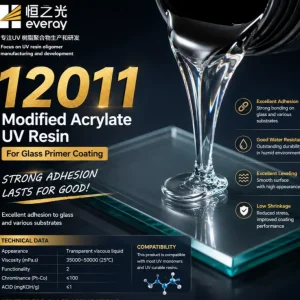
  • Wholesale 12011 Modified Acrylate UV Resin for Glass Primer Coatings

    Wholesale 12011 Modified Acrylate UV Resin for Glass Primer Coatings | Excellent Adhesion & Boiling Water Resistance Manufacturer, Product

    View Specifications
  • Buy Fast Curing Modified Epoxy Acrylate Resin 6231

    Buy Fast Curing Modified Epoxy Acrylate Resin 6231 for High Gloss UV Coatings and Inks Manufacturer, Supplier

    View Specifications
  • Wholesale 1762 UV Resin as Adhesive durable anti-yellowing

    Wholesale 1762 UV resin as adhesive: durable and anti-yellowing, high bonding strength Manufacturers, Factory

    View Specifications
  • High-Quality Polyester Acrylate 5501 LED-UV Wood Coating

    High-Quality Polyester Acrylate 5501 — A Core Resin for LED-UV Wood Coating Systems Supplier, Factories

    View Specifications
  • High-Quality 6803A Modified Epoxy Acrylate Resin

    High-Quality 6803A Modified Epoxy Acrylate Resin High Gloss Fast Curing Oligomer for UV Ink Varnish & Plastic Coating Factory, Factories

    View Specifications
  • Wholesale 6203F Low-Shrinkage Modified Epoxy Acrylate Resin

    Wholesale 6203F Low-Shrinkage Modified Epoxy Acrylate Resin - High Adhesion UV Prepolymer Manufacturer, Supplier

    View Specifications
Direct Synthesis & Custom Formulation Labs

Partner Directly with Guangdong Ever Ray Chemical Engineers

Whether developing high-rebound lattice midsoles for athletic brands, biocompatible orthotic resins for clinics, or low-viscosity high-speed 3D printing prepolymers, our application labs engineer the exact oligomer backbone to solve your performance challenges.

Request Formulation Consultation Download 2025/2026 Technical Catalog