Engineered Polyurethane Acrylates & Specialty Formulations
Explore high-reactivity UV-curable oligomers and polyurethane acrylates synthesized for superior adhesion, tensile resilience, and rigorous environmental compliance.
Global Commercial & Industrial Landscape of Polyurethane Resin Uses
A systematic analysis of polyurethane resin chemistry, macro-industrial supply chains, market drivers, and physical crosslinking mechanisms across modern manufacturing sectors.
Polyurethane (PU) resin systems—most notably radiation-curable Polyurethane Acrylates (PUA), aliphatic urethane pre-polymers, and two-component reactive polyurethanes—constitute the backbone of high-performance polymer engineering. Valued for their versatile combination of mechanical toughness, elastomeric recovery, abrasion resistance, and chemical inertness, polyurethane resins bridge the physical property gap between brittle epoxies and soft polyolefins.
At the macromolecular level, the distinctive performance of polyurethane resin derivatives stems from their phase-segregated domain structure. The backbone comprises thermodynamic alternating blocks: soft segments (formed by high-molecular-weight polyester, polyether, or polycarbonate diols) and hard segments (formed by polyfunctional aliphatic or aromatic diisocyanates, such as IPDI, HDI, TDI, or MDI, reacting with low-molecular chain extenders or hydroxyl-terminated acrylate end-cappers). Under external stress, the soft segments unravel reversibly to absorb impact energy, while the hard domains act as physical crosslinks through intensive hydrogen bonding, maintaining structural integrity and thermal deflection thresholds.
In the global marketplace, commercial polyurethane resin demand is driven by the confluence of aggressive regulatory decarbonization policies (such as EU REACH Annex XVII constraints, RoHS 3.0, and strict regional VOC discharge caps) and the rapid migration of consumer electronics and electric mobility toward lightweight, radiation-cured composites. Traditional solvent-borne finishes are systematically being replaced by 100% solids UV-curing urethane acrylates and waterborne polyurethane dispersions (PUDs), cutting energy consumption by up to 75% during industrial line curing.
Aliphatic Polyurethane Acrylates
Synthesized with isophorone diisocyanate (IPDI) or hexamethylene diisocyanate (HDI). Completely resistant to photo-oxidative degradation, yellowing, and micro-cracking under intense solar UV radiation. Essential for 3C clearcoats, exterior automotive trim, optical bonding, and cosmetic nail gels.
Aromatic Polyurethane Acrylates
Formulated via toluene diisocyanate (TDI) or diphenylmethane diisocyanate (MDI). Offers superior tensile yield strength, high mechanical damping, and aggressive chemical barrier resistance at an economical formulation cost. Optimized for industrial floorings, wood sealers, and opaque pigmented coatings.
Waterborne PUA Dispersions (PUD)
Emulsified self-dispersing polyurethane anionomers featuring internal carboxylic acid or sulfonate stabilization. Enables zero-VOC processing, low film build, superior wetting of porous substrates, and soft-touch tactile effects without hazardous organic solvents.
Chinese Chemical Factory Efficiency: Strategic Value for Global Buyers
How state-of-the-art reactor automation, integrated petrochemical corridors, and deep synthesis agility establish an unrivaled competitive foundation for high-spec polymer procurement.
Upstream Integration
Direct proximity to world-class petrochemical refineries ensures continuous access to primary isocyanates, acrylic acid, and high-purity functional monomers with minimal logistics friction.
Automated Synthesis Lines
Multi-ton computerized glass-lined reactor trains with continuous inline Viscometry, FTIR, and GC-MS monitoring eliminate human-induced batch variations.
Agile Custom Chemistry
Rapid synthesis cycle transitions from 500ml bench samples to 20-ton pilot runs within 14 working days, tailoring refractive index, glass transition (Tg), or elongation on demand.
Global Export Ready
Comprehensive regulatory compliance documentation including GHS-compliant multilingual SDS, certified REACH Only Representative (OR) support, and UN-standard IBC drum logistics.
Localized & Cutting-Edge Polyurethane Resin Uses
From consumer electronics surface finishes to subsea optical fiber protection, examine how structural polyurethane acrylates satisfy precise industrial engineering requirements.
1. 3C Consumer Electronics & Mobile Device Coatings
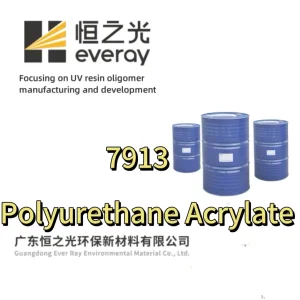
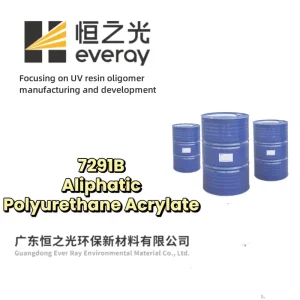
In modern smartphone housings, laptops, and smart wearables, surfaces endure constant human interaction, artificial sweat exposure, abrasive micro-scratching, and drop impacts. Conventional coatings crack under flexural impact or yellow from hand sebum. Our aliphatic polyurethane acrylates (such as the PUA 7291B and 7913 Series) provide high functionality with rapid cure response. Formulators achieve 4H-5H pencil hardness on polycarbonate (PC) and PC/ABS substrates while maintaining over 15% tensile elongation, preventing edge flaking and offering oleophobic tactile refinement.
2. Electronic Potting, Semiconductor Packaging & LOCA Optical Adhesives
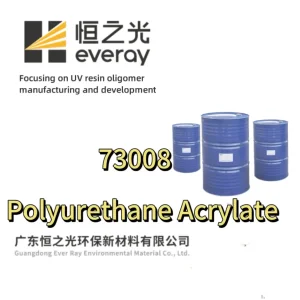
Micro-electronic assemblies and automotive camera modules require encapsulation resins that cure rapidly without generating localized cure stress that can shatter silicon dice or crack SMD solder joints. Specialized grades such as 73008 Low-Shrinkage PUA exhibit ultra-low volumetric shrinkage (<1.2%), minimal ionic impurities (Cl⁻ < 5 ppm, Na⁺ < 2 ppm), and high dielectric breakdown resistance (>25 kV/mm). In Liquid Optical Clear Adhesives (LOCA) for vehicle infotainment touchscreens, these resins ensure 99.2% optical transmission and absolute non-yellowing across 1,000 thermal shock cycles from -40°C to +125°C.
3. High-Speed Additive Manufacturing (SLA / DLP / LCD Photopolymer 3D Printing)
High-performance stereolithography demands photopolymer resins with low liquid viscosity (<450 mPa·s at 25°C) for instantaneous vat leveling, matched with high green-strength post-exposure. Aliphatic urethane acrylates give 3D printed parts the isotropic strength, flexural memory, and impact resilience typically exclusive to injection-molded ABS or polypropylene. In dental aligner models and industrial functional prototypes, our modified resin chemistries provide dimensional repeatability down to ±25 microns.
4. Automotive Clearcoats, Windshield Interlayers & EV Battery Encapsulation
Electric vehicle battery enclosures demand structural potting polymers that provide structural battery pack adhesion alongside UL94 V-0 flame retardancy and thermal conductivity. Polyurethane acrylate resins modified with halogen-free phosphor-nitrogen chemistries fulfill these criteria while preventing thermal runaway propagation between cylindrical 4680 or prismatic cells. Exterior automotive refinishes use polyurethane oligomers to yield “self-healing” clearcoats where micro-swirls caused by car washes melt away under moderate solar warmth.
| Resin Classification | Hardness (Pencil / Shore) | Tensile Strength (MPa) | Elongation at Break (%) | QUV-A Non-Yellowing | Primary Industrial Sector |
|---|---|---|---|---|---|
| Aliphatic PUA (Tri-/Hexa-functional) | 4H – 6H (Pencil) | 45 – 65 MPa | 5% – 18% | >3,000 hrs (ΔE < 1.0) | 3C Electronics, Automotive Clearcoats |
| Flexible Aliphatic PUA (Di-functional) | 70A – 85D (Shore) | 15 – 30 MPa | 80% – 220% | >5,000 hrs (ΔE < 0.8) | UV Adhesives, Nail Gel, Optical Films |
| Aromatic PUA (High-Toughness) | 3H – 4H (Pencil) | 35 – 55 MPa | 15% – 45% | <500 hrs (Indoor Only) | Industrial Wood, Metal Primers, Flooring |
| Low-Shrinkage Electronic PUA | 2H – 3H (Pencil) | 25 – 40 MPa | 30% – 60% | >2,000 hrs (ΔE < 1.5) | Semiconductor Potting, Micro-Sensors |
| Waterborne PUA Dispersion | F – 2H (Pencil) | 20 – 35 MPa | 50% – 120% | >2,500 hrs (ΔE < 1.2) | Architectural Wood, Automotive Interiors |
Emerging Technology Trends & Enterprise Procurement Standards
Strategic perspectives for chemical sourcing directors, formulators, and supply chain executives navigating decarbonization, LED-cure wavelengths, and supply resilience.
Bio-Based Carbon Polyurethanes
Synthesis utilizing bio-derived polyols sourced from succinic acid, castor oil, and 1,3-propanediol (PDO) achieves renewable carbon fractions up to 45% without sacrificing hydrolytic stability or crosslink reactivity.
Long-Wavelength UV-LED Tuning (365–405 nm)
The global transition from medium-pressure mercury arc lamps to narrow-band UV-LEDs demands oligomers optimized for surface cure responsiveness, mitigating oxygen inhibition via copolymerizable amino acrylates.
Supply Chain Redundancy & Dual Sourcing
Global Tier-1 manufacturers mitigate geopolitical and logistics vulnerabilities by partnering with vertically integrated Chinese suppliers that maintain buffer stock protocols and multiple certified reactor sites.
Rigorous Enterprise Procurement Checklist
Corporate chemical sourcing teams must evaluate suppliers beyond raw per-kilogram resin costs. The total cost of ownership depends directly on batch-to-batch consistency, monomer purity profiles, and stabilizer shelf-life guarantees. Key testing metrics verified on each Ever Ray Certificate of Analysis (CoA) include:
- Gel Permeation Chromatography (GPC): Molecular weight distribution (Mw/Mn) controlled within a tight ±3% tolerance window to ensure repeatable rheology and cure response.
- Residual NCO Group Titration: Zero free isocyanate monomers detected via FTIR (absorption band at 2270 cm⁻¹ absent), ensuring toxicological compliance and personnel safety.
- Viscosity & Color Control: Brookfield rotational rheometry and Gardner color scale rating (<1.0 for aliphatic grades), guaranteeing bubble-free coating flow and crystal-clear cured films.
- Shelf Stability Acceleration: Samples undergo 60°C thermal aging tests for 30 consecutive days with viscosity shifts constrained under ±5%, guaranteeing 12 months minimum sealed storage life.
Frequently Asked Questions on Polyurethane Resin Uses & Procurement
Detailed technical answers addressing oligomer chemistry, crosslinking density, formulation balancing, substrate pretreatment, and global shipping parameters.
The fundamental distinction lies in the isocyanate core chemistry. Aliphatic polyurethane acrylates are synthesized with cyclic or linear aliphatic diisocyanates (such as IPDI or HDI), which lack light-absorbing aromatic rings. Consequently, they provide exceptional resistance to photochemical oxidation and solar yellowing, making them the standard choice for optical coatings, clear coats, and exterior automotive finishes. Aromatic urethane acrylates use TDI or MDI backbones; they offer superior initial tensile strength, chemical resistance, and lower raw material costs, but degrade and yellow when exposed to UV light, restricting their use to indoor furniture, floor sealers, or heavily pigmented formulations.
Functionality describes the number of photopolymerizable acrylate groups per oligomer molecule. Difunctional polyurethane acrylates yield linear crosslinked matrices characterized by low shrinkage, high tensile elongation (up to 200%), and excellent flexibility, ideal for pressure-sensitive adhesives and peelable films. Multifunctional oligomers (hexa-functional to hyperbranched architectures) create densely packed, three-dimensional networks delivering 4H–6H pencil hardness and chemical resilience, though with reduced elongation and increased shrinkage stress. Modern formulation strategies frequently blend difunctional and hexafunctional resins to achieve the ideal hardness-flexibility balance.
Atmospheric oxygen diffuses into thin photopolymer films, scavenging free radicals and forming stable peroxy radicals that stall polymer chain propagation, resulting in a sticky, under-cured surface. This can be resolved chemically by incorporating reactive amino acrylate synergists or active amines (such as Ever Ray's Amino Acrylate series). These amines rapidly donate abstractable alpha-hydrogen atoms to convert unreactive peroxy radicals into active amino-alkyl radicals while regenerating initiating capacity, ensuring tack-free surface curing even under high-speed line conditions.
Low-surface-energy substrates such as untreated polypropylene, untreated PET, or engineered polyamides pose significant adhesion hurdles. Adhesion reliability is verified in our QC labs via ASTM D3359 Cross-Hatch Tape Adhesion testing (targeting class 5B retention), combined with 100°C boiling water immersion for 2 hours and subsequent thermal cycle shock testing (-40°C to +85°C). Incorporating specialized functional adhesion promoters or pure acrylic oligomers with hydroxyl, carboxyl, or phosphoric acid functionalities significantly enhances bonding by promoting chemical coordination and micromechanical interlock at the polymer-substrate interface.
Yes. Conventional mercury lamps emit high-intensity short-wavelength UVC light (254 nm) that drives rapid surface curing, whereas modern UV-LED lamps emit narrow spectrum UVA (365 nm, 385 nm, 395 nm, or 405 nm), which penetrates deeper but can leave the surface tacky. We develop customized resin systems with high double-bond reactivity and integrate amine-modified backbones tailored to pair with acylphosphine oxide photoinitiators (such as TPO or BAPO). This formulation chemistry ensures deep curing through thick, pigmented layers while maintaining clean, tack-free surface conversion.
Acrylate-functionalized polyurethane resins contain active free-radical inhibitors (such as MEHQ) that require trace amounts of dissolved oxygen to remain active. Resins must be stored in dark, opaque, high-density polyethylene (HDPE) or phenolic-lined steel drums at temperatures between 15°C and 25°C. Never store resins under pure inert nitrogen blankets, as oxygen starvation can trigger spontaneous, exothermic auto-polymerization. Kept under recommended conditions in unopened original packaging, our oligomers remain fully stable and within specification for at least 12 months from the date of manufacture.
Advanced Acrylate Oligomers, Weather-Resistant Resins & Special Monomers
Complete your chemical supply evaluation with specialized reactive oligomers designed for 3D additive photopolymers, UV flexographic varnishes, and industrial pressure-sensitive adhesives.