Primary Product Line
High-Purity Modified Epoxy Acrylate & UV Curable Oligomers
Direct factory procurement of precision-modified epoxy acrylates, vinyl esters, and specialized resin architectures designed to optimize curing kinetic profiles and film adhesion.
Buy 5338 UV resin as oligomer and active diluent, reasonable Manufacturers, Supplier
Wholesale 6805A-1 UV-resin in UV Offset Printing Suppliers, Product
Buy Polyester Acrylate 5332F – The Premium Choice for Offset Inks Supplier, Factory
High-Quality 5320 polyester acrylate: optimal ink wettability and high gloss Factory, Factories
Engineering Chemistry: The Science of Modified Epoxy Resins
Standard unmodified bisphenol-A based epoxy resins exhibit impressive chemical resistance and tensile strength; however, their industrial utility is severely curtailed by inherent brittleness, elevated viscosity, weak impact resistance, and photolytic degradation under UV radiation. Our state-of-the-art chemical synthesis facility resolves these fundamental thermodynamic limitations through targeted chemical copolymerization and backbone modification.
By grafting acrylate groups, elastomeric blocks (CTBN/ATBN), organosilicones, or aliphatic urethane segments directly into the oxirane backbone, our manufacturing units tailor crosslink density, surface energy, and radical reaction kinetics. The resultant modified epoxy acrylates provide formulators with lightning-fast UV curing response, thermal stability up to continuous 180°C exposure, and sub-micron interfacial wetting over high-surface-energy polar substrates like metals and glass.
Industrial Status: The Paradigm Shift to Radiation Curing
The global industrial landscape is experiencing a rapid regulatory shift away from solvent-based systems toward zero-VOC, energy-efficient photon-driven polymerization. Industrial processors in North America, Western Europe, and the Asia-Pacific region are standardizing production lines around ultra-fast ultraviolet (UV) and electron beam (EB) curing infrastructure to eliminate thermal drying ovens and slash operational footprints.
As a leading modified epoxy resin factory, our production protocols focus entirely on maintaining high active solid contents (98-100%), minimal halogen contamination, and trace monovalent residual compounds. Modern converting sectors require raw chemical matrices that minimize polymerization volumetric shrinkage while providing uncompromised mechanical adhesion under thermal cycling, boiling moisture immersion, and acidic exposures.
Emerging Trends
Macro-Industry Dynamics & Synthesis Evolution
Comprehensive breakdown of molecular breakthroughs shaping modern industrial protective materials and high-precision electronic manufacturing.
LED UV (365–405 nm) Radical Sensitization
Traditional high-pressure mercury arc systems dissipate substantial thermal radiation, posing extreme challenges for heat-sensitive plastics like thin PVC and BOPP films. The industry wide pivot toward narrow-spectrum cold LED illumination demands modified epoxy acrylate systems engineered with specialized tertiary amine synergists to eliminate oxygen inhibition at low irradiation dosages.
Bio-Derived & Decarbonized Feedstocks
Driven by strict corporate carbon accounting and RoHS/REACH compliance frameworks, synthesis labs are actively replacing petroleum bisphenols with epoxidized plant oils, cardanol, and rosin-based building blocks. Modern modified bio-epoxy systems attain up to 45% bio-based carbon index without sacrificing critical chemical resistance or gloss retention.
Nano-Hybrid Silane Crosslinking
By blending inorganic polysilsesquioxane cages and alkoxysilane chemistry directly onto reactive acrylate-epoxy branches, our chemists develop self-stratifying matrices. When applied, these coatings display internal flexible toughness with a hard, diamond-like nano-silica outer boundary layer boasting 5H+ pencil hardness.
Substrate Customization
Localized Applications & In-Field Performance
Formulation performance across diverse operational environments and specialized production technologies.
| Application Vector | Target Substrates | Predominant Resin System | Critical Engineering Metric | Factory Benchmark Grade |
|---|---|---|---|---|
| UV Offset & Flexo Inks | Treated PET, BOPP, Coated Paperboard | Polyester / Modified Epoxy Blend | Water-Ink Balance, High Pigment Wetting | Series 5320 / 5332F / 6805A-1 |
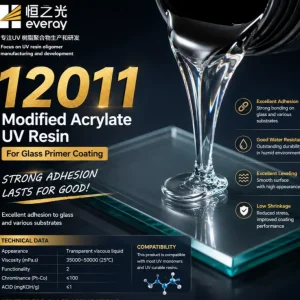
| Boil-Proof Glass Primers | Soda-Lime Glass, Borosilicate, Mirrors | Dual-Functional Modified Acrylate | 100°C Boiling Water Resistance (>2 hrs) | Grade 12011 Glass Specialist |
| Consumer Electronics (3C) | Polycarbonate, ABS, Anodized Alloys | Aliphatic Urethane & Hyperbranched | RCA Abrasion (>300 cycles), Non-Yellowing | Grade 6851A / 7600 Multifunctional |
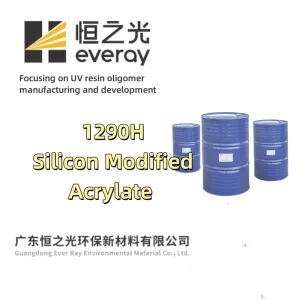
| PVC Industrial Flooring | Rigid Vinyl, Heterogeneous PVC Planks | Low-Shrinkage Acrylate Oligomer | Micro-Scratch Resistance, Low Curl Tension | Grade 1290H Flooring Resin |
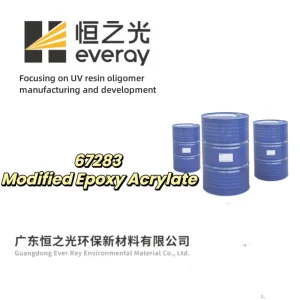
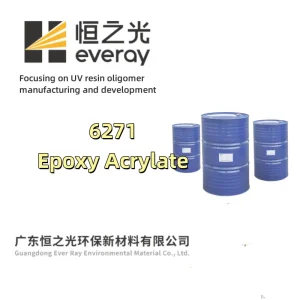
| Cosmetic Photopolymer Gel | Natural Keratin, Synthetic Acryl | Purified Modified Epoxy Acrylate | Exotherm Control, High Gloss Longevity | Grade 6271 / 67283 Color Stable |
Strategic Roadmap
Technical Roadmap & Forward Architecture (2025–2030)
Continuous investment in sustainable synthesis, ultra-high purity, and additive digital manufacturing systems.
PHASE I: 2025
Zero-Halogen Synthesis
Refining catalytic closed-loop reactor trains to produce resins with residual chloride levels <100 ppm, essential for fine-pitch semiconductor microencapsulation.
PHASE II: 2026
Dual-Cure Photothermal Resins
Commercial deployment of hybrid UV/Moisture and UV/Thermal resins capable of 100% cure penetration across shadowed 3D printing geometries and dense composite structures.
PHASE III: 2028
Circular Degradable Networks
Introduction of cleaved ester linkages inside the epoxy-acrylate crosslinked network, enabling chemical recycling and coating strip-down under mild, non-toxic alkaline catalysts.
PHASE IV: 2030
High-Refractive Optical Resins
Synthesis of thioether and zirconia-modified epoxy acrylates providing refractive index (nD) values exceeding 1.68 for augmented reality wave guides and micro-lens arrays.
Systems Engineering
Turnkey Industrial Solutions & Factory Capabilities
Beyond bulk resin manufacturing, our technical division supports downstream formulators with formulation consulting, analytical rheology, and regulatory documentation.
Rheological Rheo-Kinetic Profiling
Our analytical laboratories simulate high-speed industrial printing presses and roller coaters via rotational and oscillatory rheometers. We balance shear-thinning indices and thixotropic loops to eradicate roller spattering, pinholes, and orange peel defects under line speeds exceeding 150 m/min.
Oxygen Inhibition Mitigation
Formulating micro-thin UV layers (<5 μm) in varnishes and overprint lacquers frequently triggers tacky surfaces due to atmospheric oxygen scavenging free radicals. We integrate amino acrylate donors and sterically hindered amine structures into the resin prepolymer, delivering instant tack-free surface cure under ambient atmosphere.
Reliable Global Logistics & Safe Packing
With an annual manufacturing footprint scaling beyond 20,000 metric tons, our factory coordinates batch-to-batch consistent supply chains. Packaging configurations include 25 kg metal pails, 200 kg steel drums, and 1,000 kg IBC totes insulated for international maritime shipping under strict ambient temperature controls.
E-E-A-T Technical FAQ
Frequently Asked Questions on Factory Procurement
Detailed technical, commercial, and processing queries addressed by our chief material engineers.
How does modified epoxy acrylate differ from standard epoxy acrylate?
Standard epoxy acrylate (bisphenol-A based) cures quickly to form hard films, but suffers from high cured shrinkage (6-9%), low elongation (<3%), and susceptibility to yellowing. Modified epoxy acrylates incorporate fatty acid, polyol, or urethane modifications to reduce cure shrinkage to <2%, introduce flexibility, lower viscosity, and dramatically boost yellowing resistance under sunlight.
Can modified epoxy resins be cured with LED UV 395nm light sources?
Yes. Although unmodified epoxy acrylates are typically optimized for standard mercury lamps (254-365nm), our modified versions are synthesized to blend effectively with Type I and Type II long-wave photoinitiators like TPO, Omnirad 819, and Speedcure DETX. This facilitates high double-bond conversion under 395nm or 405nm LED fixtures without residual surface tackiness.
How do you guarantee batch-to-batch stability across large export orders?
Every industrial production batch undergoes strict quality control protocols: Viscosity index (Brookfield RVT), Color (Gardner <1.0), Acid Value (<2 mg KOH/g), Epoxy Value residue, and Double Bond conversion rate via FTIR spectroscopy. Complete Certificates of Analysis (COA) are archived and issued alongside standardized GHS Safety Data Sheets.
What is the typical shelf life and storage protocol for modified acrylate resins?
Stored in original, sealed, light-proof containers between 5°C and 30°C in dry conditions, our modified epoxy resins maintain a guaranteed shelf life of 6 to 12 months. Resins should be shielded from direct heat and daylight to prevent spontaneous radical micro-gelation.
Complete Portfolio Access
High-Performance Acrylate & Functional Resin Catalog
Select specialized resins engineered for structural adhesion, floor coatings, aesthetic graphic inks, and industrial formulations.