Wholesale Bisphenol A Epoxy Acrylate Resin 9105M-80: A Versatile Core Resin for Durable and Glossy UV Coatings
View Technical Specs
Engineered for high cure conversion, exceptional mechanical rigidity, chemical tolerance, and superior substrate adhesion across diverse precision manufacturing sectors.
Unlocking micro-capillary penetration, air-release dynamics, and ultra-high filler loading through customized prepolymer backbones and controlled molecular weight distribution.
Traditional high-viscosity epoxy systems encounter severe surface tension barriers when infusing tightly bundled glass fibers, carbon matrix composites, or porous substrates such as mineral wood and concrete. Our low-viscosity epoxy formulations are engineered with narrow polydispersity indices (PDI < 1.3), slashing fluid shear resistance down to 200–800 mPa·s at 25°C. This allows spontaneous capillary infusion, complete interstitial air evacuation, and total void elimination without requiring toxic volatile solvents.
Achieving rapid reaction kinetics without suffering severe shrinkage stress is a classical polymer engineering challenge. By employing modified epoxy acrylate backbones with flexible polyether spacer segments, our prepolymers mitigate curing volume retraction (shrinkage < 2.5%). The resulting thermoset matrix features high crosslink density, exhibiting glass transition temperatures (Tg) up to 135°C alongside Rockwell hardness ratings above 85D, striking the critical balance between physical resilience and low-stress substrate bonding.
Low starting viscosities give industrial formulators immense formulation latitude to incorporate functional additives—such as spherical silica for thermal dissipation, nano-alumina for scratch barrier durability, and active flame retardants—without pushing product consistency past processable limits. Our oligomers deliver superior pigment and mineral wetting parameters, preventing sedimentation, phase separation, and rheological drift during long-term storage.
Benchmarked analytical values across Ever Ray's flagship epoxy acrylates, aliphatic urethane acrylates, and reactive diluent series.
| Resin Series / Grade | Polymer Backbone Class | Viscosity (mPa·s @ 25°C) | Functionality (f) | Film Tg (°C) | Pencil Hardness | Core Application Profile |
|---|---|---|---|---|---|---|
| 9105M-80 | Bisphenol A Epoxy Acrylate | 800 – 1,500 | 2.0 | 68 | 2H – 3H | Wood Sealers OPV Varnishes |
| 6116 Series | Modified Flexible Epoxy Acrylate | 400 – 900 | 2.2 | 54 | H – 2H | Inkjet / Screen Inks Plastics |
| 6160M-3 | Hyper-Reactive Modified Epoxy | 600 – 1,200 | 3.0 | 82 | 3H – 4H | Fast-Line Coatings Coil Coats |
| 6203F Ultra-Low | Low-Shrinkage Epoxy Prepolymer | 250 – 500 | 2.0 | 62 | 2H | Optoelectronic Adhesives SLA 3D |
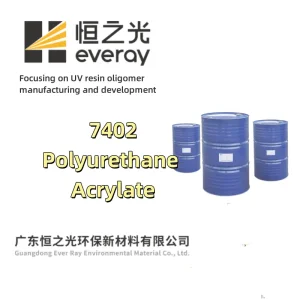
| 7402 Series | Aliphatic Polyurethane Acrylate | 1,200 – 2,500 | 2.0 | 45 | HB – H | Non-Yellowing 3C Nail Gel |
| 53036 Series | Low Viscosity Polyester Acrylate | 150 – 350 | 4.0 | 75 | 2H | Excimer Matting Flexo Inks |
Delivering high-purity chemical platforms specifically adapted to challenging thermal, mechanical, and optical environments.
As micro-pitch ball grid arrays (BGA) and chip-on-film (COF) architectures scale down, underfill resins must display ultra-fast capillary action without entrapping micro-voids. Ever Ray's low viscosity epoxy matrices ensure instant wet-out under silicon dies at reduced temperatures, delivering ionic purity (Cl⁻ < 5 ppm) that stops micro-galvanic trace corrosion while boosting reliability during thermal shock testing (-55°C to 125°C).
Modern composite processing methods such as Vacuum-Assisted Resin Transfer Molding (VARTM) demand lengthy resin open times combined with ultra-low mixed viscosity. Our systems penetrate carbon and basalt woven multi-axial textiles smoothly over 80+ meter flow distances, accelerating composite wet-out cycles while eliminating structural dry spots and ensuring interlaminar shear strength (ILSS) that exceeds demanding DNV-GL marine validation thresholds.
Stereolithographic vat photopolymerization requires instantaneous resin leveling between consecutive slice exposures. Ever Ray's customized low viscosity oligomer systems display Newtonian flow dynamics under high scraper shear, reducing recoat cycle dead-time by up to 40%. This enables high Z-axis build speeds without layer delamination or uncured monomer entrapment, providing fine-feature resolution down to 25-micron thresholds.
Repairing monolithic concrete bridge decks, seismic roadway cracks, and heritage structures requires fluid grout systems capable of gravity penetration into hairline fissures (< 0.1 mm). Ever Ray formulations penetrate deeply before curing into an impermeable barrier, sealing reinforced steel bars against de-icing salt chlorides and stopping hydraulic water seepage under dynamic vehicle loads.
EV battery packs rely heavily on dielectric insulation and structural cell-to-pack (CTP) structural bonding. Our low-viscosity resin bases facilitate bubble-free automated dispensing across massive battery tray modules, delivering high dielectric breakdown strength (> 25 kV/mm) and excellent flame retardance, all while buffering the mechanical vibrations encountered over long vehicle lifespans.
High-end 3C housings crafted from polycarbonates, anodized aluminum, and magnesium alloys demand thin, resilient protective coatings that hold up against cosmetics, skin sebum, and constant friction. Ever Ray’s UV prepolymers cure into high-gloss or excimer-matte protective shells that clear 1,000+ steel-wool rub tests without hazing, micro-cracking, or adhesive peel.
Operating a modernized 40,000+ m² chemical synthesis park in Yunfu, Guangdong, with automated process controls and strict quality assurance.
Our Yunfu production hub runs continuous Distributed Control Systems (DCS) across every reactor train, governing temperature swings within tight ±0.5°C tolerances. This digital monitoring prevents localized overheating, guarantees consistent double-bond conversion rates, and yields exceptional batch-to-batch repeatability across acid values, chromaticity, and viscosity profiles.
By leveraging deep partnerships throughout the Greater Bay Area’s petrochemical clusters, Ever Ray maintains unbroken allocations of foundational inputs: epichlorohydrin, acrylic acid, bisphenol compounds, and specialty isocyanates (IPDI, HDI). This vertical upstream integration buffers international clients from global raw-material price swings while securing prompt fulfillment on spot and recurring volume contracts.
Certified to ISO9001, ISO14001, and ISO45001 standards, our chemical plant incorporates regenerative thermal oxidizers (RTO) and multi-stage biological wastewater recycling. These systems exceed national ultra-low emission standards, guaranteeing our global OEM partners an eco-conscious, audit-ready supplier footprint built to withstand evolving environmental scrutiny.
Addressing the strict documentation, regulatory compliance, and testing protocols required by enterprise procurement offices worldwide.
Every resin shipment is backed by third-party testing covering EU REACH SVHC lists, RoHS heavy metals, halogen-free directives (IEC 61249-2-21), and US EPA TSCA inventories. We supply complete 16-section Safety Data Sheets (GHS SDS) and technical bulletins in target languages to ensure smooth port customs clearance across North America, Europe, and the Asia-Pacific region.
We maintain temperature-regulated retain storage for every finished batch for 24 months. Utilizing Gel Permeation Chromatography (GPC), Fourier Transform Infrared Spectroscopy (FTIR), and Brookfield cone-plate rheometers, our QC technicians confirm molecular weight curves, epoxy equivalent weights (EEW), and non-volatile contents, issuing formal Certificates of Analysis (COA) with each consignment.
Whether you require 20 kg steel pails, 200 kg airtight steel drums with nitrogen headspace flushing, or 1,000 kg UN-certified IBC totes, our packaging safeguards oligomer stability against thermal degradation and moisture absorption. We coordinate ocean consolidation and rapid airfreight directly through major hubs including Shenzhen and Guangzhou ports.
Strategic directions guiding Ever Ray's continuous research and development investments over the coming decade.
Developing non-food vegetable oil and cardanol-derived epoxy acrylates that achieve over 45% bio-based carbon content without sacrificing mechanical stiffness or line cure rates, helping global formulators hit Scope 3 sustainability targets.
Transitioning beyond mercury lamp emission spectra to engineer prepolymers tailored for 385–405 nm industrial LED-UV line arrays and 172 nm excimer lamps, targeting tack-free physical curing at ultra-high line speeds without requiring nitrogen blankets.
Advancing photo-thermal hybrid curing mechanisms where light initiates quick surface freeze within seconds, while ambient moisture or heat drives deeper secondary cure across shadow zones in complex electronics and automotive component assemblies.
In-depth technical answers addressing rheology, substrate compatibility, shelf life, and formulation balancing.
Thin coatings exhibit high surface-area-to-volume ratios, making them prone to atmospheric oxygen quenching the radical polymerization front. Ever Ray addresses this by incorporating copolymerizable amine synergists (such as our Amino Acrylate series) or optimizing hydrogen-donor active amines. These components convert unreactive peroxy radicals back into active chain-propagating radicals, securing hard, tack-free surface cures without needing nitrogen inerting.
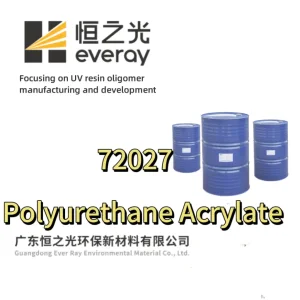
Aromatic backbones (such as standard Bisphenol A structures) contain phenoxy ether linkages that photo-oxidize under ultraviolet radiation into quinoid chromophores, causing amber discoloration. When outdoor stability or optical clarity is mandatory, Ever Ray formulates using cycloaliphatic or aliphatic polyurethane acrylate structures (e.g., our 7402 and 72027 series) built with saturated isocyanates (IPDI/H12MDI) that stay crystal clear during intense QUV accelerated weathering tests.
Polyolefins (PP, PE) and untreated polyesters (PET) present challenging surface energies (< 38 dynes/cm). To establish durable adhesive bonds, Ever Ray blends adhesion-promoting functional acrylates featuring carboxyl, hydroxyl, and phosphate ester motifs. These specialized groups bond chemically and coordinate electrostatically with substrate surfaces, achieving 5B cross-hatch ratings without requiring aggressive solvent primers or flame treatment stages.
Because low-viscosity acrylate oligomers have high double-bond reactivity, they require careful storage. They should be kept in amber, opaque polyethylene or phenolic-lined steel containers between 10°C and 25°C, away from direct sunlight, radiant heat sources, and free-radical generating sparks. We add phenolic inhibitors that require trace dissolved oxygen to maintain shelf stability, so never blanket these products with pure nitrogen during long-term storage.
Engineered for shadowless curing, dense primers, deep-draw metal flex, excimer tactile coatings, and high-resolution 3D printing formulations.