
High-Performance Functional Resins & Polymer Monomers
Explore standard Bisphenol A derivatives, modified urethane networks, and specialty functional acrylates formulated to address oxygen inhibition, interfacial adhesion, and cure velocity.
Epoxy Resin Polymer Architecture: Mechanistic Chemistry & Network Formation
An in-depth chemical breakdown of epichlorohydrin-bisphenol condensation, oxirane acrylation, and crosslinking density metrics for senior formulators and industrial procurement engineers.
Oxirane Ring Functionalization
Standard UV curable epoxy resin polymers are synthesized through the targeted ring-opening addition of acrylic or methacrylic acids onto diglycidyl ether of Bisphenol-A (DGEBA) or novolac precursors. This reaction transforms terminal oxirane rings into terminal vinyl unsaturation while introducing secondary hydroxyl groups (-OH).
- Esterification Control: Acid value suppressed below <2.0 mg KOH/g to avert catalytic instability.
- Hydroxyl Polarity: Secondary hydroxyls boost mechanical adhesion to polar substrates like glass and metals.
- Backbone Rigidity: Aromatic bisphenol structures yield high glass transition temperatures ($T_g > 85^\circ\text{C}$).
Free-Radical vs. Cationic Kinetics
While classical thermal epoxy systems utilize aliphatic amines or anhydrides requiring substantial baking, UV epoxy acrylates leverage free-radical photopolymerization initiated by Type I ($\alpha$-cleavage) or Type II hydrogen-abstraction photoinitiators under UVA/UVV actinic irradiation.
- Conversion Efficiency: Double bond conversion rate exceeding 92% within 1.2 seconds under 365–395nm lamps.
- Cationic Hybridization: Cycloaliphatic epoxy polymers blended with diaryliodonium salts deliver zero-shrinkage shaded curing.
- Oxygen Scavenging: Tertiary amine-modified variants overcome atmospheric radical quenching at the coating boundary layer.
Crosslinking & Stress Dissipation
High crosslink density creates extreme surface hardness (≥3H–5H pencil hardness) but poses severe internal shrinkage challenges (often 6% to 9% volumetric contraction). Ever Ray modifies epoxy resin polymers with flexibilizing polyether segments or aliphatic urethane bridges.
- Elastic Modulus Tuning: Balances high tensile strength (45–65 MPa) with elongation at break up to 15%.
- Volumetric Shrinkage: Engineered low-shrinkage oligomers attenuate shrinkage strain down to <2.5%.
- Thermal Degradation: Crosslinked matrices withstand lead-free solder reflow temperatures up to 260°C.
| Polymer Chemistry Family | Viscosity (mPa.s @ 25°C) | Functionality ($f$) | $T_g$ (°C) | Shrinkage (%) | Primary Industrial Vector |
|---|---|---|---|---|---|
| Standard Bisphenol-A Epoxy Acrylate | 15,000 – 35,000 (75% monomer) | 2 | 85 – 105 | 6.5 – 8.2 | Wood Sanding Primers, Paper OPV, Fast Inks |
| Modified Low-Viscosity Epoxy Acrylate | 3,000 – 6,000 (Pure resin) | 2 – 2.5 | 65 – 80 | 4.0 – 5.5 | Offset Printing Inks, Flexographic Varnish |
| Aliphatic Urethane-Epoxy Hybrid | 8,000 – 18,000 | 2 – 4 | 45 – 70 | 2.2 – 3.5 | 3C Electronic Housings, Automotive Trims |
| Hyperbranched Multi-Acrylate Polymer | 1,200 – 3,500 | 6 – 14 | 110 – 135 | 4.5 – 6.0 | Optical Display Hardcoats, Anti-Scratch Film |
| Waterborne Polyurethane-Epoxy Dispersion | 50 – 300 (40% solids) | 2 – 3 | 35 – 55 | < 1.5 | Zero-VOC Sustainable Wood & Leather Coatings |
China Factory Direct: Guangdong Ever Ray Industrial Supply Advantages
Operating a modernized chemical complex in Yunfu and Jiangmen, Guangdong, Ever Ray combines integrated raw material logistics, high-capacity automated batch synthesis, and rigorous lot-to-lot analytical testing.
Upstream Feedstock Integration
Our strategic manufacturing base in South China provides immediate proximity to primary chemical producers of bisphenol A, epichlorohydrin (ECH), acrylic acid, isocyanates (IPDI, HDI), and specialized reactive diluent polyols (TMPTA, TPGDA, DPGDA).
Insulated against global feedstock price volatility and spot-market shortages, guaranteeing stable contracted pricing.
Automated Reactor Infrastructure
Our Yunfu production hub houses 10+ advanced stainless-steel synthesis reactors equipped with automated nitrogen purging, precision temperature ramp-down curves, and real-time infrared reaction tracking to prevent runaway exotherms.
Annual production capacity exceeding 30,000 metric tons across 40,000+ m² of compliant chemical infrastructure.
Batch-to-Batch Analytical QA/QC
Every commercial lot undergoes standardized analytical clearance: Gel Permeation Chromatography (GPC) for Mw/Mn distribution, Brookfield rotational viscometry, color Gardner index, and residual monomer gas chromatography (GC).
Full Certificate of Analysis (COA) issued with lot tracking numbers; archived retained samples kept for 24 months.
Global B2B Purchasing Demands: Localization, Compliance & Certifications
Procuring UV curable epoxy polymer resins at enterprise scale requires navigating international chemical regulations, non-hazardous cargo handling, and regional technical support frameworks.
International Chemical Registrations
Our epoxy polymer products are compliant with European EU REACH (Pre-registered and Registered tonnage bands), US EPA Toxic Substances Control Act (TSCA), China IECSC, and South Korea K-REACH. We provide comprehensive Safety Data Sheets (GHS SDS) in 16 languages.
- Zero SVHC: Formulated free from Substances of Very High Concern.
- RoHS 3 (EU 2015/863): Free of lead, mercury, cadmium, hexavalent chromium, PBBs, PBDEs, and phthalates.
- Halogen-Free Certification: Cl and Br levels strictly under 900 ppm for microelectronic encapsulation.
Packaging & Multimodal Logistics
Export packaging is engineered for trans-oceanic transit, preserving thermal stability and light exclusion to prevent premature radical auto-polymerization inside shipping containers crossing tropical zones.
- Packaging Varieties: 25 kg fluorinated HDPE carboys, 200 kg steel drums, and 1,000 kg UV-shielded IBC totes.
- Inhibitor Optimization: Precise addition of MEHQ (p-methoxyphenol) guarantees >12 months shelf-life at 25°C.
- Maritime Clearance: Non-hazardous chemical certification (MSDS/DGM verified) reducing customs demurrage.
Formulation Sourcing Dilemma Solutions
Corporate procurement teams typically face tradeoffs between high price points from Tier-1 European conglomerates and uncertain quality from unvetted commodity traders. Ever Ray bridges this gap as a dedicated primary producer.
- Custom Dilution Packages: Resin supplied pre-diluted in HDDA, TPGDA, or IBOA to eliminate in-plant blending steps.
- Batch Traceability: Complete ERP batch logs linking raw precursor supply lots to delivered container serials.
- Sample Programs: Expedited global air-freight sampling (500g–5kg) with baseline formulation starting guides.
Localized Engineering Applications: From Lab Synthesis to Commercial Assembly
Our epoxy polymer resins are engineered into diverse production ecosystems. Here is how our formulation chemistry solves real-world industrial constraints.
3C Consumer Electronics & Vacuum Plating
Mobile device housings and wearable components coated with Ever Ray epoxy-urethane systems withstand intense abrasion and sweat immersion. In vacuum metallization, our resins prevent optical iridescence and provide robust interlayer bonding between PC/ABS substrates and aluminum/chromium deposition layers.
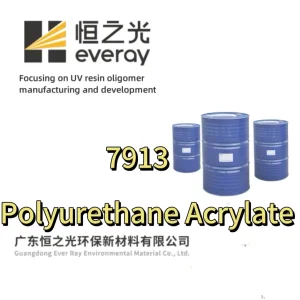
Recommended: Grade 7113A (Aromatic PA) and Grade 7913 (Polyurethane Acrylate).
High-Speed Graphic Arts & UV Inks
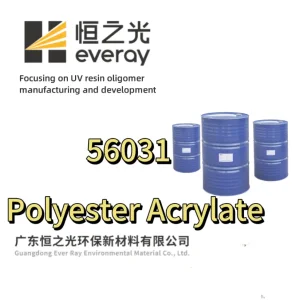
Modern flexographic and offset presses run at over 400 m/min, requiring instantaneous surface cure without ink flaking or ink-water emulsification. Our low-viscosity modified polyester and epoxy acrylates provide superior pigment wetting for carbon black and organic phthalocyanines, eliminating misting on high-speed cylinders.
Recommended: Grade 5332F, 5335F, and 56031 Polyester Acrylates.
Additive Manufacturing & 3D Photopolymers
In stereolithography (SLA), digital light processing (DLP), and LCD 3D printing, our photo-thermal dual-curing resins solve the classic brittleness and green-state deformation of acrylic networks. The acrylate groups cure instantly to freeze micro-geometry, while the secondary epoxy network achieves crosslinking during post-cure baking.
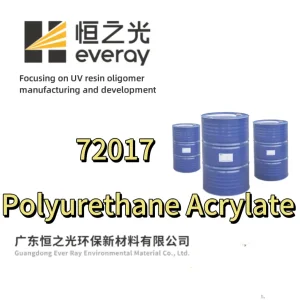
Recommended: Grade 72017 Dual-Cure and Grade 71209A-1 ABS-Like Resins.
Engineered Wood & Luxury Vinyl Flooring
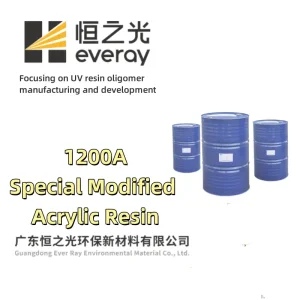
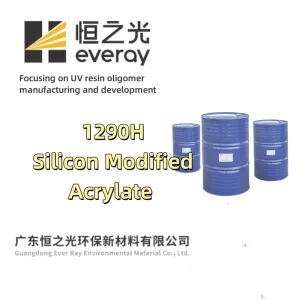
Heavy commercial flooring demands sandable base primers and scratch-proof topcoats. Our 1200A and 1290H epoxy acrylate systems provide rapid roller-coating leveling, zero swelling of density boards, and supreme resistance to micro-scratching under heavy rolling caster wheel abrasion tests.
Recommended: Grade 1200A and 1290H Low Shrinkage Epoxy Resins.
Glass Primers & Water-Transfer Printing
Glass is notoriously vulnerable to interfacial moisture peeling. By introducing silane-coupling promoters directly into modified acrylate oligomer backbones, our resins sustain 2-hour water boiling tests without micro-delamination, supporting decorative glassware, cosmetic flagons, and ceramic decals.
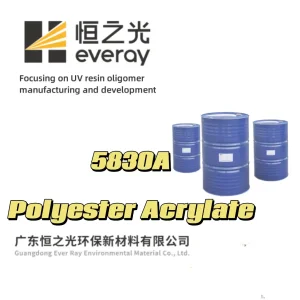
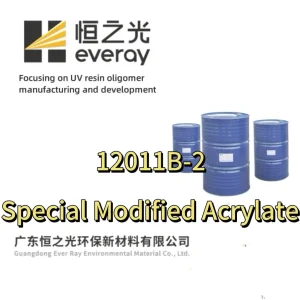
Recommended: Special Modified Acrylate Resin and Grade 5830A.
Optical Clear Adhesives (LOCA) & Encapsulation
Automotive touch displays and optoelectronic assemblies require flexible, optically clear epoxy polymers that exhibit non-yellowing behavior under intense UV solar exposure, low dielectric constants (ε < 3.0), and minimal cure shrinkage to prevent display Mura defects.
Recommended: Grade 7253A-5 Heat/Cold Resistant Multifunctional UV Resin.
Epoxy Resin Polymer Trends: Sustainability & LED UV Photopolymerization
Strategic technological inflection points reshaping radiation-curable epoxy polymers over the next five years.
Transition to 385nm/395nm LED-UV
Energy-intensive medium-pressure mercury arc lamps are being phased out globally under the Minamata Convention on Mercury. Industrial coaters are shifting to narrow-spectrum UV-A LED lamps (385nm, 395nm, 405nm). Ever Ray is engineering high-reactivity modified epoxy polymers with tailored extinction coefficients to ensure deep through-cure without generating excessive surface tackiness.
Bio-Based Carbon Content Resins
Decarbonization commitments are driving demand for renewable resins. Ever Ray’s R&D group is actively replacing petroleum-derived aromatic backbones with epoxidized soybean oil (ESBO), cardanol derived from cashew nut shell liquid, and bio-succinic acid building blocks, achieving bio-carbon contents ranging from 25% to 55% under ASTM D6866 without compromising film glass transition temperatures.
Waterborne UV Polyurethane-Epoxy Dispersions
Stricter industrial volatile organic compound (VOC) directives across the EU, North America, and China mandate the elimination of reactive diluent vapors. Our waterborne UV dispersions (PUDs) incorporate internal hydrophilic carboxylate groups into the epoxy-urethane polymer backbone. This yields water-reducible, zero-VOC coatings that deliver outstanding chemical resistance once cured.
Engineered Polymeric Oligomers & High-Impact Resins
Review our specialized portfolio of aromatic polyamides, heat-and-cold cycling adhesives, and ABS-like functional polymers designed for demanding industrial environments.
Frequently Asked Questions on Sourcing Epoxy Resin Polymers
In-depth responses covering rheological stability, crosslinking kinetics, custom synthesis, and chemical export compliance for purchasing managers and chief chemists.
What is the fundamental difference between standard bisphenol-A epoxy acrylate and modified epoxy acrylates?
How does Ever Ray manage shelf-life stability and prevent premature gelation in overseas shipments?
Can you tailor viscosity and functionality for specific coating application equipment?
How do your epoxy resin polymers perform under boiling-water adhesion and chemical soak tests?
What international chemical safety certifications accompany each shipment?
Request Technical Dossiers & Custom Polymer Synthesis
Contact our senior material specialists to discuss substrate adhesion criteria, custom oligomer synthesis, bulk container pricing, or to request a 1 kg laboratory evaluation sample.
