Bisphenol-A Derivative
Wholesale Durable 6118 Epoxy Acrylate UV Resin: Ideal for UV wood, plastic and ink applications Manufacturers, Products
Durable 6118 Epoxy Acrylate UV Resin
Explore our certified commercial-grade oligomers formulated for rapid photo-polymerization, substrate affinity, and long-term durability across high-speed industrial converting lines.
Durable 6118 Epoxy Acrylate UV Resin
Polyester Acrylate 5312–A Multi-Purpose
Fast-Curing 1730 Adhesion Resin
Special Modified Acrylate Oligomer
Durable UV Furniture Coating 7200-1
Thermal-Resistant 7253A-5 Oligomer
71209A-1 High-Impact Tough Resin
6102 Low-Shrinkage Epoxy Acrylate
Understanding the fundamental macromolecular dynamics, oxirane ring functionalization, and photo-chemo-rheological optimization required for tier-1 industrial applications.
Epoxy polymer architectures rely on the precise stoichiometric reaction of epichlorohydrin with bisphenol-A or novolac precursors. When modified into acrylated epoxy oligomers, free terminal vinyl functionalities introduce ultrafast, radical-induced cure speeds (<0.2 sec under medium-pressure mercury lamps) while retaining internal aromatic ring rigidity, ensuring exceptional Shore D hardness, chemical inertness, and dielectric insulation.
Traditional cycloaliphatic and free-radical epoxy systems undergo volume shrinkage of 6% to 9% during polymerization, introducing critical interlaminar stress. Our advanced epoxy acrylate synthesis utilizes high molecular weight hyperbranched modifiers and elastomeric polyurethane hybrid blocks. This structural mitigation curtails post-cure volumetric shrinkage to below 2.1%, ensuring adhesion across untreated PET, polyimide, and aluminum foils.
The global regulatory transition toward decarbonization has accelerated the demand for zero-VOC, 100% reactive solids content systems and bio-based epoxy acrylates. By synthesizing cardanol, itaconic acid, and epoxidized soybean oil (ESBO) into the polymer skeleton, our current synthesis lines achieve high biocarbon contents (up to 42%) without sacrificing solvent resistance or glass transition temperature (Tg > 95°C).
Tailoring polymer chemistry to resolve failure modes in electronics manufacturing, automotive lightweighting, clean packaging, and continuous composite processing.
High-purity epoxy polymers designed for optical clear adhesives (OCA), liquid crystal module perimeter encapsulation, and conformal circuitry protection. Exhibits trace halide ions (<200 ppm Cl⁻), ultra-low outgassing under thermal vacuum, and refractive indices tuned precisely to glass (nD = 1.51 - 1.54).
Thermal-shock-resistant structural matrices for carbon-fiber prepregs, battery pack insulating coatings, and lightweight exterior composite panels. Polymer backbones endure extreme freeze-thaw cycles (-40°C to +150°C) without micro-fracturing or delamination.
High-solid roll-coating and excimer matting systems designed for luxury vinyl tiles (LVT), engineered hardwood, and high-pressure laminate floors. Provides immediate sandability, instant cure speed for 120 m/min lines, and long-term Taber abrasion resistance.
Low-migration, high-gloss overprint varnishes (OPV) and energy-curable flexographic inks for pharmaceutical folding cartons and food indirect contact packaging. Formulated with reactive tertiary amines to suppress surface oxygen inhibition.
Deploying closed-loop DCS distributed automation, intelligent thermal cracking, and advanced analytical characterization across our 40,000 m² chemical production complex.
Our Yunfu production hub operates multi-stage stainless steel chemical reactors managed entirely through automated DCS architecture. Real-time mass flow meters, laser viscosity feedback sensors, and dual-zone thermal jackets maintain temperature deviations within ±0.3°C, ensuring virtually identical molecular weight distribution (Mw/Mn) across 20-ton reactor charges.
Every polymer lot undergoes systematic characterization via Gel Permeation Chromatography (GPC), Fourier Transform Infrared Spectroscopy (FTIR), and Brookfield cone-and-plate rheometry. Acid value, oxirane residual content, water content (Karl Fischer), and color index (Gardner) are cross-checked against strict OEM tolerance specifications prior to batch release.
Located in the heart of the Pearl River Delta chemical manufacturing corridor, our upstream raw material pipeline maintains strategic buffer tanks for acrylic acid, bisphenol-A diglycidyl ether (DGEBA), isocyanates (IPDI/HDI), and polyols. This captive upstream integration insulates international distributors against raw chemical supply crunches and price volatilities.
Objective evaluation of key polymer categories to assist chemical engineers, formulators, and sourcing specialists in selecting optimum oligomer backbones.
| Polymer Chemistry Family | Tensile Strength (MPa) | Elongation at Break (%) | Viscosity (mPa.s @ 25°C) | Tg Transition (°C) | Recommended Primary End-Uses |
|---|---|---|---|---|---|
| Standard Bisphenol A Epoxy Acrylate | 45 - 65 | 1.5 - 3.5% | 15,000 - 35,000 | 65 - 85 | Wood primers, paper varnishes, screen inks, rigid clear topcoats |
| Modified Epoxy Acrylate (Flexible) | 30 - 45 | 8.0 - 25.0% | 5,000 - 18,000 | 35 - 55 | Metal packaging, vacuum metallization, plastic coatings |
| Aliphatic Polyurethane Acrylate | 20 - 40 | 40.0 - 150.0% | 3,000 - 25,000 | -10 - 45 | Non-yellowing 3C coatings, UV adhesives, nail gels, thermoforming |
| Aromatic Polyurethane Acrylate | 35 - 55 | 15.0 - 45.0% | 8,000 - 40,000 | 40 - 70 | Heavy-duty wood flooring, abrasion-resistant primers, pigmented coats |
| Polyester Acrylate Oligomer | 15 - 35 | 5.0 - 20.0% | 500 - 6,000 | 15 - 40 | Offset litho inks, pigment dispersion pastes, low-viscosity flexo inks |
| Hyperbranched Multi-Functional Acrylate | 50 - 80 | 0.8 - 2.0% | 1,200 - 4,500 | 80 - 120 | Ultra-hard scratch-resistant coats, 3D photopolymer cure boosters |
Streamlined international chemical export pathways engineered to meet the regulatory, environmental, and packaging demands of global tier-1 buyers.
Every commercial polymer consignment is supported by comprehensive documentation, including region-specific Safety Data Sheets (GHS/CLP compliant in 16 languages), Certificate of Analysis (COA), Technical Data Sheets (TDS), and confirmation of compliance with EU REACH (SVHC <0.1%), US EPA TSCA, California Proposition 65, and RoHS Directive 2011/65/EU.
We supply resin in standardized export configurations: 200 kg UN-rated tight-head steel drums, 1,000 kg Intermediate Bulk Containers (IBC totes), or temperature-controlled flexi-tanks. All inner liners are passivated and light-blocked (UV/actinic light opaque) to eliminate container-induced gelation during cross-equatorial ocean freight.
Global procurement teams often struggle when moving from bench trials to full coater runability. Ever Ray maintains rapid formulation piloting: within 14 business days, we adjust backbone stoichiometry, viscosity targets, functional diluents, and reactive amine ratios, shipping validated 1 kg, 5 kg, or 20 kg pilot evaluation samples directly to your lab.
Clear answers addressing chemistry selection, oxygen inhibition mitigation, cross-contamination prevention, and long-term shelf storage stability.
Engineered for anti-yellowing clarity, soft-touch tactile sensations, high offset water balance, and industrial 3D additive printing.
7913 Anti-Fouling Polyurethane Acrylate
Polyester Acrylate 5319A-1 Solution
7411B Low Viscosity Matte UV Resin
5403-3F Hydro-Equilibrium Ester
61163 Anti-Yellowing Modified Resin
Polycarbonate Acrylate 72203A
Anti-Yellowing Elastic Polyurethane
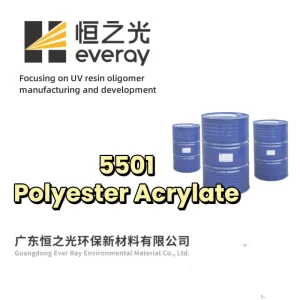
Polyester Acrylate 5501 Core Resin