
High-Performance Acrylate & UV Curable Photopolymers (Part I)
Direct supply of specialized acrylate oligomers, fast-setting solutions, hyperbranched monomers, and low-shrinkage resins engineered for additive tooling, stereolithography (SLA/DLP), protective coatings, and industrial potting.
Global Enterprise Procurement Demands in Additive Manufacturing
How Tier-1 industrial manufacturers transition from rapid prototyping to serial digital mass production using customized macromolecular photopolymers.
Tight Molecular Weight & PDI Control
Global procurement teams in stereolithography demand batch-to-batch Polydispersity Index (PDI) consistency within ±3%. Uncontrolled oligomer dispersity disrupts radical propagation kinetics, altering critical exposure energy (Ec) and depth of penetration (Dp), resulting in build failures across vat platforms.
Low Linear & Volumetric Shrinkage
In high-density lattice structures and automotive tooling, standard acrylate shrinkage of 6–10% induces severe warpage and residual internal shear stress. Industrial specifiers necessitate hyperbranched architectures and dual-cure polyurethane acrylates that curb volumetric shrinkage below 1.5%.
Thermal & Long-Term Creep Resistance
End-use automotive under-the-hood and electronic components require Heat Deflection Temperatures (HDT at 0.45 MPa) surpassing 120°C to 180°C. Ever Ray's custom formulations combine high functional crosslinking with rigid cycloaliphatic and isocyanurate backbones to resist elevated thermal load.
Engineering Solutions Across Global Manufacturing Vertical Markets
Bridging polymer synthesis and precision hardware engineering: addressing specific challenges in consumer electronics, automotive components, medical modeling, and sports lattice elastomer architectures.
3C Electronics & Wearables
Optically clear, sweat-resistant, and high-impact structural resins. Formulated with aliphatic polyurethane acrylates (PUA) ensuring anti-yellowing (Delta E < 1.0 after 1,000h QUV exposure) and skin-safe non-sensitizing contact profiles.
Automotive & Rapid Tooling
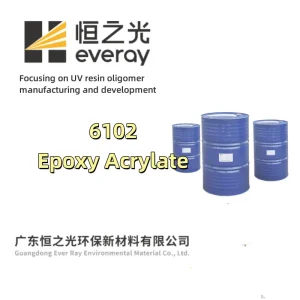
Replacing machined aluminum jigs and injection prototype molds. Epoxy acrylate systems reinforced with hyperbranched segments that deliver Rockwell M hardness up to 95 and withstand cyclic pressure up to 45 MPa during short-run thermoforming.
Footwear Lattices & Dampers
Dual-cure photo-thermal polyurethane elastomers engineered for digital light synthesis (DLS). Exceptional tear strength (> 45 kN/m), high rebound elasticity (> 58%), and mechanical hysteresis stability across -20°C to +50°C climatic windows.
Excimer Lasers & Fine Coatings
Oligomers synthesized specifically for excimer laser crosslinking (172 nm vacuum ultraviolet) and extreme surface curing. Delivers silky, ultra-matte soft-touch finishes without traditional matting agent blooming or rheological thickening.
Material Science Roadmap: Advancing Photopolymer Kinetics & Dual-Cure Architectures
A rigorous examination of molecular backbone design, radical polymerization kinetics, and how our Yunfu R&D center solves legacy stereolithography constraints.
1. Mitigating Oxygen Inhibition in Rapid Vat Photopolymerization
Atmospheric and dissolved molecular oxygen act as notorious radical scavengers in free-radical acrylate systems, quenching photo-generated triplet states and yielding unreactive peroxy radicals (ROO•). In top-down SLA or continuous liquid interface printing (CLIP/DLP), this results in severe tacky surfaces, incomplete conversion, and dimensional distortion.
Ever Ray solves this through deliberate copolymerizable amino acrylate synergists (such as our amino-modified oligomers) and hyperbranched architectures. The tertiary amine motifs undergo alpha-amino hydrogen abstraction, regenerating carbon-centered reactive radicals that consume oxygen locally. This mechanism accelerates surface tack-free speed by over 300% without compromising pot-life viscosity.
2. Photo-Thermal Dual-Curing Polyurethane Acrylate Networks
Traditional pure-UV acrylic networks suffer from inherent brittleness due to high crosslink density and narrow relaxation windows. Our dual-cure technological roadmap (embodied in grades like 72017) separates part generation from mechanical property maturation:
- Stage 1 (Photochemical Green Body Formation): Acrylic double bonds (C=C) undergo rapid UV-LED (385 nm or 405 nm) radical photopolymerization, curing green parts within milliseconds to lock microscopic geometry with minimal volumetric deviation.
- Stage 2 (Thermal Interpenetrating Network Curing): Post-cure heating (100°C–140°C) triggers blocked isocyanates, epoxy-acid, or hydroxyl additions, forming an interpenetrating polymer network (IPN) characterized by extensive hydrogen bonding, boosting tensile elongation from 12% to over 280%.
| Polymer System | Viscosity (25°C, mPa.s) | Tensile Strength (MPa) | Elongation at Break (%) | HDT (0.45 MPa, °C) | Volumetric Shrinkage (%) | Primary 3D Printing Domain |
|---|---|---|---|---|---|---|
| Standard Bisphenol A Epoxy Acrylate | 12,000 – 25,000 | 65 – 82 | 2.5 – 5.0% | 75 – 90°C | 6.5 – 8.2% | High-definition master models, rigid casting patterns |
| Aliphatic Urethane Acrylate (High Functionality) | 3,500 – 8,000 | 45 – 60 | 15 – 35% | 85 – 105°C | 3.0 – 4.2% | Clear optical components, non-yellowing housings |
| Photo-Thermal Dual-Cure PUA (72017 System) | 1,200 – 2,800 | 35 – 55 | 180 – 320% | 65 – 80°C | < 1.4% | Damping lattices, midsoles, engineering elastomeric seals |
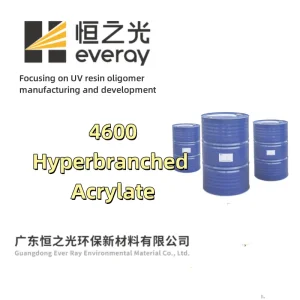
| Hyperbranched Acrylate Oligomer (4600 System) | 800 – 1,800 | 70 – 90 | 4.0 – 8.0% | 130 – 165°C | 2.1 – 2.8% | Scratch-resistant coatings, precision micro-fluidic molds |
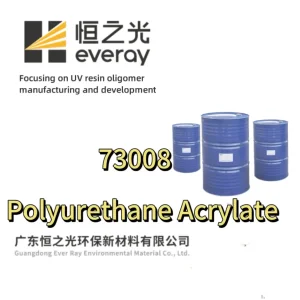
| Low-Shrinkage Potting PUA (73008 Grade) | 4,000 – 9,500 | 28 – 42 | 60 – 110% | 110 – 135°C | < 0.9% | Electronic encapsulated sensors, thermal-shock resistant tooling |
Global Commercial & Industrial Manufacturing Landscape
Navigating the global realignment of photocurable chemical precursors, raw material backward integration, and direct supply relationships.
Upstream Chemical Integration in South China
For decades, European and North American resin blenders depended on multi-tiered chemical supply chains, inflating FOB costs and lead times. Operating out of Guangdong, Ever Ray leverages direct domestic access to essential feedstocks: Isophorone Diisocyanate (IPDI), Hexamethylene Diisocyanate (HDI), Bisphenol A diglycidyl ethers, and Acrylic Acid.
This localized synthesis footprint insulates overseas customers from shipping disruptions, mitigates monomer shortage bottlenecks, and delivers competitive industrial pricing across ISO tank, 1000L IBC, and 200kg drum deliveries.
Tier-1 Formulator Confidentiality & Toll Synthesis
Modern additive manufacturing service bureaus and 3D printer OEMs rarely utilize generic catalog formulations. They require customized oligomer backbones matched to proprietary optical engines (405nm monochrome LCD vs. 355nm Nd:YAG solid-state laser vs. 385nm DLP LED arrays).
We provide comprehensive OEM/ODM and toll-synthesis agreements under strict non-disclosure protections, delivering exclusive batch consistency, customized analytical Certificates of Analysis (COA), and direct regulatory dossier access.
Regulatory Compliance, Safety Data & Localized Technical Support
Ensuring frictionless international chemical transit, environmental stewardship, and dedicated laboratory field support for global industrial clients.
EU REACH & US TSCA Registration
Every commercial grade export is systematically screened against European Chemical Agency (ECHA) SVHC candidate lists and registered within compliant frameworks. We provide complete 16-section GHS Safety Data Sheets (SDS) and technical dossiers customized for customs border clearance.
RoHS & Halogen-Free Electronics Directives
Electronics potting grades (such as 73008) and stereolithography casing polymers undergo ICP-OES elemental analysis to certify non-detectable levels of heavy metals (Lead, Cadmium, Mercury, Hexavalent Chromium) and polybrominated biphenyls (PBB/PBDE), fulfilling IEC 61249-2-21 standards.
Export Logistics & Cold-Chain / Inert Preservation
Photoactive oligomers sensitive to premature ambient polymerization or temperature-induced viscosity drift are shipped in light-shielded, moisture-barrier HDPE containers or fluorinated drums with inhibitor level stabilization (MEHQ/BHT) certified for 12 months ambient storage.
Specialized Acrylate & Dual-Cure Resin Solutions (Part II)
Explore durable polyurethanes, high-hydroxyl polyester systems, excimer laser oligomers, and active diluents configured for robust performance in industrial stereolithography, wood finishes, and graphic arts.
Frequently Asked Technical & Procurement Questions
Expert answers from Ever Ray application engineers regarding viscosity modification, dual-cure scheduling, photoinitiator pairing, and bulk contract fulfillment.
How do Ever Ray's dual-curing polyurethane acrylates (e.g., 72017) resolve the inherent brittleness of traditional 3D printed photopolymers?
Can Ever Ray adjust oligomer viscosity and reactive diluent packages for high-speed SLA, DLP, and LCD print engines?
What is the key chemical distinction between aliphatic and aromatic polyurethane acrylate oligomers in outdoor or 3C electronics applications?
What minimum order quantity (MOQ) and packaging configurations does Ever Ray support for international sampling and mass production?
How does the 4600 Hyperbranched Acrylic UV resin achieve ultra-high scratch resistance without excessive viscosity buildup?
Partner with an Integrated UV Photopolymer Manufacturer
Accelerate your additive manufacturing materials development. Connect directly with Guangdong Ever Ray's senior polymer chemists to request technical data sheets, bespoke oligomer synthesis, and pilot trial samples.
