
Featured 3D Printing & Industrial UV Coating Oligomers
High-purity prepolymers and synthesized resins formulated to deliver non-tacky finish, rapid photopolymerization, Shore D hardness, and chemical barrier properties for printed substrates.
High-Quality 6803A Modified Epoxy Acrylate Resin High Gloss Fast Curing Oligomer
Explore Resin Specifications
Buy 17701 Low Shrinkage Modified Acrylate Oligomer - Dimensional Stability Grade
Explore Resin Specifications
Buy Aromatic PA UV-resin 7162 for Plastic Spray-coatings & Rigid Print Enclosures
Explore Resin Specifications
Buy 73008 Low-Shrinkage Polyurethane Acrylate Resin for Potting & Metal Coating
Explore Resin Specifications
Wholesale High Gloss Fast Curing Modified Epoxy Acrylate Resin (UV Oligomer)
Explore Resin Specifications
High-Quality Durable 6271 UV resin: Low Yellowing Risk Structural Formulation
Explore Resin Specifications
High-Quality Fast Curing 7402 Polyurethane Acrylate UV Resin for Tough Coatings
Explore Resin Specifications
High-Quality 53036 Polyester Acrylate UV Resin: Excimer Laser Smoothing Compatible
Explore Resin SpecificationsOvercoming Additive Manufacturing Defects with Functional Epoxy Coatings
Why modern rapid manufacturing protocols rely on dual-functional epoxy acrylate systems to bridge the structural gap between rapid prototyping and end-use industrial performance.
Hermetic Micro-Porosity Sealing
Stereolithography (SLA), Selective Laser Sintering (SLS), and Fused Deposition Modeling (FDM) parts inherently suffer from inter-bead voids and microscopic fissures. Specialized 3D printing epoxy coatings exhibit ultra-low surface tension (<32 mN/m) paired with Newtonian flow profiles, penetrating deep into sub-micron capillaries. Upon UV exposure, the oligomer chains crosslink into an impermeable barrier, achieving helium leak tightness (<1×10⁻⁸ mbar·l/s) for pneumatic, hydraulic, and subsea assemblies.
Elimination of Anisotropic Weakness
Layered additively manufactured components demonstrate anisotropic mechanical variance, with Z-axis tensile failure typically occurring at 30% to 50% lower shear thresholds than the X-Y print plane. Applying a high-modulus modified epoxy acrylate coating transfers localized stress concentrations across the perimeter envelope. The resulting cured composite shell imparts structural hoop strength, elevating continuous flexural modulus up to 3,200 MPa and drastically improving overall fatigue resistance.
Tribological & Chemical Shielding
Uncoated photopolymer or polyamide 3D printed components exhibit pronounced swelling, softening, and plasticization when exposed to brake fluids, hydrocarbons, aromatic solvents, or prolonged alkaline washdowns. Guangdong Ever Ray’s aromatic and bisphenol-A epoxy backbones deliver crosslink network densities exceeding 85%, ensuring pencil hardness exceeding 3H-4H (ASTM D3363) and resistance to over 200 double MEK rubs without surface degradation.
Formulator Advisory: Managing Radical Shrinkage vs. Interfacial Adhesion
A primary failure mode when coating 3D print substrates is film delamination induced by excessive volumetric shrinkage during ultra-fast radical photopolymerization. While standard tri- and tetra-acrylate monomers shrink by 8% to 14%, Ever Ray’s engineered modified oligomers (such as our 17701 and 73008 grades) employ sterically hindered backbones and urethane segments that lower volumetric shrinkage below 3.2%. This prevents edge curling, peel-off on low-surface-energy polymers (ABS, PA12, PC), and micro-cracking across complex geometric fillets.
Localized Industrial Implementations & High-Stress Environments
Across aerospace clusters, precision tooling foundries, and consumer electronic production hubs, our 3D printing epoxy coatings transform baseline additive parts into mission-critical production components.
Aerospace Aerodynamic Wind Tunnel Models
Additive scale models fabricated via SLA or PolyJet require microscopic surface smoothness (Ra < 0.1 µm) to avoid turbulent air separation during high-subsonic aerodynamic testing. Dipping or robotic HVLP spraying of Ever Ray 6803A epoxy acrylate delivers an optically clear, self-leveling glaze that fills stepping ridges without blunting critical edge profiles.
Automotive Jigs, Fixtures & Low-Volume Tooling
Large-format FDM tooling (Ultem, carbon-fiber reinforced nylon) deployed on automotive welding and checking lines requires wear-resistant protection against abrasive stamping edges. Formulating with high-reactivity modified epoxy oligomers and silica nanofillers imparts extreme impact abrasion resistance, doubling tool lifespan under cyclic assembly-line contact.
Consumer Electronics (3C) & Wearables
Smartwatches, true wireless earbuds, and computing housings prototyped via rapid resin printing must withstand synthetic sweat, oleic acid, thermal cycling (-20°C to 70°C), and drops. Combining aliphatic polyurethane acrylates (e.g., Ever Ray 7402) with bisphenol epoxy acrylates produces flexible yet hard topcoats that prevent yellowing under intense daylight exposure.
Rapid Injection Mold Inserts
Direct 3D printing of composite photopolymer mold cavities for short-run prototyping allows production of 50 to 500 plastic shots. However, molten polymers (ABS/PP at 230°C) cause thermal shock degradation. Coating the print face with Ever Ray high-Tg (Tg > 110°C) modified epoxy acrylates builds a thermally resilient barrier that increases mold parting line longevity.
Polymer Chemistry Performance Comparison Matrix
Quantitative analysis of primary UV curable oligomer families synthesized by Ever Ray for additive manufacturing post-processing, functional coating, and direct resin compounding.
| Oligomer Chemical Family | Viscosity (25°C, mPa·s) | Glass Transition (Tg, °C) | Tensile Modulus (MPa) | Shrinkage Rate (%) | Adhesion on PA12/ABS | Primary Industrial Role |
|---|---|---|---|---|---|---|
| Modified Epoxy Acrylate (6803A) | 4,500 – 7,500 | 85 – 105 | 2,800 – 3,400 | < 3.5% | Class 0 (5B) | High-gloss hard coat, chemical sealing |
| Low Shrinkage Acrylate (17701) | 1,200 – 2,500 | 65 – 75 | 1,900 – 2,300 | < 1.8% | Class 0 (5B) | Dimensionally critical post-curing, film overprint |
| Aliphatic Polyurethane Acrylate (7402) | 8,000 – 14,000 | 45 – 60 | 1,200 – 1,700 | < 2.5% | Class 1 (4B) | Outdoor weatherable, anti-yellowing flexible topcoat |
| Hyperbranched Acrylic Resin (4600) | 800 – 1,800 | 110 – 135 | 3,500 – 4,200 | < 4.0% | Class 2 (3B) | Anti-scratch barrier, high line-speed UV glazing |
| Aromatic Urethane Acrylate (7162) | 15,000 – 25,000 | 70 – 85 | 2,200 – 2,700 | < 3.0% | Class 0 (5B) | Impact-resistant structural coating, industrial fixtures |
| Polyester Acrylate Oligomer (53036) | 600 – 1,400 | 35 – 50 | 800 – 1,200 | < 4.5% | Class 0 (5B) | Excimer laser skin-feel matte finishes, fine pigment wetting |
Technical Roadmap: Next-Generation 3D Printing Epoxy Coatings
How Guangdong Ever Ray’s synthesized polymer laboratory is resolving critical limitations in photopolymer chemistry through targeted molecular design and advanced crosslinking mechanisms.
Dual-Curing (UV / Latent Thermal) Architectures
Complex 3D-printed geometries often exhibit deep undercuts, internal fluidic channels, and shadow zones where UV radiation cannot penetrate. Ever Ray is pioneering dual-cure hybrid backbones combining acrylate groups for instant UV surface tack-free pinning with blocked cycloaliphatic epoxy rings that thermally crosslink at 80°C to 120°C. This hybrid chemistry guarantees 100% cure throughout interior geometries, eliminating residual monomer migration.
Excimer 172nm Laser Micro-Folding Smoothing
Traditional secondary smoothing techniques rely on hazardous organic vapor smoothing (acetone for ABS, chloroform for PLA) which damages fine dimensional tolerances. Our latest modified polyester and epoxy acrylate formulations (including 53036) are engineered for 172nm excimer laser curing. The high-energy ultra-shallow radiation induces localized surface crosslinking shrinkage within 200 nanometers, creating uniform haptic matte finishes without liquid matting agents.
Bio-Based & Ultra-Low VOC Monomer Synthesis
With global sustainability mandates tightening, Ever Ray is synthesizing bio-renewable modified acrylates derived from epoxidized soybean oil (ESBO), cardanol, and itaconic acid derivatives. These renewable oligomers retain bisphenol-level mechanical rigidity while reducing carbon footprints by over 40% and maintaining total volatile organic compound (VOC) emissions at < 0.5% during high-energy post-cure cycles.
Guangdong Ever Ray: Supply Chain Resilience & Production Scale
Operating from our modern chemical manufacturing campus in Yunfu, Guangdong, we ensure continuous resin supply, strict molecular reproducibility, and streamlined global export logistics.
Upstream Chemical Integration & Raw Material Security
Unlike secondary chemical blenders, Guangdong Ever Ray directly synthesizes the base acrylate oligomers from primary precursors—including acrylic acid, bisphenol-A diglycidyl ethers, and diverse diisocyanates (IPDI, HDI, TDI). This upstream chemical integration cushions our international customers against raw material spot-market price volatility and secures uninterrupted production runs even during severe global chemical supply constraints.
Distributed Control System (DCS) Batch Consistency
Every reactor in our 40,000 m² facility is regulated by state-of-the-art Distributed Control Systems (DCS), continuously monitoring reaction temperature within ±0.5°C, exothermic feed dosing rates, and ring-opening conversion kinetics. Every outgoing batch undergoes Gel Permeation Chromatography (GPC) to verify molecular weight distribution (Mw/Mn), Brookfield rotational viscosity profiling, and standardized UV curing reactivity testing.
Agile Scale-Up & Global Hazardous Goods Logistics
Whether supplying 25 kg testing drums for pilot line qualification or 1,000 kg IBC containers for high-throughput continuous operations, Ever Ray manages end-to-end hazardous chemical export logistics. Situated in the Greater Bay Area close to Shenzhen and Guangzhou international maritime terminals, our shipping protocols ensure expedited customs clearance, compliant UN-rated packaging, and full IMDG maritime safety compliance.
Global Market Integration & Regulatory Assurance
Formulating with chemicals destined for North American, European, and Asian markets requires rigorous alignment with chemical registrations and workplace environmental safety protocols.
REACH, SVHC & RoHS Verification
All Ever Ray oligomers exported to European Union member nations are compliant with EU REACH Annex XVII restrictions and free from Substances of Very High Concern (SVHC) exceeding 0.1% w/w thresholds. Our resin chemistries eliminate restricted phthalate plasticizers, toxic organotins, and hazardous residual monomers, enabling full compliance with EU RoHS Directive 2011/65/EU for electronics manufacturing.
US TSCA & EPA Low-VOC Compliance
For North American industrial coaters, Ever Ray provides complete regulatory dossiers verifying substance listing on the US Toxic Substances Control Act (TSCA) Chemical Substance Inventory. Furthermore, because our UV formulations are 100% active solids containing zero solvent diluents, operations easily satisfy California South Coast Air Quality Management District (SCAQMD) Rule 1113 and Rule 1151 standards.
Comprehensive Technical Documentation (TDS & GHS-SDS)
Global procurement teams receive exhaustive documentation for every product grade, including bilingual 16-section GHS Safety Data Sheets, standardized Technical Data Sheets (TDS), starting formulation guidelines, and spectral absorption curves. This transparent data reduces internal qualification times from months to weeks.
Technical & Procurement Frequently Asked Questions
Direct answers from Ever Ray’s senior formulation chemists regarding curing behavior, substrate compatibility, shelf life, and international sample requests.
High-Performance Acrylate Resins & Special Functional Oligomers
Complete your 3D printing and post-processing formulations with Ever Ray’s hyperbranched scratch-resistant grades, flexible urethane acrylates, and high-bonding adhesives.
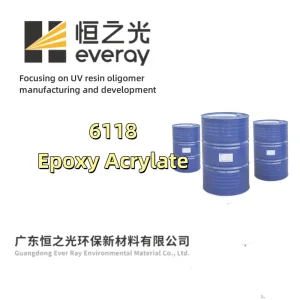
Wholesale Durable 6118 Epoxy Acrylate UV Resin: Ideal for Rigid 3D & Wood Finishes
Explore Resin Specifications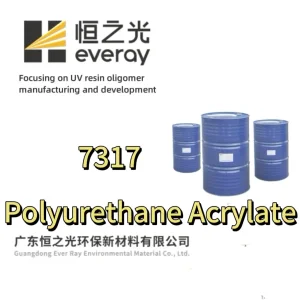
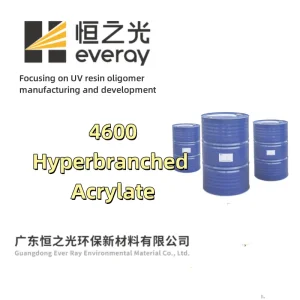
Buy Scratch Resistant 4600 Hyperbranched Acrylic UV Resin for Protective Hard Coats
Explore Resin Specifications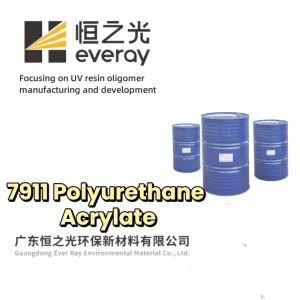
Wholesale Polyurethane Acrylate 7911 – High-Performance Tough Structural Coating
Explore Resin Specifications
Buy Fast Curing Modified Epoxy Acrylate Resin 6231 for High Gloss Leveling
Explore Resin Specifications
Wholesale Low Viscosity 6300 Modified Epoxy Acrylate UV Resin for Spray Application
Explore Resin Specifications
High-Quality 6203F UV Resin for Corrosion-Resistant Metal & Print Finishes
Explore Resin SpecificationsPartner with a Dedicated UV Resin Chemical Synthesis Manufacturer
Whether you are formulating end-use 3D printing photoresins, engineering an automated spray post-finishing line for additive components, or scaling international distribution of high-performance epoxy oligomers, Guangdong Ever Ray provides direct factory engineering support, batch consistency, and global regulatory compliance.
